Rotary's Four-Way Test
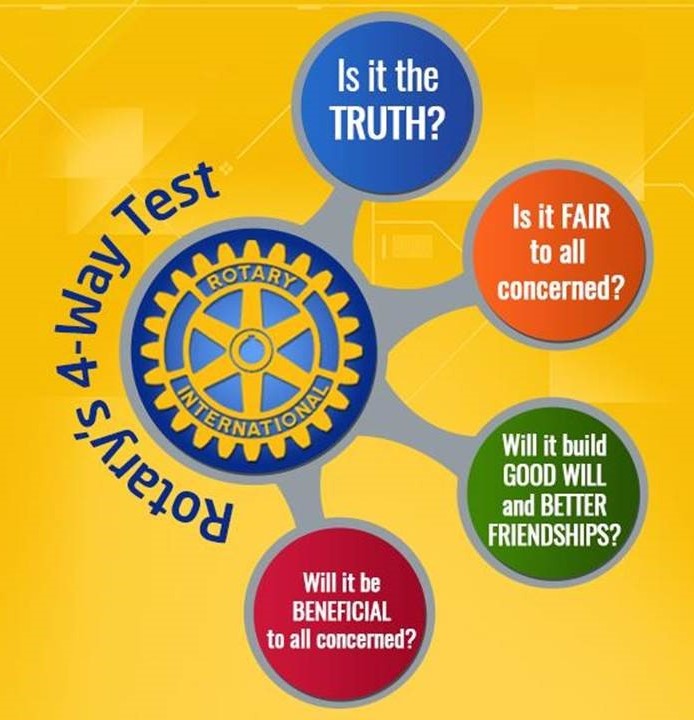
The Rotary Four-Way Test serves as a moral compass for Rotarians, guiding ethical behavior and decision-making. It is nonpartisan and nonsectarian, making it universally applicable across cultures, professions, and communities.
The Four-Way Test was created in 1932 by Herbert J. Taylor, a Rotarian from Chicago, as a moral framework to save the struggling Club Aluminum Products Company from bankruptcy. Taylor sought a simple, memorable guide to ensure ethical behavior in business and personal interactions. The test was later adopted by Rotary International and has become a global standard for ethical decision-making in both personal and professional contexts.
Four-Way Test of the things we think, say or do
1. Is it the TRUTH?
Encourages honesty, transparency, and integrity in all actions.
2. Is it FAIR to all concerned?
Promotes equity and just treatment for everyone involved.
3. Will it build GOODWILL and BETTER FRIENDSHIPS?
Fosters positive relationships, collaboration, and mutual respect.
4. Will it be BENEFICIAL to all concerned?
Ensures that decisions and actions create positive outcomes for all parties.

By consistently applying these principles, Rotarians aim to:
Encourage ethical practices in business and personal life
Strengthen community trust and accountability
Promote goodwill, cooperation, and sustainable positive outcomes

The Rotary Four-Way Test is more than a set of questions
It is a way of life that encourages ethical conduct, fairness, and community-minded decision-making. Its simplicity and universal applicability make it a timeless tool for fostering integrity, trust, and positive social impact in both personal and professional spheres.