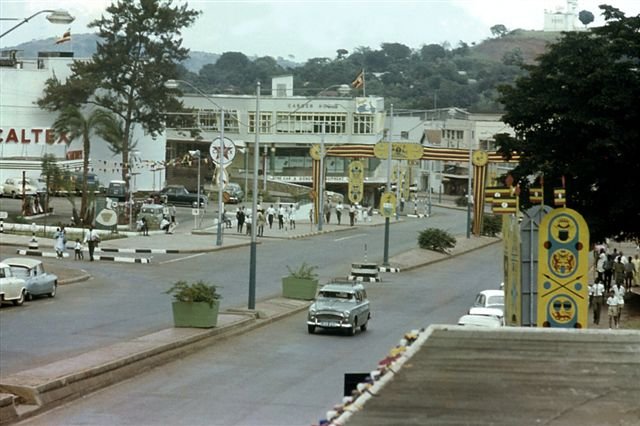
9th October 1962: Kampala Roads Decorated For Independence.
Photo Credit: Daphine Seager. | Source: mccrow.org. uk
Uganda obtained Independence from Britain on October 9, 1962. The day was a Tuesday. KNN looks back at what the day was like — and what was happening around the world — and presents this synopsis.
Who Was There?
Queen Elizabeth II didn’t make the trip herself, but she sent Prince Edward, Duke of Kent to represent her. He opened Parliament and handed over the independence papers.
Prime Minister Milton Obote (then 37 years old) and his 16-man Cabinet were sworn in.
Sir Edward Muteesa II (then 28 years old) became the first President of Uganda.
Celebrating Uganda’s 64th Independence Anniversary
9th October 1962: Kampala Roads Decorated For Independence.
Photo Credit: Daphine Seager. | Source: mccrow.org. uk
Uganda obtained Independence from Britain on October 9, 1962. The day was a Tuesday. KNN looks back at what the day was like — and what was happening around the world — and presents this synopsis.
Who Was There?
Queen Elizabeth II didn’t make the trip herself, but she sent Prince Edward, Duke of Kent to represent her. He opened Parliament and handed over the independence papers.
Prime Minister Milton Obote (then 37 years old) and his 16-man Cabinet were sworn in.
Sir Edward Muteesa II (then 28 years old) became the first President of Uganda.
| Leader | Title |
|---|---|
| Dr. Apollo Milton Obote | 1st Prime Minister |
| Sir Edward Muteesa II | 1st President |
What Was Happening Around the World
- Roughly 300,000 babies were born worldwide that day (Uganda’s number is unknown).
- The world population stood at about 3.1 billion (Male: 49.9%, Female: 50.1%).
- About five members of our Club were born in the same month as Independence Day.
- Roughly 30 members were already alive in 1962 — some old enough to understand what was going on then.
Uganda: Independence Day vs. Today — A Factsheet
| Statistic | 1962 (At Independence) | Today (2024/2025 Estimates) |
|---|---|---|
| Population | Just over 8 million | Approx. 49 million |
| Population Gender Split | Male: 50.43% Female: 49.57% | Male: 49.4% Female: 50.6% |
| Life Expectancy | 47 years | ≈ 68 years |
| Economy (GDP, current prices) | ≈ $449 million | ≈ $49 billion |
| GDP Per Capita | $56 | ≈ $1,000 |
The 1962 population was roughly the daytime population of Kampala City today — but spread across the entire country! Uganda now has one of the youngest and fastest-growing populations in the world.
The Independence Profile Around Africa and the World
On October 9, 1962, only Uganda gained independence on that exact day — but several other countries attained independence within the same year:
| Country | Independence Date | From |
|---|---|---|
| Samoa | 1 January 1962 | New Zealand |
| Rwanda | 1 July 1962 | Belgium |
| Burundi | 1 July 1962 | Belgium |
| Algeria | 5 July 1962 | France |
| Jamaica | 6 August 1962 | United Kingdom |
| Trinidad and Tobago | 31 August 1962 | United Kingdom |
At that time, about 20 other African territories were still under colonial rule. Today, they are all independent — once governed by:
- British (e.g., Southern Rhodesia — Zimbabwe, Bechuanaland — Botswana, Swaziland — Eswatini, Nyasaland — Malawi, Kenya, Gambia, Zanzibar)
- Portuguese (e.g., Angola, Mozambique, Guinea-Bissau, Cape Verde, São Tomé and Príncipe)
- French (e.g., Comoros, French Somaliland — Djibouti, Réunion, Mayotte)
- Spanish (e.g., Spanish Sahara — Western Sahara, Equatorial Guinea)
- South African (e.g., South West Africa — Namibia)
Fact Quiz
Did you know? Which African country was never colonised — and why? (Check next week’s KNN for the answer!)
— Compiled by KNN Editorial Team