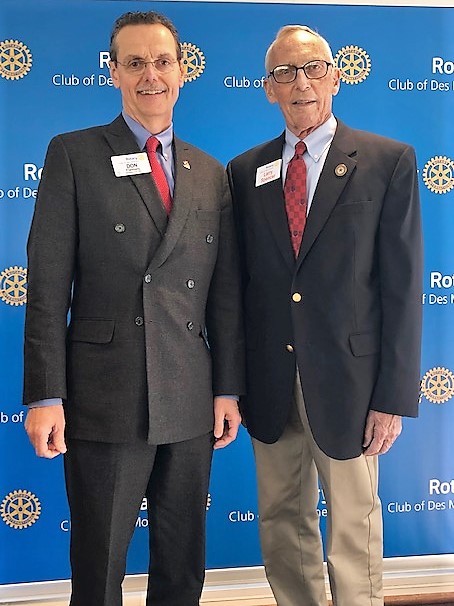
Summer may be gone for a while, but the glorious, crisp mid-autumn weather that we so often experience in Iowa was in full bloom as we met at the Wakonda Club at noon for our weekly meeting. President Don Flannery welcomed us and called on Rob Hedgepeth for words of inspiration for this day, recognizing our long tradition of emphasizing appreciation for our veterans from over the years as we approach the day that honors them. Rob shared some excellent insights and commendations, helping us all to be more appreciative of the debt we owe to so many for their service and sacrifice in protecting all Americans in times of both war and peace. Dave Busiek introduced our guests, with additional attention to all veterans in the audience. Then John Tone introduced our newest member, Roberta Yoder, highlighted in another item in this report.
Next, David Oman was asked to introduce our speaker for the day, and it’s unlikely that anyone could have better represented the significance of the holiday we will observe on November 11. Larry Spencer grew up in Earlham, IA, graduating from high school there and later earning a degree in mathematics from Parsons College in 1962. Enlisting in the Navy the next year, he became a pilot, later becoming one of the early Navy fliers engaged in the Vietnam War. In February of 1966, his plane was shot down, he was captured and began the first of his 2, 551 days as a prisoner of war in Hanoi, five days short of seven years, suffering extreme mental and physical cruelties while there. He was later awarded two Silver Star Citations and David chose to read from a part of the first of them. “Through his resistance to those brutalities, he contributed significantly toward the eventual abandonment of harsh treatment by the North Vietnamese…..By his determination, courage, resourcefulness, and devotion to duty, he reflected great credit upon himself and upheld the highest traditions of the Naval Service and the United States Armed Forces.” In opening his comments, Larry stated that it is impossible to condense seven years of such an ordeal into twenty-five minutes, and it could be added that it is difficult, at best, to reflect in print the gravity and significance of his presentation, which was truly riveting. But a few of his many observations included the following.
He generally quoted Abraham Lincoln regarding, “Persons usually are about as happy as they allow themselves to be,” and it was that philosophy that guided the prisoners who more successfully coped with their situation. One of the most critical elements of captivity is the feeling of being alone, and communications are the key to survival and mental well-being. For that reason, the implementation and use of the communications code via wall-tapping became a great strength to their resilience and mental health. He said that as the conflict continued, the treatment of prisoners got slightly better, but as an example of hardships, the food consisted mainly of, in respective four-month increments depending on what was growing nearby at the time, three kinds of soup (cabbage, spinach or pumpkin) along with bread or rice. Since most of the losses at the time were related to air operations, a majority of the prisoners were military officers so there likely was a bit more consideration of them by the captors. Larry related that for a part of the time, he had a roommate, in his case a few years older than he was, and their conversations were a great learning experience, covering topics about both themselves and situations around them. Out of such conversations came a number of observations, including the need for patience; the sharpening of the senses regarding things and happenings in our midst; the role of faith and confidence in those around us; and the imperative need to do what you have to do under the circumstances. In closing, he credited the Veteran’s Administration medical facilities in both Des Moines and Iowa City for being excellent in their attentiveness and service to veterans and, finally, admonished us to remember every day that, “Life is good”, then added, “so don’t mess it up.”
It was a memorable presentation about a topic we must never forget and we greatly appreciate Larry Spencer and his wife, Ann, joining us today and his sharing his experiences and observations with us.