Channing Dutton: A Path to Climate Action
Posted by Rod McCullough
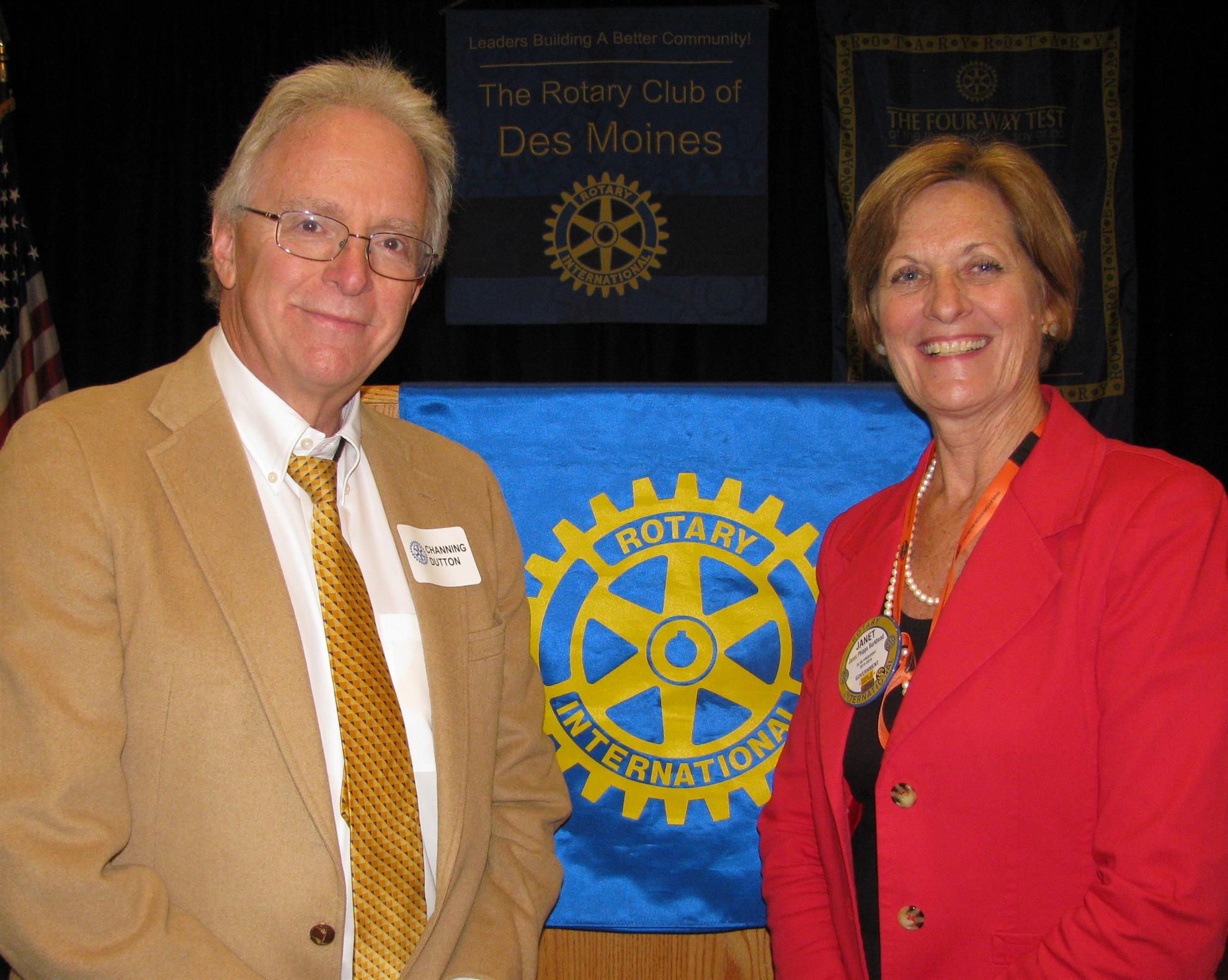
What a day at Rotary! Guests from Kosovo, an honored U.S. Marine, the son and brother of Presidents, and all that happened before our keynote!
Susan Moritz provided an invocation inspired by the words of Rachel Carson, author of 1962’s “Silent Spring.” Mark Lyons introduced our guests who included Major General James Livingston, recipient of the Congressional Medal of Honor, and Maria and Neil Bush, son of President George H.W. and brother of President of George W. Rose Heaphy from KCCI read the news.
President Janet Phipps Burkhead welcomed two special guests from Kosovo, Ambassador Vlora Çitaku, Ambassador of the Republic of Kosovo to the United States and Security Attaché Brigadier General Xhivit Gashi. They and the Deputy Prime Minister are in Des Moines to announce the opening of the Kosovo Consulate in the Saddlery Building, an historic event because it is the first office of its kind in Iowa.
Mayor Frank Cownie framed his introduction of our keynote speaker, Channing Dutton, with some remarks about his recent Paris meetings on climate change. He said this was the meeting where “the world came to the conclusion that we have a problem and we need to deal with it.” He said 650 mayors from around the world have now signed on to the Mayor’s Compact to reduce energy use. Des Moines has reduced by 15% and has a goal of 50% by 2030.
Mr. Dutton, who is a West Des Moines attorney by profession, said that his search to educate himself about climate change started with a ride on his recumbent bicycle. During the ride, he listened to a podcast of NPR’s Science Friday featuring Lester Brown, author of “Plan B 4.0: Mobilizing to Save Civilization.” Fascinated by Brown’s description of why Saudi Arabia gave up on growing wheat because that process depleted their water supply, he expanded his study.
“Science knows carbon follows temperature,” said Dutton. Using a detailed set of animated graphs, he showed Rotarians the rates of carbon dioxide change in our atmosphere over the past 800,000 years. Up to 1980, those rates varied between 185 and 300 parts per million; since 1980 to 2014 the rates went from 300 to 400 ppm. 2014 was a record-setting temperature year and in 2015, that record was broken.
In building his case for “A Path to Climate Action,” Dutton described the recent history of the Iowa Climate Science Faculty. In 2012, the group included 8 members and by 2014, 160 members were calling for climate change action, noting the negative effects on Iowa’s health. News of the Zika virus, spread by mosquitos, is an example of health effects. Australian scientists warn that the warming atmosphere increases the spread of mosquitos. Pope Francis has said, “Climate change is a problem which can no longer be left to a future generation.” According to the World Economic Forum, climate change is the top threat in the world today. Noting that climate change can no longer be a “red or blue” issue, he listed a number of responsible political figures who recognized the need for action.
After his prepared remarks, Dutton answered a question about how we transition in this way by describing fossil fuels (oil and gas) as the Trojan horse: “they have been a tremendous gift and have allowed incredible achievements, but now they threaten our existence. The jobs they have created need to become solar jobs and wind jobs.”
All in all, a thought-provoking keynote.