A little over three weeks ago I picked up my grandchildren, Ava and Jesse from our local railway station.
I had occasion to remind them that 10 years ago to the day the first trains left Kippa-Ring Station on the long-promised Redcliffe Peninsula rail line.
Like many young teenagers today, they struggled to show excitement, making me realize it might have meant more to me than to them.
Back in the late 19th Century, many emerging towns across Queensland were convinced that getting a railway connection was the ticket to business prosperity.
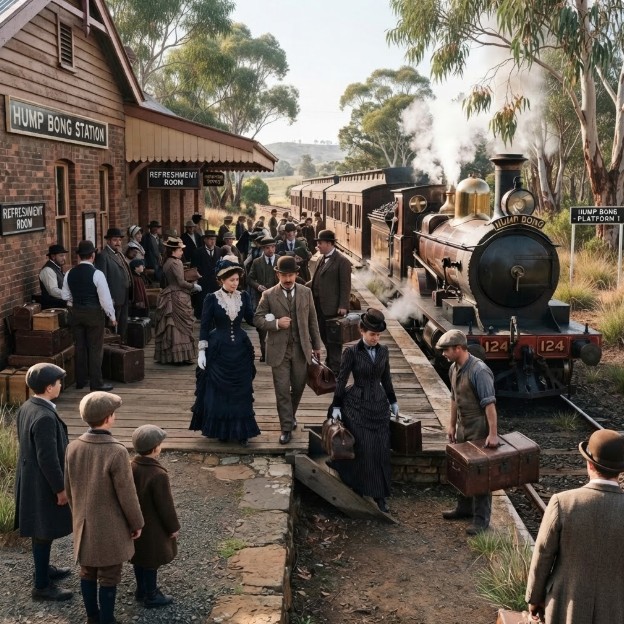
Even Humpy Bong on the Redcliffe Peninsula—a booming seaside resort near Brisbane in the 1880s—viewed a train link as crucial for its future.
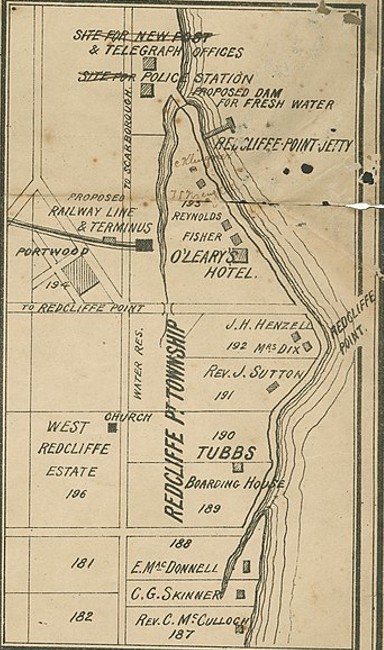
In 1878, land in Portwood Estate, around today's Portwood, Sheehan and Sylvin streets, was offered for sale. The plots were advertised as large, high-set, scenic and healthy, with exceptional views, while Humpy Bong was promoted as a future fashionable seaside resort.
The estate map showed a “Proposed Railway Line & Terminus” — Humpy Bong Station —just northeast of the estate, near today's Macnaughton Street, between present day Oxley Avenue and Humpybong Creek.
Although postulated by the real estate auctioneer at the time, the Redcliffe Peninsula railway did not open until 3 October 2016, over 138 years later, and its final station was in neighbouring Kippa-Ring.
REFERENCES:
The Telegraph (Brisbane, Qld. : 1872 - 1947) Sat 20 Jul 1878 Page 6 Advertising Auctioneer's Notice.
All aboard for 10th anniversary special. Moreton Daily. 2 October 2026.
The earliest known mention of "Umpie Boang" comes from two articles published in the Sydney newspaper, The Colonial Observer in 1842.
In an "Extract from the General Diary of the German Mission at Moreton Bay, for the months of October and November 1841", the author says "On Tuesday, the 12th [of October], Mr. [Augustus] Rode having visited the camp on his return from Brisbanetown, accompanied by Wogan and Wunkermany [Hunkermany], who signified their intention of going to the northward, which induced Messrs. [Friedrich Theodor] Franz and [Johann Gottfried] Hausmann to prepare for a journey to the natives at Umpiebang [Umpie Boang] and Toorbal."
In a "Short account of a six weeks residence among the natives at Durundur, the station of David Archer, Esq., from the 5th of April to the 19th of May 1842, by the Rev. Christopher Eipper." the diarist writes, Thursday, 28th [April] —Previous to leaving our station I had made an arrangement with the brethren Hausmann and [Ambrosius Theophilus Wilhelm] Hartenstein, who had gone to Umpie Boang [later Humpybong] and Toorbal, that after two or three weeks had elapsed, or whenever he felt desirous to return to our station they should come to Dunundur in order to receive the sheep, which Mr. A. had contributed for our Mission some time ago."
Augustus Rode, Friedrich Theodor Franz, Johann Gottfried Hausmann, the Rev. Christopher Eipper and Ambrosius Theophilus Wilhelm Hartenstein were part of group of Gossner Missionaries, who arrived at the Moreton Bay Penal Colony in March 1838 to proselytize and evangelize the aboriginal people and establish the Zion Hill Mission (now Toombul-Nundah), which the locals called at Umpie Daggur.
REFERENCES:
The Colonial Observer (Sydney, NSW : 1841 - 1844) Thu 13 Jan 1842 Page 116 COLONIAL STATISTICS.
The Colonial Observer (Sydney, NSW : 1841 - 1844) Sat 23 Jul 1842 Page 347 MORETON BAY.
The Commandant of the first Moreton Bay Penal Colony, Lieutenant Henry Miller (40th Regiment of Foot) relocated the short-lived settlement at Redcliffe Point south to the banks of the Brisbane River in May 1825. Over time fresh intakes of government exiles and their guards frequently heard the local Indigenous people use words such as "Ngumpin" and "Bong". Their exact meanings evolved or adapted depending on how these words combined with each other or other words.
Humpy ~ oompie, umpie = Ngumpin [Turrbal-Yuggera language sub-group] loosely translates as "temporary shelter, hut, or dwelling". Ngumbi translates as "home or camp". The local Turrbal people referred to the Brisbanetown as "Umpi Korrumba" (or Oompie Korrumba), which loosely translates as "many houses".
Bong [Turrbal-Yuggera language sub-group] loosely translates as "empty, deserted, gone, vanished, dead, lifeless."
Another language crossover is also the direct origin of the common Australian slang word "bung" (as in, "the fridge has gone bung" or "a bung knee"), adapting the original Turrbal-Yagara meaning of "dead" to describe something that is broken, ruined, or out of action.