
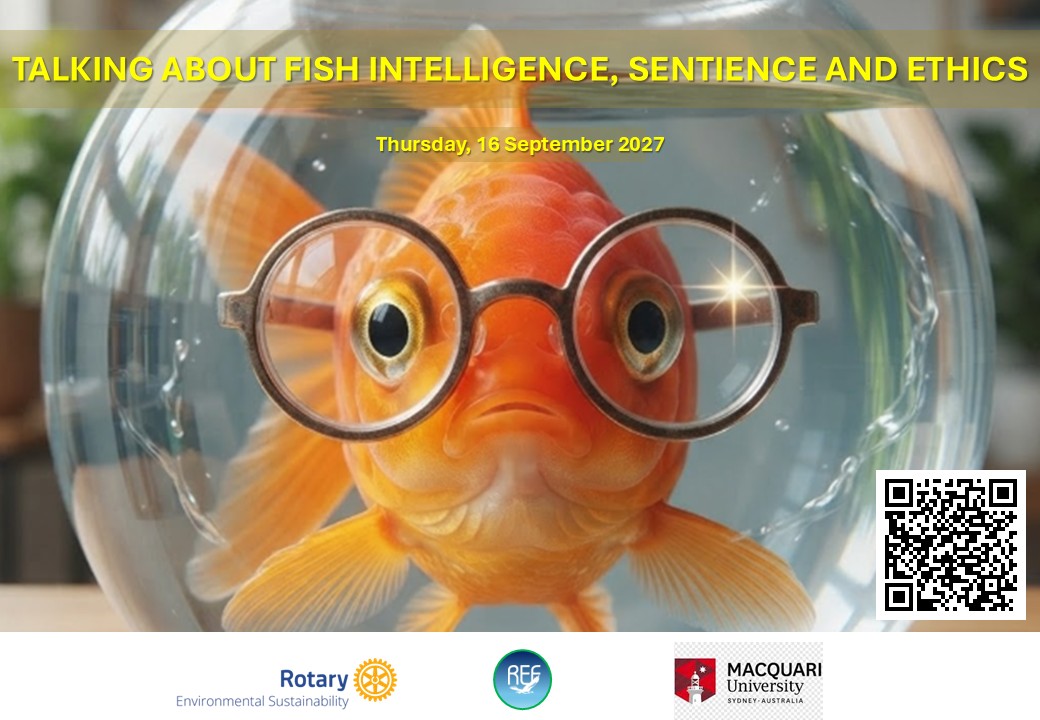
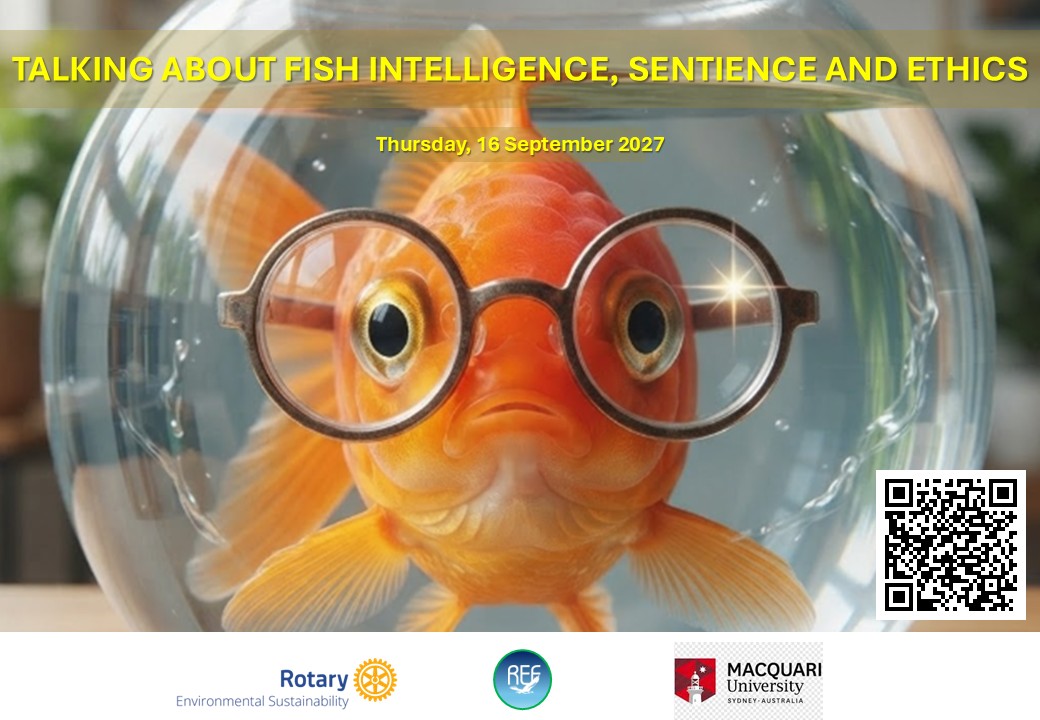
TALKING ABOUT FISH INTELLIGENCE, SENTIENCE AND ETHICS
Sep 16, 2027 7:00 pm - 9:00 pm
NOTE: THIS EVENT IS ALSO AVAILABLE ONLINE.
Register and the Microsoft Teams meeting link to join online will be provided in your 'Registration Confirmation' email.

Dr. Culum Brown is a professor and leading researcher in the behavioural ecology and cognition of fishes at Macquarie University in Sydney, Australia.
- Current Role: Professor at Macquarie University, where he runs the Fish Lab (Behaviour, Ecology and Evolution of Fishes Laboratory).
- Research Focus: Fish intelligence, cognition, social behaviour, learning, and fisheries conservation.
- Education: PhD from the University of Queensland (2000) and a Bachelor of Science in Zoology/Animal Biology from the University of Melbourne.
- Impact: Published over 200 peer-reviewed papers cited more than 13,750 times, and recognized as one of Australia's most influential animal behaviour researchers.
- Media & Outreach: Frequently featured on science programs like ABC's Conversations and known as a prominent champion for fish welfare and intelligence.
Culum Brown is one of the leading voices in fish cognition, and his core argument runs against the "three-second memory" cliché. Even the smallest fish are capable of learning and can retain memories for months. Within schools of fish, there is often a strict social hierarchy which can include forms of bullying.
Fish are smarter than we give them credit for.
Most people assume fish are simple, forgetful creatures — the old joke about a three-second memory. Culum Brown says that's wrong. In a major review paper he published in 2015, he went through decades of research and concluded that fish are just as capable as birds, reptiles and mammals in many ways — sometimes more so. Culum also argues the evidence shows fish feel pain in much the same way other animals do.
Why he thinks that
His argument comes down to shared ancestry. Fish, frogs, lizards, birds and humans all have backbones, and evolution tends to reuse what already works rather than reinvent it. So our brains and bodies aren't as different as they look. If that's true, he says, then fish also have real experiences — they're aware of themselves and the world around them, not just swimming robots.
Why he cares so much
This isn't just an academic curiosity for him. If fish think and feel like other animals, then they deserve similar protection — and that has big consequences for commercial fishing, which is why the topic gets pushback.
The work behind it
He co-edited a standard textbook on the subject, Fish Cognition and Behavior, and has studied how fish learn from each other, remember things, have individual personalities, and even handle basic numbers and directions. His writing on how fish learn from one another has been cited hundreds of times. One practical result: he worked out ways to train young fish in hatcheries before releasing them into the wild, so more of them survive. That idea caught on and is now standard practice in hatcheries around the world.
Fish are far more cognitively sophisticated than most people assume, and in many domains match or exceed other vertebrates. In his 2015 review Fish Intelligence, Sentience and Ethics in Animal Cognition, he surveys fish sensory perception through to higher cognition and concludes that "fish perception and cognitive abilities often match or exceed other vertebrates," adding that the evidence for pain perception "strongly suggests that fish experience pain in a manner similar to the rest of the vertebrates."
His reasoning is evolutionary: "Evolution is a conservative process," so vertebrate brain physiology and function are broadly similar across fish, amphibians, reptiles and mammals. From that, he argues fish are sentient — they have subjective experience and a sense of their place in the world. Macquarie University
The ethics point
The reason he pushes this so hard is welfare and policy: if fish cognition and pain perception resemble other vertebrates', the case for affording them comparable protection follows — and he's explicit that the stakes are high "not least because of fishing-related industries."
The research behind it
He co-edited Fish Cognition and Behavior (Wiley-Blackwell, 2006 and 2011, with Kevin Laland and Jens Krause), and his work spans social learning in fishes, learning and memory, cerebral lateralisation, personality, numeracy and spatial cognition. Two reviews of social learning in fishes have each been cited over 500 times.