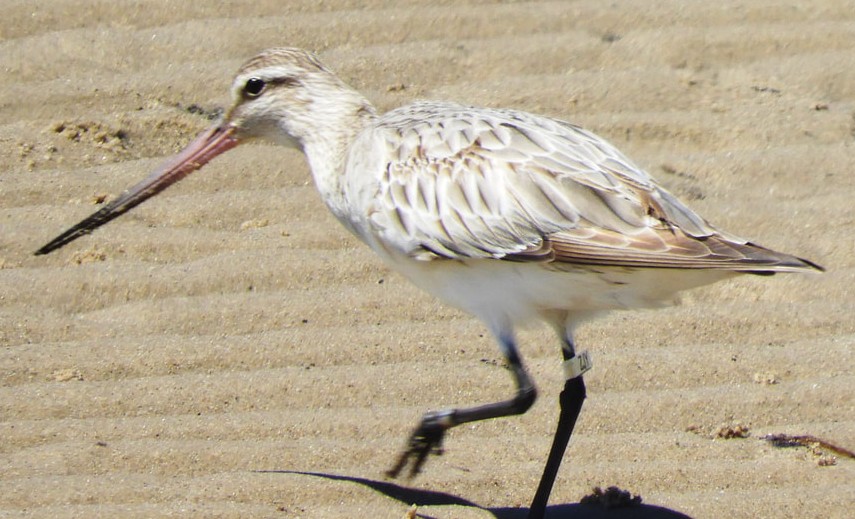
Ava held her Pop's hand as they stood on the foreshore of Deception Bay, where the morning tide was slipping away. Beneath the pale sky, the shore became a shining staircase of saltmarsh, mangroves and mud flats. These intertidal wetlands are both dining room and resting place for shorebirds. "Look closely," Pop whispered. "The visitors have come from far north, following the East Asian-Australasian Flyway."
Ava lifted her binoculars. A Bar-tailed Godwit walked through the wet mud, its bill curved gently upward. It pushed that bill deep into the soft flats, searching for molluscs, crustaceans and worms. Each probe was like a tiny question asked of the mud: Is lunch here? The godwit did not need to hurry. Its long bill could reach food hidden below the surface.
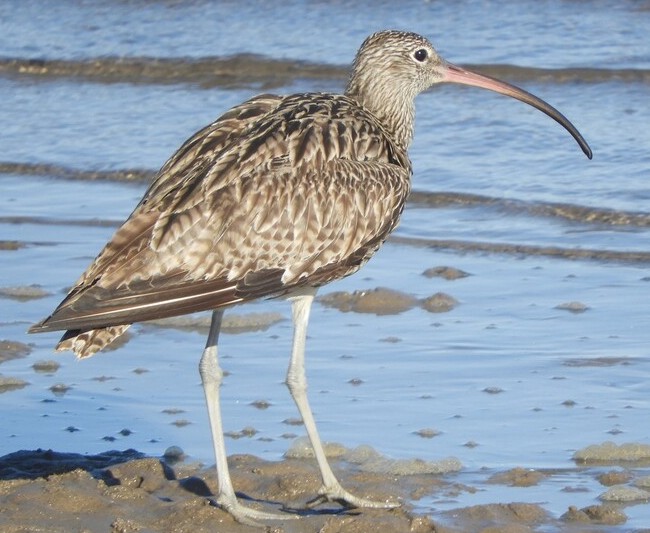
Farther away stood an Eastern Curlew, taller and darker, with a wonderfully long, down-curved bill. Pop explained that this visitor uses sheltered coastal wetlands, including mudflats, mangroves and saltmarshes. It was standing quietly at the edge of the wetland, where a changing tide uncovers the small animals that shorebirds need. Around it, other birds rested together, saving energy for the next journey.
"Are these birds found somewhere else too?" Ava asked.
"Yes," said Pop. "At Hays Inlet, their cousins and these same travelers use the intertidal flats as a feeding and roosting place. Hays Inlet is recognised as habitat for Bar-tailed Godwits and Eastern Curlews. The mangroves shelter birds when the tide covers the feeding ground, while the open mud gives them room to search when the water retreats."
At Hays Inlet, Ava imagined the mudflats as a vast dinner table. The godwits probed. The curlews searched with their long bills. Some smaller sandpipers pecked at creatures on the surface or made shallow probes below it, the way Curlew Sandpipers do on intertidal mudflats, estuaries, lagoons and mangrove edges. Their prey included small marine invertebrates, especially polychaete worms.
By afternoon, the tide began to return. The birds gathered on safe, quiet ground. Ava wanted to run closer, but Pop gently stopped her. "A good visitor leaves a bird enough space to eat and rest."
She watched the godwit lift its wings. The flock rose like a silver ribbon, then settled again beyond the reeds. Hays Inlet Conservation Park features a wide mix of coastal wetland habitats. While the lower, intertidal regions of the inlet are dominated by saltwater-loving mangroves and saltmarsh flats, the freshwater and brackish upper fringes—where creeks feed into the basin—host semi-aquatic vegetation including reeds, rushes, and sedges.
Migratory shorebirds must feed on Australian mudflats and wetlands to build the energy needed for their enormous journeys.
Ava squeezed Pop's hand. Deception Bay and Hays Inlet no longer seemed like two places. They were two chapters in one living story, written by tides, mud, mangroves and wings. And when the birds flew north, Ava promised she would keep their quiet “dinner table” — the massive, concentrated, and easily accessible feast — for their return.
The photographs of the Bar-tailed Godwit and Eastern Curlew are provided by our partner, REF Environmental, a non-profit volunteer organisation, founded in 2006, dedicated to protecting, restoring, and educating the community about the ecosystems across the Moreton Bay Region. The NFP is based as the Deception Bay Environmental Hub, a purpose-built community and environmental facility leased from the local council.
REF is hosting a "Welcome Back the Shorebirds of Moreton Bay" event on Sunday, 4 October 2026.
Why not come along and celebrate the return of our migratory waders from the Northern Hemisphere. Moreton Bay and Deception Bay are important sites for endangered migratory waders. Learn about their ecology and lives as well as participate in a guided walk with experienced birders, where you can observe these amazing birds going about their daily lives along the Deception Bay foreshore.
Who knows, you might meet Ava and her Pop.
HIGHLY PATHOGENIC H5N1 AVIAN INFLUENZA | NOTIONAL IMPACT ON HAYS INLET | CASE STUDY | SUMMARY
This case study examines how the arrival of highly pathogenic H5N1 avian influenza in Australia could affect Hays Inlet, a protected estuarine wetland near Brisbane. The paper argues that Hays Inlet is especially vulnerable because it is part of the broader Moreton Bay coastal system, supports large numbers of resident and migratory birds, and contains habitats - tidal flats, mangroves, saltmarsh and shallow waters - that encourage aggregation and therefore disease transmission.
The report begins by setting the context: H5N1 reached mainland Australia in June 2026, ending the country's isolation from the global outbreak. Soon after, the virus was detected in wild seabirds in Southeast Queensland, including Moreton Island and the Sunshine Coast. Because Hays Inlet is ecologically connected to these areas and lies close to Brisbane, the author sees it as facing an immediate biosecurity threat.
A major strength of the paper is its use of 11 years of quarterly bird survey data collected at Silcock Street Park, Clontarf, by local volunteers. Across 43 surveys, observers recorded 153 bird species and more than 14,000 individual observations. The study compares these records with federal H5N1 risk assessments produced by DCCEEW for more than 3,000 Australian bird and mammal species. Those assessments classify species by susceptibility to infection, conservation status, and overall national risk.
Of the 152 Hays Inlet bird species that could be matched to the federal database, 28 were rated very highly susceptible, 24 high, 55 moderate and 45 low. The species seen as most vulnerable include waterfowl, herons, egrets, spoonbills, cormorants, terns, gulls and several birds of prey. Raptors are considered especially exposed because they may feed on infected carrion. In terms of national risk, two species - the Little Tern and Plumed Egret - were assessed as very high, while many migratory shorebirds, including the Far Eastern Curlew, Black-tailed Godwit, Common Greenshank, Great Knot, Red Knot and Sharp-tailed Sandpiper, were rated high because of both disease risk and conservation concern.
The paper stresses that local impacts may be worse than national scores suggest. Seasonal crowding at Hays Inlet increases transmission risk: migratory waders gather in large feeding flocks on the tidal flats, and resident species such as Pied Stilts and Little Black Cormorants can also form dense groups. The author notes that nearby communal roost sites elsewhere in Moreton Bay may further amplify infection risk even for birds that only feed at Hays Inlet.
Mammals appear less vulnerable overall. Species observed in a 2026 Bioblitz - such as Eastern Grey Kangaroos, koalas and Brushtail Possums - were generally rated low risk. The Little Red Flying Fox showed somewhat higher concern because communal roosting may aid spread, and the paper notes that more research is needed on local bats and microbats.
The report concludes with practical management recommendations. These include promoting the Avoid, Record and Report protocol for the public; keeping pets and people away from dead or sick wildlife; rapidly reporting suspected cases; adjusting bird-monitoring programs to look for signs such as tremors, twisted necks and carcass clusters; and requiring workers, contractors, researchers and volunteers to disinfect footwear and equipment and avoid bird habitat where possible. Overall, the paper presents Hays Inlet as a valuable local case study showing how long-term ecological data can guide preparedness, early detection and biosecurity planning for H5N1.
DOWNLOAD THE FULL CASE STUDY REPORT + FACTSHEET
The report and factsheet was written by Bob Crudgington. He is an experienced environmentalist, workshop facilitator and an online learning designer with a passion for the ecology, flora and fauna of Moreton Bay and Southeast Queensland. Bob is the founder of REF Environmental, one of Rotary's eco-friendly partners.