Jesse had one question left on his Grade 9 science project sheet: "Talk to someone in your community who runs a sustainable business."
His Pop was a craft distiller, a small local outfit making gins and vodkas. So on Friday afternoon after school, Jesse sat down with his notebook.
"So how did it start?"
"Two of us — me and your Uncle Piers, " Pop said. "We wanted good spirits and a business that didn't chew through the planet. Gin and vodka now; rum and whisky later."
"What does sustainable actually mean here?"
"Power, process and waste. We put a solar array on the roof — the sun runs the whole place during daylight. And we don't use electric pumps. The mixing tank starts on the floor, where we blend molasses, yeast and water. Then we lift it to the mezzanine, where it ferments about ten days. After that, the liquid runs downhill into the still. Gravity does the work for free — no fuel, no power bill."
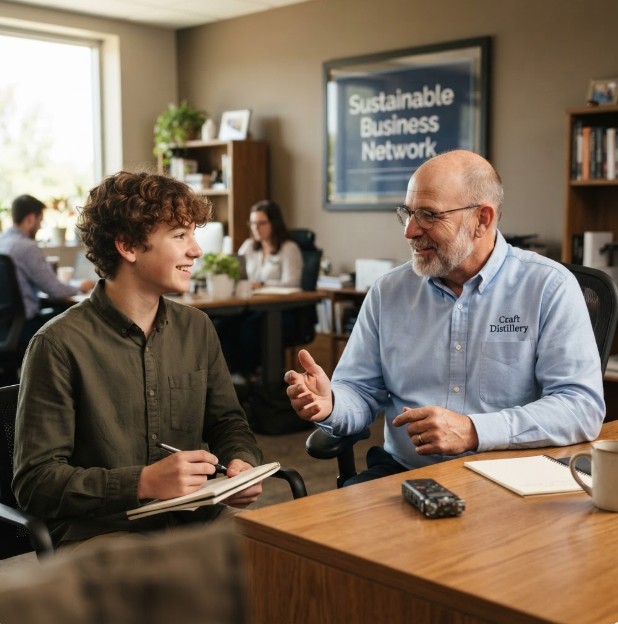
Jesse sketched the climb-and-drop for himself. "So nature's doing the heavy lifting."
"Every chance we get. The still heats the liquid to vapour, then it cools back to liquid — stronger and purer. It comes off in three parts. The heads are poison, we discard them. The tails we run through again for a little more. The hearts are the good stuff. Then we add water gradually to reach the right strength, and bottle, cork and label it. We even print the labels ourselves — cheaper than a printer for a small run, and we only print what we need."
"Doesn't that make a lot of waste?"
"Loads," Pop said. "We store the leftovers in big industrial tanks called IBCs. Two farmers take our rum waste and feed their cattle — someone else's input instead of our problematic output. For the spent botanicals from the gin and vodka, we're still looking for a pig farmer, maybe" He shrugged. "Honest answer: we haven't solved everything. Sustainability is a direction, not a finish line."
"Botanicals?"
"The flavourings — juniper berries, lemon peel, bitter orange peel. We buy them from local growers and we're growing some ourselves now, in pots out the front. The flavour gets in either by soaking the plants in the spirit or letting the vapour pass through them."
"You buy everything locally?"
"Wherever we can — botanicals, casks, stills. Even our plumber and electrician. Keeps money in the neighbourhood and keeps trucks off the road."
Jesse turned the page. "Does the sustainability stop at closing time?"
Pop laughed. "A still doesn't care what time it is. One run takes eight to fourteen hours, and you never leave it alone — fire, pressure, alcohol vapour. So Uncle Piers and I split the ends of the day instead of running a formal night shift. One of us starts at three or four in the morning, because heating a big copper still takes hours. Start in the dark and the spirit flows as the sun comes up — which is our cheapest power anyway. The other one closes out the run that evening."
"And the yeast?"
"Alive, and not on our schedule. If a mash ferments too fast or overheats, one of us drives in very early in the morning to save the batch. That's the deal."
Jesse read his notes back. "So — solar power, gravity instead of electric pumps, early starts split two ways, waste that feeds cattle, plants out front, everything local."
"That's the lot," Pop said. "None of it is too high-tech. You just keep asking: is there a cheaper way that's also the smarter way? Most of the time, the green answer and the money-saving answer are the same answer."
Jesse grinned. "That's going straight in the project."
Savindi Caldera is “Talking about making Sustainability work for Business and People”