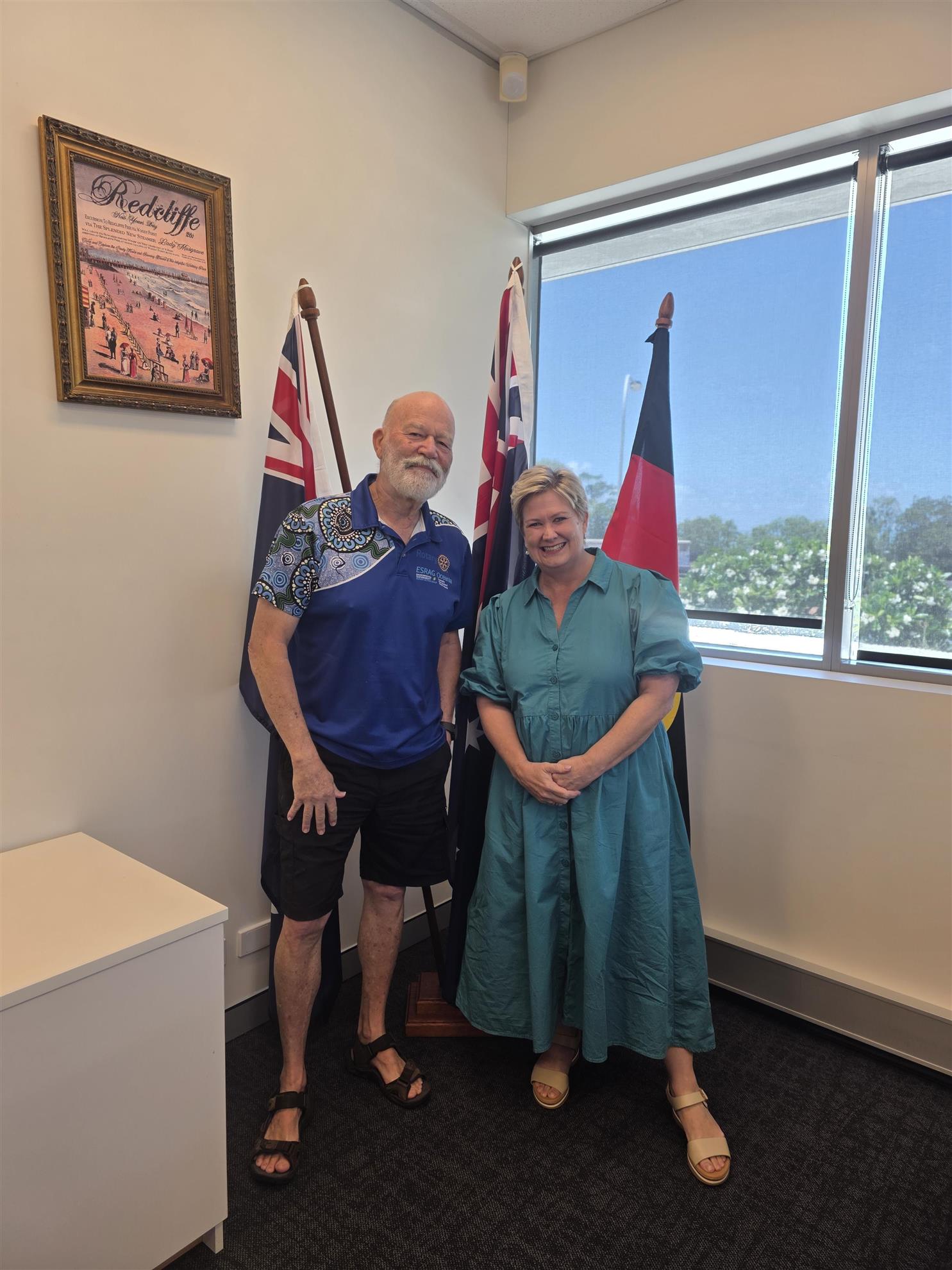
Rotarian and Environmental Sustainability Rotary Action Group (ESRAG) Member, Peter Row met with local State member, Kerrie-Anne Dooley MP at her electoral office in Bluewater Square on 19 January 2026.
Ms Dooley has been a member of Parliament’s Health, Environment and Innovation Committee since 28 Nov 2024.
With this in mind Mr Row shared an overview of the Rotary Club of Redcliffe Sunrise’s ongoing funding support for local community services, including those focused on health and the assistance of individuals experiencing homelessness.
The meeting also provided an opportunity to explore potential future partnerships and initiatives to further support the local community.
Mr Row provided an update on ESRAG's promotion of monthly environmental-sustainability community awareness forums and annual signature events including family fun days which encourage community participation.
ESRAG members believe that environmental-sustainability advocacy can make a difference.
Accordingly, Mr Row also took the opportunity to comment on several topical issues on which he believed the State government could be more environmentally effective.
ENVIRONMENTAL PROTECTION AGENCIES/ AUTHORITIES
Like the Federal Government, the States (NSW, Vic, Sa, WA, Tasmania) and the Australian Capital Territory all have independent bodies (or equivalents) to regulate environmental protection in their respective jurisdictions.
Queensland is the only state without a fully independent, standalone Environmental Protection Agency (EPA). Its functions are managed through the Department of Tourism, Environment, Science and innovation (DETSI).
Why?
THE MARINE PARKS ACT 2002 AMENDMENT | SHELLFISH REEFS RESTORATION
Globally over 85 per cent of oyster reef ecosystems have been lost or degraded with less than 10 per cent remaining in Australia.
Healthy shellfish reefs are an important part of many functional inshore marine ecosystems, providing a range of ecosystem services benthic habitat, filtering large volumes of water to improve water quality, coastal protection by reducing high-energy wave intensity, fish production and support for seagrass, mangroves, saltmarsh and coral reefs.
On 23 April 2021 the Shellfish Reef Restoration and Adaptation expert working group (SRRA WG) recommended “A review of the Marine Parks Act 2004 and subordinate legislation with a view to establishing and defining restoration in the context of a comprehensive strategy for providing for conservation of the marine environment.”
The Marine Parks Act 2004 'protects and conserves'. It does not have any provision to 'restore and enhance'.
Despite much encouragement the incumbent Labor government at the time and its LNP successor are yet to amend the legislation accordingly.
Why?
THE PORT OF BRISBANE CHANNEL ENHANCEMENT PROJECT
The Port of Brisbane Channel Enhancement Project aims to improve efficiency of the shipping channel servicing the port and ensure it is as safe as it can be as well as cater for the future needs of the global shipping market.
The final Terms of Reference (TOR) for the Project’s Environmental Impact Statement (EIS) have now been released by the Queensland Coordinator-General.
The project update (September 2025) stated that the TOR were "available to view online".
Click on the link and you receive the message: 'Page Not Found'.
Why?
SOLAR PANEL RECYCLING
The former labour government introduced “a product stewardship pilot ... designed to test the feasibility of collection, re-use and recycling for solar panels from homes, businesses and solar farms, ensuring a significant reduction in landfill.
The pilot has been discontinued and to date the current government has not progressed their position on solar panel recycling. Hence the uncertainty in Queensland and the City of Moreton Bay Council faces in recycling.
The current position with the Brisbane City Council (BCC), City of Moreton Bay Council (CMBC) and the Sunshine Coast Council (SCC) is as follows:
Brisbane City Council does not accept solar panels as general landfill. Solar Panels are accepted at Council’s Resource recovery Centres: Chandler, Ferny Grove, Nudgee and Willawong.
Sunshine Coast Council does not accept solar panels in general landfill. Solar Panels are accepted at Council’s Resource recovery Centres: Beerwah, Buderim, Caloundra and Nambour.
City of Moreton Bay Council does not accept solar panels as landfill. Those wanting to recycle solar panels have to find a specialist recycler or installer for proper disposal.
Having said that, the Federal Government is now investing “$24.7 million over three years to deliver a national pilot for recycling solar panels and establish up to 100 pilot collection sites nationwide.
Labor pilots national solar panel recycling program 16 January 2026
National Solar Panel Recycling Scheme Launched In Australia 19 January 2026
How many collection sites in Queensland? How may collection sites in the City of Moreton Bay?
Watch this space!
4WD vs TURTLES
According to the Qld Government, the Department of Environment, Tourism, Science and Innovation (DETSI) has obligations under the Nature Conservation Act 1992 and the Recreation Areas Management Act 2006 as well to the people of Queensland, to balance the protection of the Bribie Island Recreation Area (BIRA) for both conservation and recreational use.
BIRA is a very important recreation area for the Southeast Queensland population centres in proximity to the island and 4WD access is one of the significant aspects of eastern beach [Ocean Beach] recreation.
According to Minister Powell, "we have no plans to restrict access to beaches in key tourism areas like Bribie Island. But we expect everyone to do the right thing: follow the rules, respect wildlife, and keep these areas pristine. Our rangers work alongside the Queensland Police Service to enforce a zero-tolerance approach to dangerous driving and environmental damage, and every dollar from camping and vehicle permits goes straight back into managing these areas".
The Qld Government called for a Sustainable Visitor Capacity Management (SVCM) Study for BIRA.
The findings/ recommendations of the SVCM Study are intended to inform development of the draft Bribie Island National Park and Recreation Area Management Plan.
Public consultation of the management plan has been delayed. However, it likely to occur in the first half of 2026.
Watch this space!
The Bribie Island Environmental Protection Bribie Island Environmental Protection Association (BIEPA) made some reasonable recommendations to protect turtles and their hatchlings:
Cap daily vehicle numbers --- Use caps that were successfully implemented during the Covid-19 Pandemic as a guide. Impact --- 20 days per year1.
Use the Vehicle Permit process to manage demand on high visitation days. Options might include:
Removing the 20 Peak Visitation Days from yearly permits;
Implement a separate Daily Permit Lottery for those 20 days;
Remove annual permits, offering day permits and camping permits only; or
Require all permit holders to simply book their day visit.
During turtle nesting season --- November to April
Permit dawn to dusk driving only2. No night driving!
Permit hard sand driving only, with the beach closed to traffic two hours either side of high tide3. Keep off the dunes!
Drivers undertake on-line training and assessment covering driver behaviour, ecology and wildlife awareness as a requisite of the Vehicle Permit Application process.
- Based on the data provided in the sustainable Visitor Capacity study, caps would only effect approximately 20 days per year.
- Except for camp zone access, emergencies and authorised park management functions.
Control access to beach track entrances to enforce compliance
Read the full BIEPA article: Protecting Bribie Island NP's Ocean Beach.
ZERO LITTER TO THE BAY
"Zero Litter to the Bay by 2030" is a $35 million Queensland Government initiative aiming to eliminate plastic pollution in Moreton Bay. The program funds over 100 stormwater filtration devices to trap litter larger than 5mm in high-risk areas. This initiative aims to stop roughly 6,000 wheelie bins of waste annually, protecting local marine life like dolphins and turtles."
Read the full story in the Qld Government's Media Release.
The Crisafulli Government has now opened applications for the program.
Eligible councils can now apply to receive a share in $35 million.
Doubtless, the City of Moreton Bay Council will respond.
Watch this space!
NOTE: There are eight billion tonnes of plastic polluting the earth. However, “the two biggest sources of microplastic pollution are not bottles or straws”.
Synthetic fibres (35%) and tyre particulates (28%) account for 63% of all plastic pollution.
A single thread or particle washes into the waterways from stormwater drains. The wind also blows them and they settle on soil where they are ingested by worms.
They Infiltrate plants, flowers and crops then work their way up the food chain into mammals and birds.
Humans consume at least 50,000 microplastic particles a year.
Fragments of plastic have been found in blood, semen, lungs, breast milk, bone marrow, placenta, testicles and the brain.
PROTECT COOCHIN CREEK AND THE PUMICESTONE PASSAGE
A major new tourist development has been proposed for Coochin Creek, on the edge of the Ramsar-listed Moreton Bay Marine Park — one of Queensland’s most sensitive and significant wetland ecosystems.
Despite strong local and scientific concerns, the Queensland Deputy Premier and Minister for State Development, Infrastructure and Planning, the Hon. Jarrod Bleijie, has “called in” the development application, taking the final decision out of local hands. There is no right of appeal on a ministerial call-in decision.
The Crisafulli Government subsequently approved a 150-site tourist park at Coochin Creek near Caloundra.
According to a State Government media statement (8 January 2026) "The decision was made after rigorous consultation and aligns with the Crisafulli Government’s Destination 2045 tourism strategy and recent planning reforms that encourage low-impact ecotourism in regional landscapes including through partnerships with the private sector. The landmark decision follows a comprehensive assessment that addressed environmental safeguards, alongside infrastructure and economic considerations."
Sunshine Coast News (8 January 2026) reported the project drew "criticism from community groups, who formed a coalition to oppose the plans. The State Assessment and Referral Agency (SARA) also expressed concerns over the proposal, stating it was “of the view there is not an overriding need in the public interest for the proposed development”. SARA also found the development did not comply with planning legislation and it conflicted with the Rural Landscape and Rural Production Area designation.
ABC News reported that the State government overrode the Sunshine Coast Council. "The council is of the view that the current proposal is of a scale and intensity that has the potential to adversely impact on ecologically important areas adjacent to the site, through noise, light, waste, and water quality impacts," Mr Bleijie wrote in the notice. He said it was of state interest due to the economic and tourism impact.
An online petition with more 1,000 signatures read “These sites are located next to the ecologically significant Pumicestone Passage, a Ramsar-listed wetland of international importance. The area is home to sensitive ecosystems and lies adjacent to national park and state forest. They are also inside the Northern Inter Urban Break (NIUB) greenbelt."
The Wildlife Preservation Society of Qld stated "The site sits beside the Pumicestone Passage, a 35-kilometre estuary supporting dugongs, turtles, dolphins, and internationally significant populations of migratory shorebirds. The area provides habitat for over 100 threatened species and multiple endangered ecological communities. This is not a low-impact, nature-based proposal. It threatens the integrity of the Northern Inter-Urban Break (NIUB) — the vital green buffer separating Brisbane and the Sunshine Coast — and risks serious harm to surrounding ecosystems."
The Society also stated that "this development risks long-term, irreversible damage to the biodiversity and natural character of the Pumicestone Passage; and listed the environmental risks: run-off pollution from sediment, waste and chemicals; light and noise disruption to wildlife; sewage system discharge affecting waterways; disturbance to migratory birds from tourism activities; bushfire safety concerns due to restricted access routes
Is it eco-tourism or greenwashing?