 In 2025 the Rotary club of Redcliffe Sunrise received Federal funding to work with local state high schools to establish indigenous gardens at the schools.
 Plans to establish an indigenous garden at Clontarf Beach State High School (CBSHS) are well advanced.
The Principal and Science Staff met with Rotarians from the local Environmental Sustainability Rotary Action Group (ESRAG) in September 2025 and briefed them on their conceptual design.
The gardens will comprise three zones and are to be located adjacent the school's Ecocentre on Isobel Street, Clontarf.
Zone 1: Three existing raised garden beds between the Ecocentre and a neighbour's property.
- It is proposed to plant edible indigenous natives tubestock and other smaller natives, the latter being transplanted to zone 2 once the site is prepared.
Zone 2: Between the Ecocentre and a neighbour's property.
- It is proposed that the central feature of this garden be a pond with water natives, which may be a possible home for native fish and frogs.
- Bunnings Rothwell is one of the sponsors of this feature. They very generously supplied a solar pump to recycle and aerate the pond water.
- Sleepers and associated material to box the pond are to be supplied by a local timber merchant.
- Grade 11 Industrial Technology and Design (ITD) students, aptly named the 'construction crew' will build and box surrounds and finalise the box feature.
Zone 3: Between the Ecocentre and Isobel Street.
- It is proposed that this zone be a nature garden landscaped to replicate a natural ecosystem by incorporating native plants.
See the Photo Album | Indigenous Gardens Project 2025-2026 Clontarf Beach State High School (CBSHS).
Rotarian-ESRAGers have drawn on the knowledge and expertise of the Department of Environment, Tourism, Science and Innovation (DETSI) - Regional Ecosystem (endemic and natives); the City of Moreton Bay Native Plants & Ecosystems, Kumbartcho Nurseries (Jay Schieder, Environmental Conservation Manager); Murri Tukka – Traditional First nations Plant Foods (Bruce Phillips, Butchulla Elder); and Bushtekniq P/L, bush regeneration services.
These gardens --- immersive spaces --- will provide hands-on educational experiences for teacher students centered on native flora, traditional uses, and sustainable gardening practices.
This project --- the planting of Indigenous gardens on school grounds is a satisfactory precursor for student volunteers to undertake, prior to their involvement in the larger re-nativisation programme.
The growing, cooking and presentation of Indigenous foods could feature as part of the school syllabus.

Attributions:
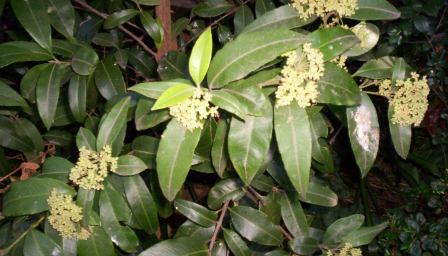
- Photograph 1: Backhousia citriodora [Lemon Myrtle] HelloMojo 18 March 2007. Licensed under the Creative Commons Attribution-Share Alike 3.0.
- Photograph 2: Dried and crushed lemon myrtle leaves. CSIRO. 6 June 2007. 6 June 2007.Licensed under the Creative Commons Attribution-Share Alike 3.0.
Reference reading:
- 2024-25 Stronger communities Grant Round 9 facebook Luke Howarth's post 27 November 2024.
- New Ecocentre for Clontarf SHS. Saltwater Newsletter No 65 Page 3. October 2009.
- Aquapro AP1360SP Solar Pump And Panel Kit Bunnings Warehouse. RRP $413.69.
Other reading: