Bulletin for December 8th, 2016
Rotary Club Burlington Central December 8, 2016
Pres Mike Molloy chaired the regular Thursday breakfast meeting.
Thanks were offered to Rod Collard for arranging the Paradiso Christmas-Holiday party which was highly successful.
Our only guest today was Bill Thompson also our guest speaker and he was welcomed. It was a small crowd. It was noted that Viktor was on a school trip. Jamie Edwards was standing in for as sergeant at arms who, in an attempt to extort money from the group asked all past presidents to stand up and to pay a fine to make up for all the fines they missed while they were president. Unfortunately the rest of the club was also fined, because… why not?
Catherine Brady celebrated her 60th birthday last week and noted that an excellent party of friends and family that ends up at 330 in the morning brings it home that one is 60!
Viktor is now staying with the Radford's but when he was told that Bert is a church minister became quite nervous at the prospect of having to go to church every Sunday. He displayed great relief at not being obliged to do so while staying with them.
Jamie Edwards will be going away until February. Mike Malloy was very sad, for the first time in his married life, not to be given a fruitcake for Christmas. Since he was always the only one to eat it and he is on a mission to lose weight I can only assume his wife was being kind to him.
The Children's Christmas party will take place on 22 December. Eric Anderson who has always had the largest number of family members attending said that his 23-year-old grandchild still looks forward to it. Incidentally your scribe’s eldest grandson says it's his favourite event of the year.
The club was asked whether there was interest in involved in Guess Who's Coming To Dinner and approximately 50% indicated that they were, in one way or another. Catherine Brady has volunteered to take it on. Somebody wondered whether Guess Who's Coming To Brunch might also go down well.
Lesley Allison is planning a wine and cheese party as an introduction to the community to Rotary and this will be coming up soon.
Peter Thoem who must be thanked for his extraordinary work in getting speakers for all of our meetings is still looking for a speaker for January 5 2017. Between January and March many of these spots have been filled by club members and other Rotarians. This was to try and make it easier for attendance on mornings with difficult weather to relieve people from having to come from afar.
The group was asked please to check ahead for the duty rosters which can be found on “Calendars” on the website.
There are still slots available for the Christmas Salvation Army kettles on the 17th and 24th December for an hour or so at a time.
Catherine Brady is organising a food and clothing drive. Please support this drive in order to be able to give a good donation to the food bank.
Please check emails for information about the Seniors Breakfast on 17 December.
Lesley Allison introduced Bill Thompson a retired CA who has worked on museum boards and the Historical Society and is a member of the Halton County Radial Railway.
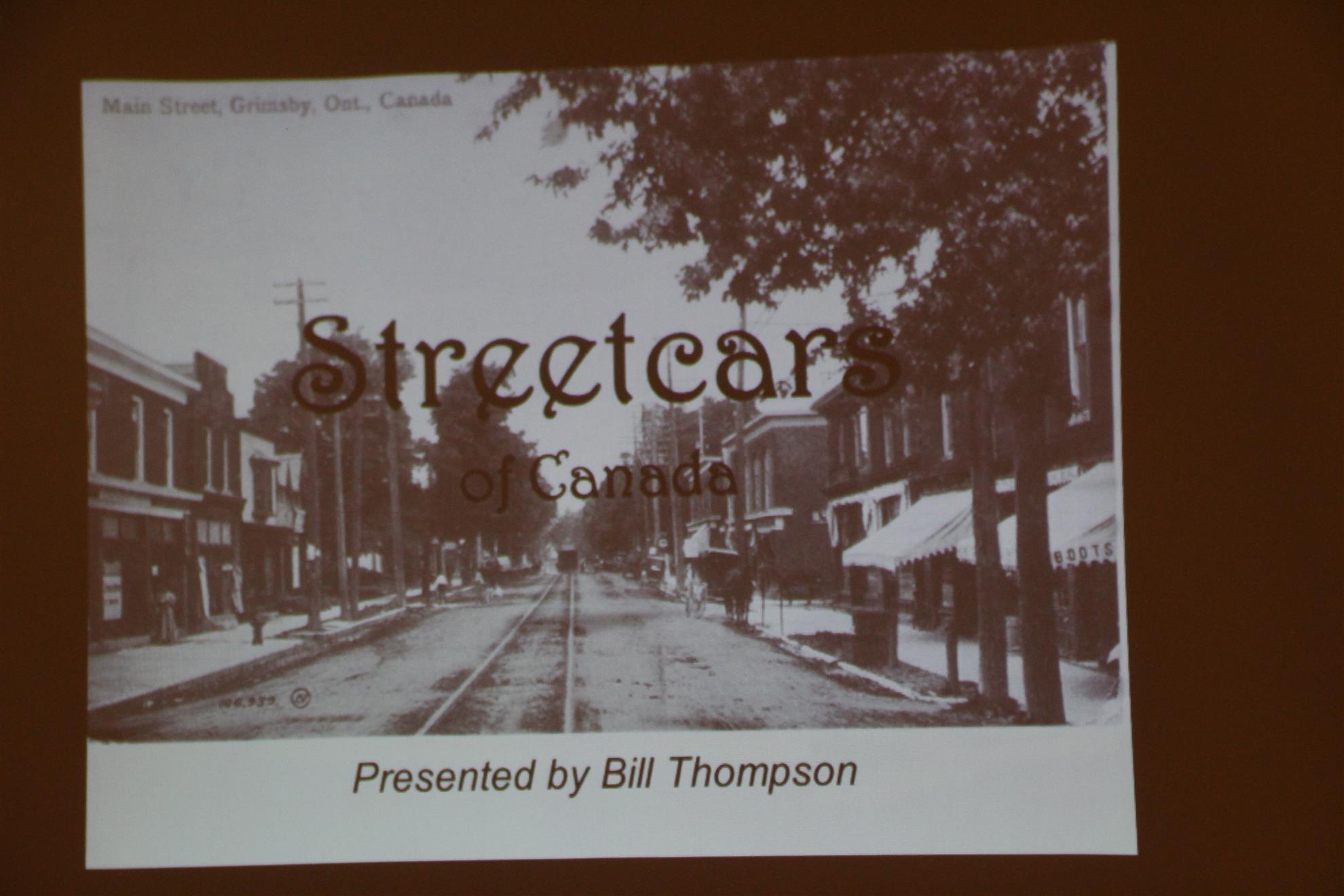
Streetcars of Canada.
This was the first form of rapid transit throughout Canada. Trams, trolleys, streetcars, were to be found everywhere in Canada from St John’s to Victoria at the turn of the last century. Even small communities such as Grimsby and then Burlington had their streetcars. Bill displayed a good number of the 600 or so postcards he has commemorating this remarkable era.
In 1908 there were only 140 cars in Ontario. Horse and carriage, bikes, delivery carts and streetcars were to be seen everywhere and in only 10 years the whole thing was turned around and horses were found only with difficulty with the huge increase in the number of cars. Streetcars even ran between cities. There was a streetcar that went between Toronto and Guelph, the Toronto Suburban Streetcar Company. There is also the Niagara Saint Catherine's and Toronto Streetcar line. There were connections between steam ferries and cities. There were five lines running out of Hamilton. There were impressive terminal buildings owned by the streetcar companies.
Statistics were extraordinary: in a town of 1100 people there were over a quarter of 1 million passengers per annum at $0.25 a ride. In the US there were 40,000 streetcars and 5.8 billion passengers in 1902.
Toronto is the only city left with streetcars. Urban rail disappeared rapidly with the onset of the automobile. (It has been said that this was hastened by big money from big oil.)
Originally, street cars were drawn by one horse. By 1890 most streetcars were electrified. All the streets were mud, and having smooth riding rails major transit much easier. The track size was standard and designed to be the same width as an English carriage. There was a difference of a number of inches from freight trains which is also to prevent freight trains from getting onto the streetcar system. We saw an amazing picture of a horse riding on a trolley behind a streetcar as it went downhill.
They were privately run and publicly run. Access was made to amusement parks and frequently the companies would build the part of the end of the line to create traffic. Sometimes when there was relatively light traffic, amusement parks were built along the way. There were dance pavilions, casinos, baseball diamonds and beaches. London had a streetcar that went from when it went through St Thomas to Port Stanley.
In the 1800s roads were private and frequently told at the whim of the landowners. Frequently there would be several tolls along major road. The streetcar companies created their own roads to avoid the tolls. There were many lines and many different companies. When the TTC was established in 1921, it was made up of nine separate systems.
Streetcars used not to run on Sundays because "it would lead to deep injury to the religious interests of the people" in 1897 by popular vote streetcars were allowed on Sundays.
Most streetcars were built of wood to start with and as they became electrified and had to carry heavy equipment they became steel framed and went from the speed of 8 mph up to 60 miles an hour. They had First Class, and Smoking carriages. Ladies would never smoke in public and were not compelled to witness smoking. There were streetcars with mahogany and wicker armchairs. The streetcar in those days might cost $15,000.
One of the most fascinating streetcar lines was the Niagara Gorge Beltline which connected with steamboats and went along the length of Niagara Gorge, crossed into the United States and back again. The whole trip cost a dollar and was hop on hop off. It became very difficult to maintain with huge problems of landslides and ice build up that destroyed the tracks. The trams ran every 15 minutes and took two hours. They had as many as 17,000 passengers a day.
Eventually hydro companies bought the lines but frequently because they were unable to manage them ended up closing them. Cars finally spelled the end of the streetcar. The irony is that now 60 years later we are seeking to replace what was almost totally eradicated. "If we forget the past were bound to repeat it"
The Halton County Radial Railway in Milton has many of the original streetcars including the first car on the TTC and makes for a wonderful day to ride the rails back into history. The museum tells the story of the streetcar. Every Halloween they have two Saturdays where the streetcars are running and two Saturdays in December where Santa rides the rails.
Click image above to see slideshow of Streetcars.
Anthony Ford-Jones