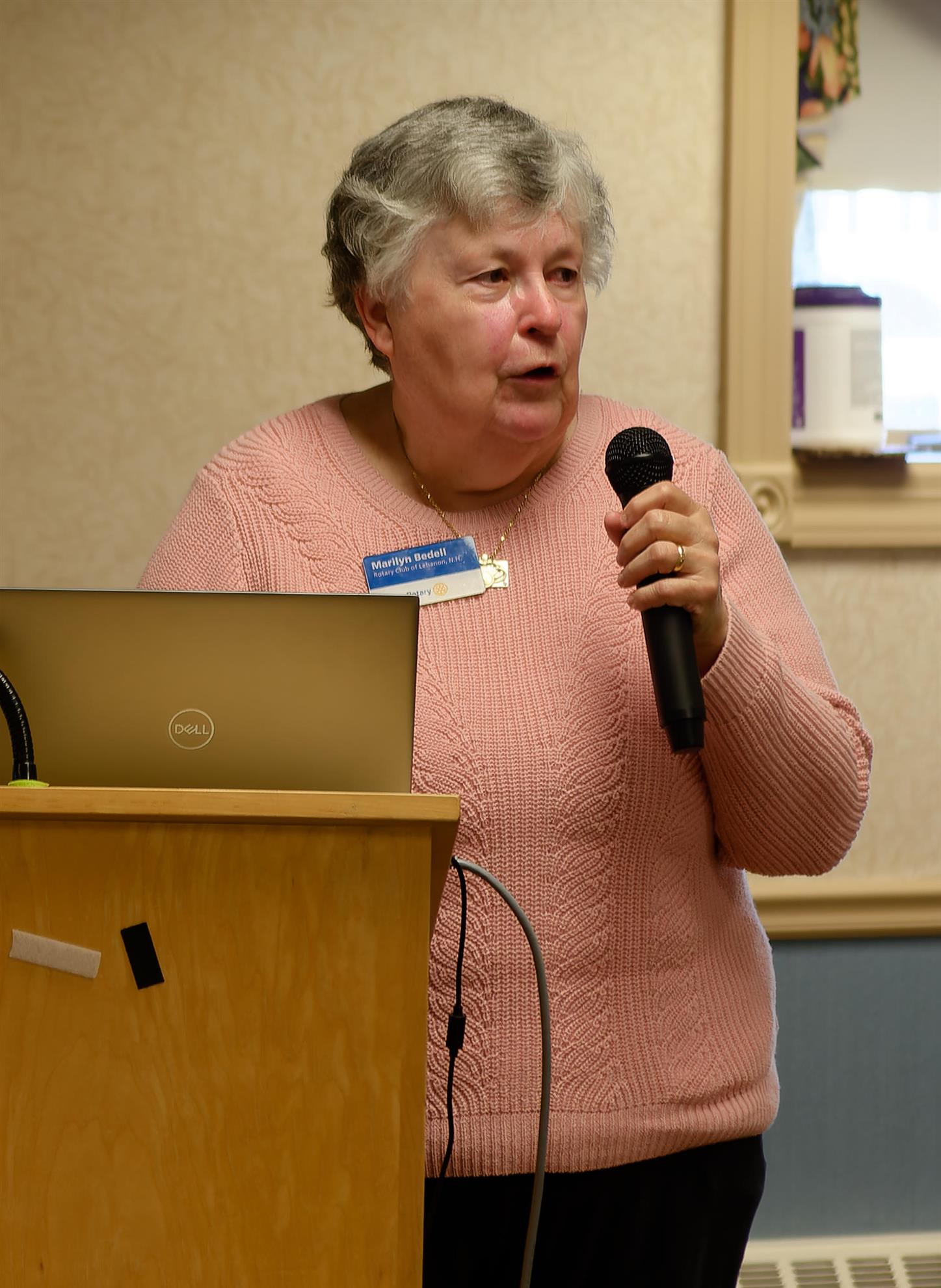
Our speaker today was Marilyn Bedell. She gave us an update on Rotary International's work to eradicate polio.
Marilyn Bedell
She began by reviewing the history of polio, and what caused it to escalate after the invention of flushed toilets, sewage systems, and use of baby formula.
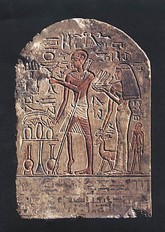
Poliomyelitis is said to have first occurred nearly 6,000 years ago in the time of ancient Egyptians. The evidence for this is in the withered and deformed limbs of certain Egyptian mummies.
Before the advent of modern indoor plumbing and sewage systems, many cities had open sewers that were no more than gutters with outhouses in backyards. Almost everyone had, at one time or another, been exposed to polio, and with open sewers and outhouses the norm—there was ample opportunity to contract polio. [Resulting in Herd Immunity] Polio viruses infected generations of babies, who were protected in part by antibodies passed on to them by their mothers. When a child became infected with the poliovirus the results were flu-like or cold-like symptoms. The diagnosis of polio was rare because the symptoms were often indistinguishable from other childhood diseases.
Cases of paralytic polio began to rise once changes in public sanitation and other health measures came about, such as changes to water purification, milk pasteurization and use of formula instead of breast milk. Better hygiene meant that babies and the young were not receiving some immunization from their mothers.
In northern Europe and in the United States, epidemics of paralytic polio began to appear in the late 19th early 20th centuries. The full impact of polio wasn’t felt in the United States until the summer of 1916, when an outbreak resulted in 27,000 people being paralyzed and 6,000 died. The 1916 epidemic caused widespread panic and thousands fled the cities to nearby mountain resorts. Movie theatres were closed, meetings were cancelled, and public gatherings were almost nonexistent. Children were not to drink from water fountains, and were told to avoid amusement parks, pools, and beaches. From 1916 onward, a polio epidemic appeared each summer in at least one part of the country, with the most serious outbreak occurring in the 1940s and 1950s.
In the United States, it would be the 1952 polio epidemic that marked the worst outbreak in the nation’s history. Of the nearly 58,000 USA cases reported that year, 3,145 died and 21,269 were left with mild to disabling paralysis. Statistically, more children died of polio in 1952 than any other infectious disease.
Polio in the United States changes with the advent of the Salk, followed by the Sabin vaccines.
Rotary’s global polio initiative was started in the Philippines when a District Governor from the Philippines began to question why polio was such a problem in his country, but not in the United States. This led him to champion to administration for polio vaccine to every child in the Philippines. He was able to demonstrate that when a population of fully vaccinated, polio disappeared from the environment. This service project was shared at Rotary International Conventions.
This compelled Rotary’s leadership to develop plans to “tackle” polio worldwide. Beginning in 1985, our Rotary leadership inspired the World Health Assembly to pass a resolution to eradicate polio. This paved the way for the formation of the Global Polio Eradication Initiative in 1988.
Since PolioPlus began in 1985, Rotary’s vast network of 1.2 million members has contributed money, volunteer time and networking expertise to the worldwide polio eradication effort.
Rotary work in Polio eradication has been bolstered by our partnerships with the World Heath Organization, UNICEF and the Centers for Disease Control. The Bill and Melinda Gates Foundation joined this partnership in 2007. Annually since 2007, the Gates Foundation has matched Rotary’s donation to polio 2:1. We have met the challenge and annually see 150 million going to polio eradication efforts in the areas of vaccine distribution, surveillance, development of new vaccines, national immunization days and “mop-ups” when polio outbreaks occur.
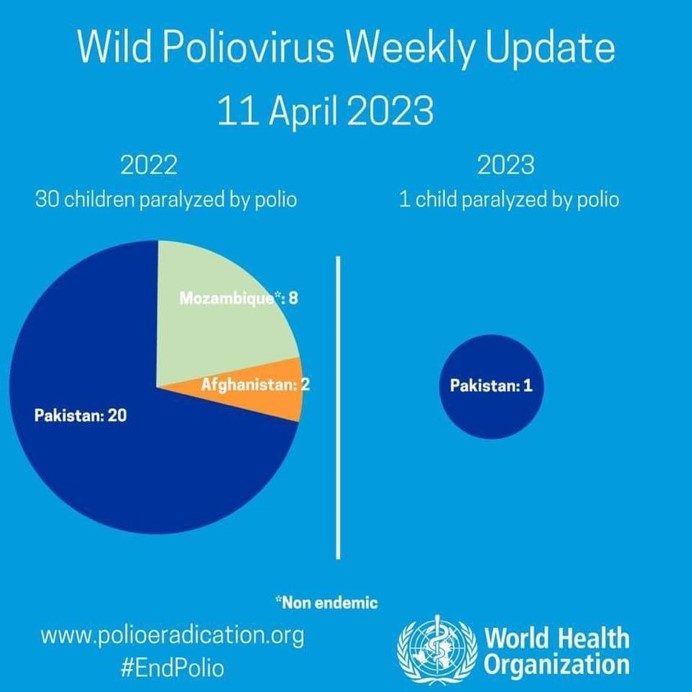
In 1988, there were 350,000 wild polio cases documented worldwide. As o April 11, 2022, their has only been 1 documented wild polio case in Pakistan. In 2022, there were 30 wild polio cases.
The two remaining endemic countries are Pakistan and Afghanistan. Fortunately, it has been reported by RI that the Taliban is supportive of vaccine administration. Brave female polio worker in both Pakistan and Afghanistan are on the frontlines of administering vaccines. Despite the murder of polio vaccine administrators, the women working on the frontlines continue to work to get vaccines to children.
One of the most troubling parts of our eradication efforts in vaccine derived polio cases. On very rare occasions, if a population is seriously under-immunized, there are enough susceptible children for the excreted vaccine-derived polioviruses to begin circulating in the community. If the vaccine-virus is able to circulate for a prolonged period of time uninterrupted, it can mutate and, over the course of 12-18 months, reacquire neurovirulence. These viruses are called circulating vaccine-derived polioviruses (cVDPV). An inactivated (killed) polio vaccine (IPV) developed by Dr. Jonas Salk and first used in 1955, and a live attenuated (weakened) oral polio vaccine (OPV) was developed by Sabin. The attenuated vaccine is the vaccine of concern. There are efforts underway to modify the oral vaccine to eliminate the risk of cVDPV.
Prior to the start of the meeting, there were conversations about golf, and the room was "a buzz" as we had 22 members in the room.
President Ed Friedman called the meeting to order just after 12:08 noon.
Ernst was asked to lead us in the 4-Way Test...he gave us his own version which he sent to me at the end of the meeting
Dear Marilyn, here is my parody on the 4 way test as perceived by a Limburger.
1) Is it fun? If not, make it so.
2) The soup never gets eaten as hot as it is served.
3) (with the Brew fest in mind) the largest fire could initially have been extinguished by a glass
of beer.
4) (in view of my future leadership) "Oderint dum metuant", which is a quote from emperor
Tiberius and means: "let them hate me as long as they fear me".
Following Ernst's version, we all recited the original:
Of the things we think, say or do:
Is it the Truth
Is it Fair to all Concerned
Will it build Goodwill and better Friendships
Will it be Beneficial to all concerned.
Ernst Oidtmann played and we sang our Rotary welcome song, and then Yankee Doodle Dandy.
It was then on to the buffet.
Marilyn opened WebEx and we were delighted to see Kirk Baird on the screen. Kirk has missed meeting due to medical/surgical issues.
Marilyn Bedell then provided a polio update. See Story above.
It was then time for announcements:
Rotary Foundation Ron Bedell will be sending our reminders to get annual donations into the Foundation by 30 June 2023.
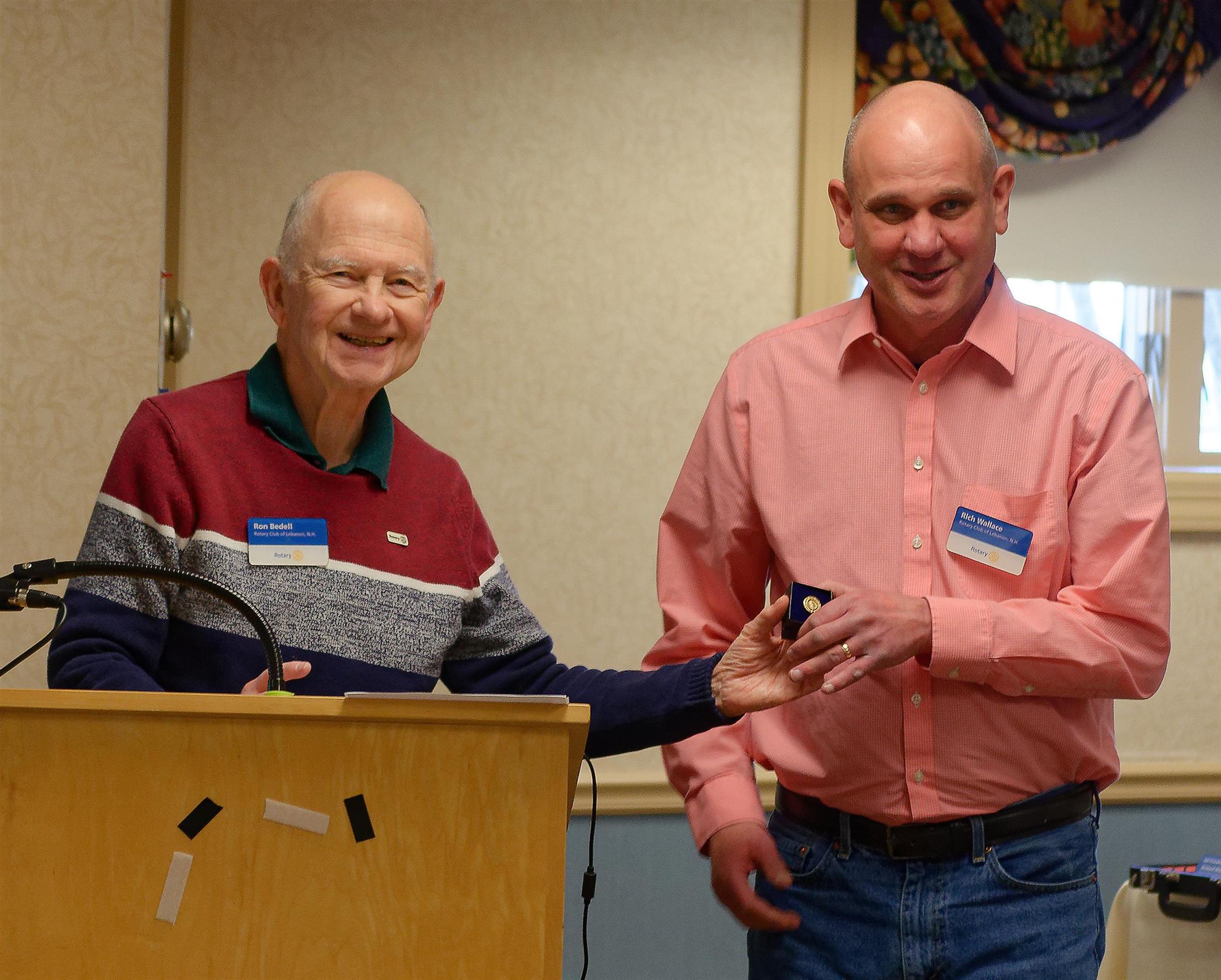
Ron then invited Rich Wallace up to the podium to present him with his Paul Harris pin. Ron thanked Rich for his ongoing supporting the Rotary Foundation!
Ron Bedell and Rich Wallace
100th Anniversary Update David Crandall reported that installation of Harmony Park will be on Monday, April 24, 2023 starting at 11:30 PM. Merchants on the Mall are aware this will be happening. Response to the park has been positive. Our metal sign that will be at the park is getting its final coat of paint. David has flyer we can put up to announce the dedication on May 13th. Yard signs have been designed, and David and John will be putting the all around the city.
Or Centennial Dinner Invitation will be going out at the beginning of May. It is being sent to our members, former members, district leaders and all the Clubs in our District. If you want to make sure someone is on the list to get an invitation, send the name and email to Marilyn Bedell.
Mascoma River Clean-up will be July 22, 2023. Stay tuned for details. Ernst would love to have someone volunteer to co-chair this event.
Brew FestOur next meeting will be Monday, April 24 at 1 PM at Service Credit Union.
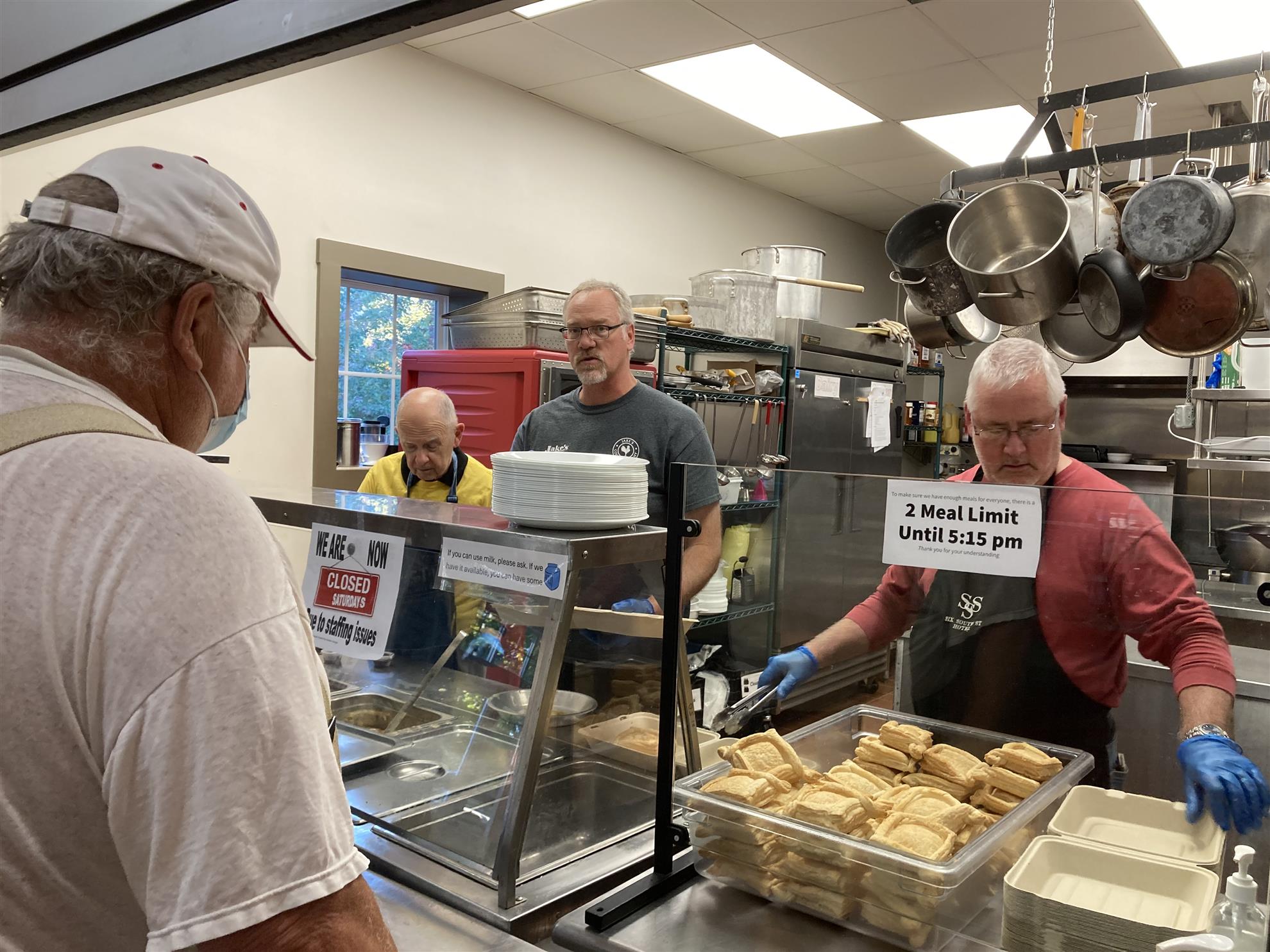
Listen DinnerVolunteers are need for the June 13, 2023, Listen Dinner. If you can help, let Dean know. We are no longer able to sign up on the Listen web page. Dean will collect names and get them to Larry at Listen.
Creative Housing Solutions There is a new Visions Spring Newsletter. If you would like to see it, email either Bruce Bergeron or Marilyn Bedell for a copy. It isn't on their website yet.
GOLF Friedman reportedlan are underway to have ads published in the Valley News about our Golf Tournament. Everyone is encouraged to solicit golf teams and sponsors. Currently we have 9 team, and about $4,000 in sponsorships.
Poker Room John Yacavone reported that we will received $9,843 from our sponsorship of the poker room in April. This is less than last year. Next year John hopes to get dates in early May instead of April.
Emmah's Garden/Charities RequestBruce Pacht described the project being proposed for Emmah's Garden. Angela Nelson made the motion that this request should be circulated to club members for an electronic vote. The motion was seconded by Hank Clark. It passed in the affirmative unanimously. After the meeting you should have received an email that states the following:
As mentioned at today’s regular meeting, voting is now open to Lebanon Rotarians on the following question:
Do you support Charities’ allocation of $4,000 dollars to Emmah’s Garden efforts in 2023-24?.
Voting will conclude at the close of Lebanon Rotary’s regular meeting on Thursday, April 27.
If members confirm, the Club will apply for 1:1 matching DDF (District 7850 designated funds) which would allow us to apply $8,000 to the proposed project. Our contribution will continue and expand on the experimental agriculture and clean water project begun by Emmah’s Garden last year with help from Lebanon Rotary in the village of Nyandoche Ibere, Kenya aimed at improving the village’s nutritional, health, and economic future.
In a nutshell, here is what the coming year’s project will aim to accomplish:
Create a replicable, high-productivity field demonstrating the ability to double productivity of existing fields using a well-researched and established US model.
Establish a water-harvesting, storage and distribution system to take advantage of the region’s two rainy seasons and mitigate the local effects of drought conditions.
Provide a small annual stipend to the village organizer and agricultural teacher.
If the experiment is successful, the relatively new Rotary Club of Kisii (near the village) may be inspired to take on a broader initiative (perhaps on the scale of a global grant!) to expand or replicate the practices in other villages.
Please do take a few moments to vote. If you have any questions before voting, please contact me (Bruce Pacht).
Happy Dollars
Ed Friedman was happy to report that his granddaughter, Lainy continues to make progress. She is now over 9 pounds. She is still in ICN, but the hope is that she will be able to go home to Claremont before too long.
Ron Michaud has a sad dollar. Ron was one of 9 children, and his last remaining sibling, Geraldine has died. Marilyn, another sister died about 3 months ago. Both have been tough losses.
Ernst Oidtmann is one of 7 children. All the Oidtmann clan are still alive, though some of the spouses haven't survived. His second happy dollar was for the 3 ship models that are in his car on the way to th Howe Library to go on display.
Bill Secord announce the Bell Canto Spring Concert that will be on Saturday, May 6, at 7:30 PM and Sunday, May 7, at 4 PM. The program is called Journeys. It will be held at the First Congregational Church in Lebanon.
Bel Canto celebrates the Spring season by exploring the many forms of journeys, from physical travel to flights of imagination, from past remembrances to future hopes, from spiritual and metaphorical to transformational. We will take these various journeys through music for choir, piano, and handbells, across a range of musical genres and styles. We are happy to be collaborating with the handbell choir from Church of Christ at Dartmouth College in Dan Forrest’s exciting “A Bronze Triptych”. Other pieces include works by Mendelssohn, Brahms, and Stanford, as well as arrangements from folk, Native American and African American spiritual traditions.
Hank Clarke reflected on one of the past Bel Canto performances and how much he like the rendition of Shenandoah.
Paul Tierney's grandson is 11 months old. He advised us that he had a bad experience using the H&R Block online tax reporting system. He wrote a 1500 word 'nasty gram" to the company.
Bruce Pacht reported on a variety of award that members of the North Country Chordsmen and groups within the Chordsmen received at a major competition. It tired to find more details on the Chordsmen's Facebook and webpage, but couldn't get the details I missed when I was taking minutes.
John Yacavone promised a condensed version of his memories of working with the Director of the Civil Defense program in Connecticut during the Cuban Missile Crisis. He could not remember the name of the director. After multiple emails to officials in the Connecticut state government, and coming up without the answer, he wrote to the governor of Connecticut, and within 3 hours had a response. You can read all about this, if and when John publishes his memoir.
Angela Nelson reported that she missed coming to meeting. She is delighted that tax season is in the rearview mirror.
Marilyn Bedell forgot to add that is was delightful being one of 4 women members in the club today. This hasn't happened very often.
Queen of Hearts Draw
Angela Nelson pulled the Ace of Diamonds. The search for the Queen continues.
Members at the meeting: Kirk Baird*, Marilyn Bedell, Ron Bedell, Dean Cashman, Hank Clarke, David Crandall, Jim Damren, Ed Friedman, Joy Gobin, Tim Guaraldi, Ahmad Haidari, Ron Michaud, Angela Nelson (tax season is over!), Ernst Oidtmann, Bruce Pacht, Phil Rentz, Bill Secord,Marion Steiner, Paul Tierney, Rich Wallace, Steve Whitman, Cal Wollfe, John Yacavone
* joined by WebEx
Projects and Fundraisers
Next Listen Dinner June 13, 2022, Volunteer needed.
ONLINE SIGN UP HAS BEEN DISCONTINUED.
Let Dean Cashman know if you can help and he can email Larry the names of members who will help at the dinner.
Lebanon Casino Fundraiser - Spring 2023 - We raised $9,843!
Harmony Park Installation and Dedication
Save the Dates!
Installation of the park elements will happen on Monday, April 24 starting at 11:30 AM. Feel free to drop by to see the progress being made.
Dedication on May 13, 2023 at 1 PM...FREE ICE CREAM...Volunteers to serve ice cream will be needed!
Club's 100th Anniversary Dinner will be under the tent at the Quechee Inn at Marshland Farm on June 29,2023 at 5:30 PM. Meal to be served at 6:30 PM...
The vote is in...it will be a plated meal.
30th Bedell Classic Golf Tournament - See you at the golf course Friday, May 26 2023!! Time to recruit golfers and sponsors! Plan to volunteer on the day of the event, or contribute help prior to the event. Talk to Ed Friedman, Bruce Bergeron and Dean Cashman if you have questions.
Mascoma River Clean-Up — July 22, 2023
Save the Date! July 22nd for our next Mascoma River Clean up!
Ernst Oidtmann would like a member to co-chair this event with him.
We will do this in partnership with the Lebanon Conservation Commission
Brew Fest 2023
Brew Fest on to
September 2, 2023
CHEERS!!
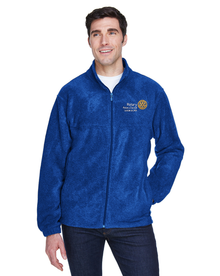
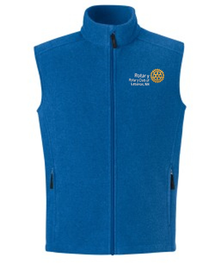
Top Stitch Rotary Vests and Jackets — A great holiday present to give to yourself!
John Yacavone has arranged for members to order light and heavier weight jackets and vest for us to wear when doing service projects...for days when our tees shirts just aren't enough to keep us comfortable and warm.
If you click the link below, Top Stitch has created a special website for Lebanon Rotary Club members to order the following clothing items.
1. Men’s and Women’s light weight jackets
2. Men’s and Women’s fleece vests
3. Men’s and Women’s fleece jackets
All jackets and vests will have Rotary Logo and club name.
Just pick your item and follow the instructions for ordering. If you decide to pick up your item at Top Stitch located at 233 Mascoma Street Lebanon, NH 03766 there will be no charge for shipping, otherwise shipping will be charged. If you have any questions about your order please contact Cody at Top Stitch at 603-448-2931. Turn around time is 3.5 - 4 weeks. Once you place your order your order will be processed no waiting on other orders to be fulfilled.
Tools and vision: How ending polio helps fight malaria
By Etelka Lehoczky Photography by Esther Ruth Mbabazi
Health workers in Pakistan go door to door administering the polio vaccine. Volunteers in Zambia perform a dramatic skit showing how malaria spreads. These efforts may seem very different, but they're deeply connected.
A global partnership has mobilized millions of workers, reached underserved populations, and gathered unprecedented amounts of health information in the fight to end polio. That work by the Global Polio Eradication Initiative, of which Rotary is a core partner, is proving crucial in the battle against malaria.
UNICEF estimates that malaria kills a child under age five nearly every minute. "The children are the most susceptible, because they haven't built up any immunity," says Bill Feldt, a chair of Rotary's first US$2 million Programs of Scale award recipient, Partners for a Malaria-Free Zambia.
And yet, malaria is a preventable disease that many believe can be eliminated. Inspired by the GPEI's results and equipped with its tools, health experts and Rotary members are applying its lessons to malaria.
The information challenge
To dramatize the importance of bed nets that have been treated with insecticide to prevent malaria, Rotaractors in Zambia dress up as mosquitoes and act in educational skits. It's a creative way to reach people in an area with a lower literacy rate, and it's based on a lesson from the GPEI: To stop a disease, you've got to dispel misinformation.
"When we began doing polio vaccinations in Ethiopia, this rumor started circulating that the vaccine was meant to sterilize Muslim children," says Jenny Andrews, the executive director of Malaria Partners International. "Rotary was able to bring together a large group of faith leaders, traditional healers, tribal leaders, and medical doctors to do radio and TV ads to overcome that fear. That's one thing we've learned from polio: Instead of waiting for a problem to arise, we get out ahead of it."
There's plenty of misinformation about malaria to counter. When health workers spray rural homes with insecticide, the clouds of bugs that emerge can suggest that mosquitoes are being summoned, not killed. When bed nets are given away, people may not realize they're free. And many people don't realize that leaving an infection untreated puts others at risk.
"Sometimes, if they have malaria and they live far away from a health facility, they'll say, 'Oh well, I've had it before, I'll just hang on,'" says Jim Moore, a founding board member of Malaria Partners International. "Part of it is educating people that they should get tested for malaria if they're feeling sick. Because if they get bitten by [another] mosquito, the parasite can be transmitted from them to the mosquito, and then to their neighbors and family members.
"You are essentially training local leaders — religious leaders, business leaders, tribal leaders — to understand how malaria gets transmitted," he adds.
Thanks to Rotary's polio work, members already have strong relationships with those leaders. Ezra Teshome, a past district governor for District 5030, has been leading Rotary delegations on polio immunization trips to Ethiopia, Uganda, and Kenya since 1997. He says working effectively against malaria is a matter of getting key officials involved. Fortunately, he already knows just whom to talk to.
"The success of my work in East Africa is really due to connecting with the right people," Teshome says. "We've gotten the blessing of the minister of health, the prime minister, and the president's office in these countries. Those kinds of connections make it easier to help the health workers." Click Here to read more.
We now have hybrid meetings on Thursdays at noon, in person at the Dwinell Room at Harvest Hill on the Campus of Alice Peck Day Hospital, OR join us via Zoom. Click Here to request the Zoom Link.





.jpg)






.jpg)

.png)