
Guest Speaker Angela Teale from Square Kilometre Array project introduced by Laurie Dines.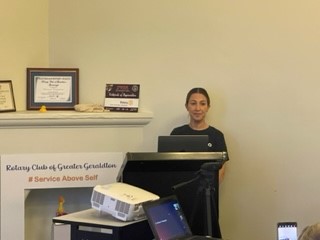
Australia is a member of the international organisation established to build and operate the world’s most powerful radio astronomy facility, the SKA Observatory (SKAO).
The SKA Observatory will consist of two radio-telescopes, one in Australia (SKA-Low), and one in South Africa (SKA-Mid). The two telescopes will observe the sky at different radio frequencies and complement each other scientifically.
The SKA project builds on decades of Australian ingenuity that places us among the best in the world in developing technologies for radio astronomy and operating national facilities for the benefit of scientific and broader communities.
The Square Kilometre Array is an international effort to build the world’s largest radio astronomy observatory.
As well as playing the major role of developing the site for the SKA-Low telescope in Australia, we've been involved in the SKA project since its conception and we've worked with industry, universities and other key science organisations on the final design, prototyping and testing of elements for the SKA telescopes.
SKA-Low will consist of an array of 131,072 Christmas tree-shaped antennas, grouped in 512 stations, each with 256 antennas. A number of these antenna stations will be placed in the centre and the rest will span out along three spiral arms, stretching 74 kilometres end to end. SKA-Low will operate at frequencies between 50 and 350 MHz, similar to FM radio and TV broadcasts.
In addition to our role as operations partner and managers of the telescope site, we are also contributing to the construction of the SKA-Low Telescope. With the support of the Australian and Western Australian Governments, we established the observatory site in 2009. Like light pollution in big cities limits how much of the night sky you can see with your eyes or with an optical telescope, cities and towns also generate radio interference that limits what radio telescopes can 'see'.
The Murchison region was selected for its ideal vantage point from which the SKA-Low telescope and its Australian precursor telescopes could observe the best area of the sky. The weather patterns are relatively stable, and it is accessible to the city of Geraldton though sufficiently far enough away from city-generated radio frequency interference. The SKA project is a multi-generational project that will operate for at least 50 years, so these environmental and socio-geographic considerations were critical in site selection.
Questions from Kevin Green, Laurie Dines, Phil Martin, Jo Clarke, Geoff Wood, Bob Urquhart, Grant Woodhams and Barry Dring.
For more information: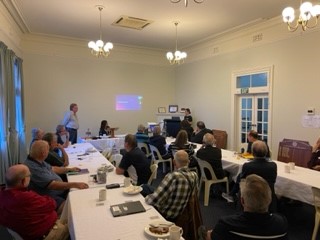
https://www.csiro.au/en/about/facilities-collections/international-facilities/ska
Guest speaker thanks by SKA mesh provider Phil Martin.