

Mentoring is what Kinship is all about.
A child needs one person in their life who supports them and who they know will not give up on them. That was Rebekah Christensen’s core message as she explained the Kinship program to members during their regular noon hour meeting at Prante’s on Tuesday, September 17th. Even the oldest of us recall that growing up was hard to do; having a mentor can be vital to success. Most of us can remember an individual or individuals who mentored us at various stages of our development.
The children in the program come from good families; families who have realized that given their situation they need help. The absence of mentoring within the family can be due to a variety of reasons: a spouse is dead, absent or infrequently present due to work commitments and other scenarios. Often it is a combination of one of those reasons and the absence of support from an extended family as none are in the area.
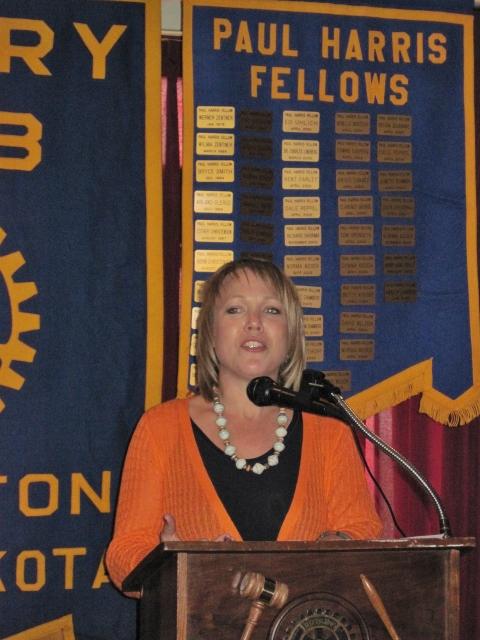
Rebekah Christensen
The program is currently structured to mentor children from age 5 to age 16. Care is taken to make an appropriate match of the youth to the volunteer adult. The expectation is of four hours a month; as one hour a week or all four hours in one block or any combination that works. For the adult mentor volunteer it frequently requires only a bit of thought to connect what they are already doing that week as a mentoring opportunity. Currently there are 40 matches the longest of which is 9 years. This summer the local Kinship program closed 10 matches meaning the child graduated high school. At the moment 18 children are on the waiting list.
Aside from the child, who benefits from the program? Without question society benefits as this clearly is a social problem prevention program. Data reflects a 35 % decrease in teen pregnancy; 46 % decrease in drug use; and a 52 % decrease in both school drop outs and violent behavior when children in mentoring programs are compared to the children in the general population not in such programs. Many mentors have expressed that for as much as they gave to the program they received more back. Mentors do not have to be individuals; they can be couples or even families.
Ms. Christensen urged Rotary members to learn more at the Kinship web site: www.rekinship.org.