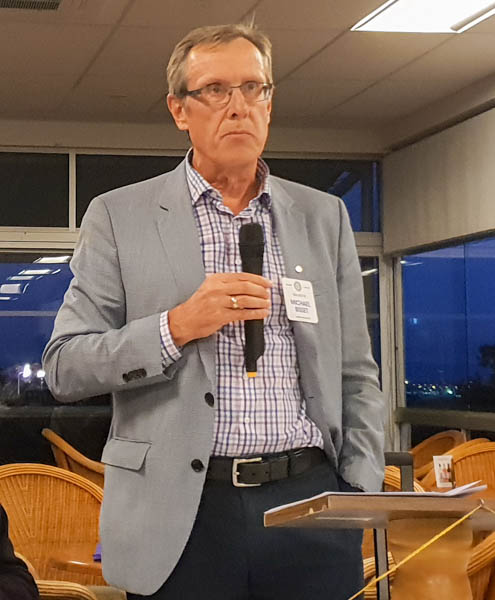
 | MY FAMILY BACKGROUND My parents were born in the early 1930's into middle-class Melbourne, and their parents had sufficient means to provide private school secondary education for both of them. My father’s parents were small retail business owners with the corner store and ultimately a couple of them. My mother’s father was a senior manager/administrator in the Church of England, and he received an MBE from the queen for services to the church. A big deal in that era we were told when we were old enough to understand who the Queen was. |
The Queen's presence reappeared in the same house many years later when my grandmother turned 100 and received the letter from the Queen.
My parents married at the young ages of 23 and 21 respectively and as was the standard of the day my mother had to resign from her bank job when she married. Dad’s career was in the textiles manufacturing industry in various managerial sales and marketing roles.
I was born in 1958 and had a fantastic 1960's childhood where you just seemed to be allowed to roam the streets and paddocks of our new neighbourhood which was about l0 km east of Melbourne. I have an older brother and younger sister. The suburb where the family home was full of kids who spent all daylight hours after school in the street playing footy, cricket, fighting, racing bikes, billycarts and just getting into trouble as we dared each other on, as you did when you were very young.
- When I think back, parenting was so hands off during my childhood. The epitome of hands-off parenting for me was the annual Guy Fawkes cracker night when the dads would compete to build the biggest bonfires on their verges replete with burning car tyres and then literally set the street on fire. It was quite something to look up the street and see so much on fire. Then to cap it off they would set off an arsenal of fireworks and rockets with minimal regard for safety. The injury tally became clear at school the next day.
- My parents were passionate football fans with dad being Richmond and mum a very passionate Melbourne girl. For some reason, they allowed us, kids, to choose our team and I became an Essendon follower. Saturday afternoons in the late 60's and into the 70's as kids were often spent at the MCG which influenced my keenness of Victorian football. I saw some great finals and Grandfinals at the MCG from 1970 until we moved to WA in 1998.
- My secondary school was a private C of E school which quite frankly my brother, and I was somewhat unenthusiastic, about given all our friends headed to the local gov't school. In the end, I had a sufficiently enjoyable time, especially with the sporting side and was somewhat rebellious on a number of the aspects of the school culture. It was the 1970's after all, which my father did not always understand. I finished school in 1976 and university in 1980.
- I married my wife joy in 1990 at the age of 32. 1990 is also significant as it is the year of shame for Essendon supporters as this was the year that Collingwood broke their drought and won their first flag since 1958. Joy and I have three kids who are Julian 26, Cameron 20 and Stephanie 18. we moved here in late 1998 with two kids, and Stephanie was born here and so is the only true West Australian in the family.
- My father encouraged or required me to work from a young age. So in my young teens, a mate and I had a local lawnmowing business which required us to push our lawnmowers and gear around our very hilly suburb. Not easy when you are not too strong, and you might have a 5 km round trip to do one $3 lawn. In school breaks dad had me working in the warehouse at a textile factory where he worked which helped me understand the worker at the bottom of an organisation. Good learning without me realising it at the age of 15.
- University wasn't a straight path for me as in 1977 I dropped out of Monash University after the first eight weeks causing a mighty blow up with dad, but it was not a wasted year as I worked on a few eclectic things such as a workers compensation private investigator for a short period. Not honest work as you have to deceive and prey on people who more often than not had a legitimate incapacity. Fortunately, that work didn't last long for me in 1977, and the next work was on a production line for a large furniture manufacturer. Very monotonous but good learning as I had to join a union which again taught what goes on at this level and some of the less savoury tricks such as how to sabotage production lines. Not me but I learnt what they would do.
- So 1977 was a year of good learning, and it made me realise I had to get back to university the following year, which I did. I did a degree in Business Studies finishing in 1980. Unlike today graduate jobs for all professions were plentiful which I think had something to do with a very strong and protected Australian manufacturing sector.
- My profession was to then start in human resources. Human resources consist of some specialty areas such as industrial relations, remuneration, training, leadership development, employment law, and recruitment.
- In 1981 I accepted a graduate role as an industrial relations officer with BHP Steel in Port Kembla NSW. Along with the car industry, this was one of the most hotbed strike-prone industries in the country at the time. it was a massive industrial site of more than 20,000 people. at the time it was a throwback to another era regarding hardened and entrenched views of management and labour. It was industrial warfare every day with about 20 unions representing employees who on any day would have up to 70 separate work bans and strikes underway. An amazing environment to learn and see the full gamut of human behaviour in a work environment. To be honest after 2.5 years here there were not too many people behaviour issues that surprised me as my career progressed.
One of my objectives in this time was to work just long enough to save enough money to travel overseas for a year, which I did and will touch on that shortly after having a year of travelling from April 1983. I returned to Melbourne and started to knuckle down on building a human resources career with an objective to move into a manager level role and then a GM of the function. My preference was to try and move upwards in large organisations and keep learning by changing companies and industry.
I was operating at a GM level by 38 (possibly a bit early when I look back as I learnt at this team executive level the expectations are high, and on some occasions, I was a bit short of some experiences and wisdom. I think spurred on by the fear of failure I figured out how to get through these moments. Companies I worked for between the age of 24 and 40 in Melbourne included Exxon chemicals (sold), Mobil Oil (merged with Exxon), National Mutual Life insurance which became AXA and then later sold to AMP. By the age of 40, I had worked for four large multinationals in the steel, petrochemical manufacture, oil production and financial services industries.
- At the end of 1998, I moved to WA and into my five the industry which was mining. I took on the role of GM HR with Rio Tinto iron ore. I enjoyed my time there which coincided with the acquisition of another Australian mining company called the North Group and seeing off an ACTU led strategy to try and re unionise the Pilbara.
- I left RIO after around seven years and went to the more entrepreneurial end of mining and joined a smaller company called Lion Ore which was a nickel mining company and had operations here, SA and Botswana. During the nickel price boom around 2006, the business ended up being sold to a Russian company called Norilsk. They overpaid massively for the assets and about a year later when the nickel price tanked all WA operations were put into care and maintenance. 95% of jobs including the executive team were lost at that time.
- After that, I did a short stint of consulting with BHP Iron Ore before starting with my final role as the Asia Pacific HR executive with Newmont Mining. Newmont today is the largest global gold company, and I had a wonderful career with them from 2009 until March this year when I retired.
- With Newmont, I was fortunate to have mines and thus people-related challenges in Australian, Indonesian, Pacific Islands and NZ operations. The period involved some very challenging cultural, industrial relations and people change issues in Indonesia in particular. Also, in this time we sold mines in Australia, NZ and ultimately the Indonesian operation which employed around 8000 people. In my last year in the role, I worked in Ghana for six months to cover for one of my peers who resigned which again was a wonderful cultural learning experience.
- Finally relating to work, during the past 20 years I have been involved in some outside groups at different times which included:
- Lifeline WA board member.
- Australian Mines and Metals Association board member.
- Chamber of Minerals and Energy Executive committee member.
My first travel overseas was 1983/84 which like many Australians involved 12 months of exploring. At this stage, I had been working for bhp in Port Kembla for 2 and a bit years and now had enough saved to take off. The first part of my trip was a very adventurous 13-week overland trip from Nepal to London with 20 others in the back of a converted canvass sided ex British army truck. We planned to move through Nepal and India, cross into northern Pakistan and then track south along the Afghanistan border on the Pakistan side but only 50-l00km inside the border. Then get to a crossover point into Iran at a tiny outpost where all three countries borders intersect. Once through Iran it was on to turkey, Yugoslavia and then safe Europe.
- At that time you just set off and made a plan as you went. Also at that time in 1983, Russia was fighting their war in Afghanistan, and the revolution in Iran had happened, their borders for foreigners to cross their country had been shut for years and were shut as we headed towards this area. Also, Iran and Iraq were halfway through their 8-year war. Looking back this was a very dangerous part of the world at that time with so much war going on and especially so when we moved through the tribal areas of Pakistan where weapons and guns were on display every day as they were being trucked by the Pakistanis to the Mujahadeen on the other side of the border. As the world found out 20 years later this war in 1983 was also being fought by bin Laden. So, there was a fair chance we were going to experience a few new things in this corner of the world.
- Anyway, we did have several challenging moments over this three week part of the trip in Pakistan and Iran where we were held briefly at gunpoint on a couple of occasions. Somehow our drivers were able to get us through these moments and kept us moving forward. Once the overland finished, I was in western Europe for another eight months part of which a couple of us hitchhiked around and when winter came took to the trains.
- Since then travel has always been a major part of my life and then family life over the past 15 years. As a family, we have had some great sailing trips to the USA and Caribbean, skiing trips to Japan, Canada and Europe and plenty of summer holidays at our house in Margaret River.
- My main sporting interest is cycling for the last 15 years or so. With friends, I have had six trips to France and Italy, a couple of trips to Victoria for the three peaks challenge and a couple of times raced the Menzies to Kalgoorlie race.
- My next trip in 2 weeks is to ride from Queenstown to Christchurch via the west coast with one other friend.
- That's about it for me, I am new to this retirement thing and very much enjoying the rotary projects of the Science Challenge, and Claremont Men's Shed and slowly adding some additional activity. I have just accepted a board position to a, not for profit called Ngala which is a parenting/childcare NFP.
- Hopefully, this part of my life can also expand with perhaps an additional NFP role.
- Thanks very much for this opportunity and I look forward to your fellowship over the coming years.