OEM talks hurricane preparedness at Kiwanis
David Alamia, City of Baytown’s emergency management coordinator, asked the Kiwanis Club of Baytown members if they were ready for a hurricane.
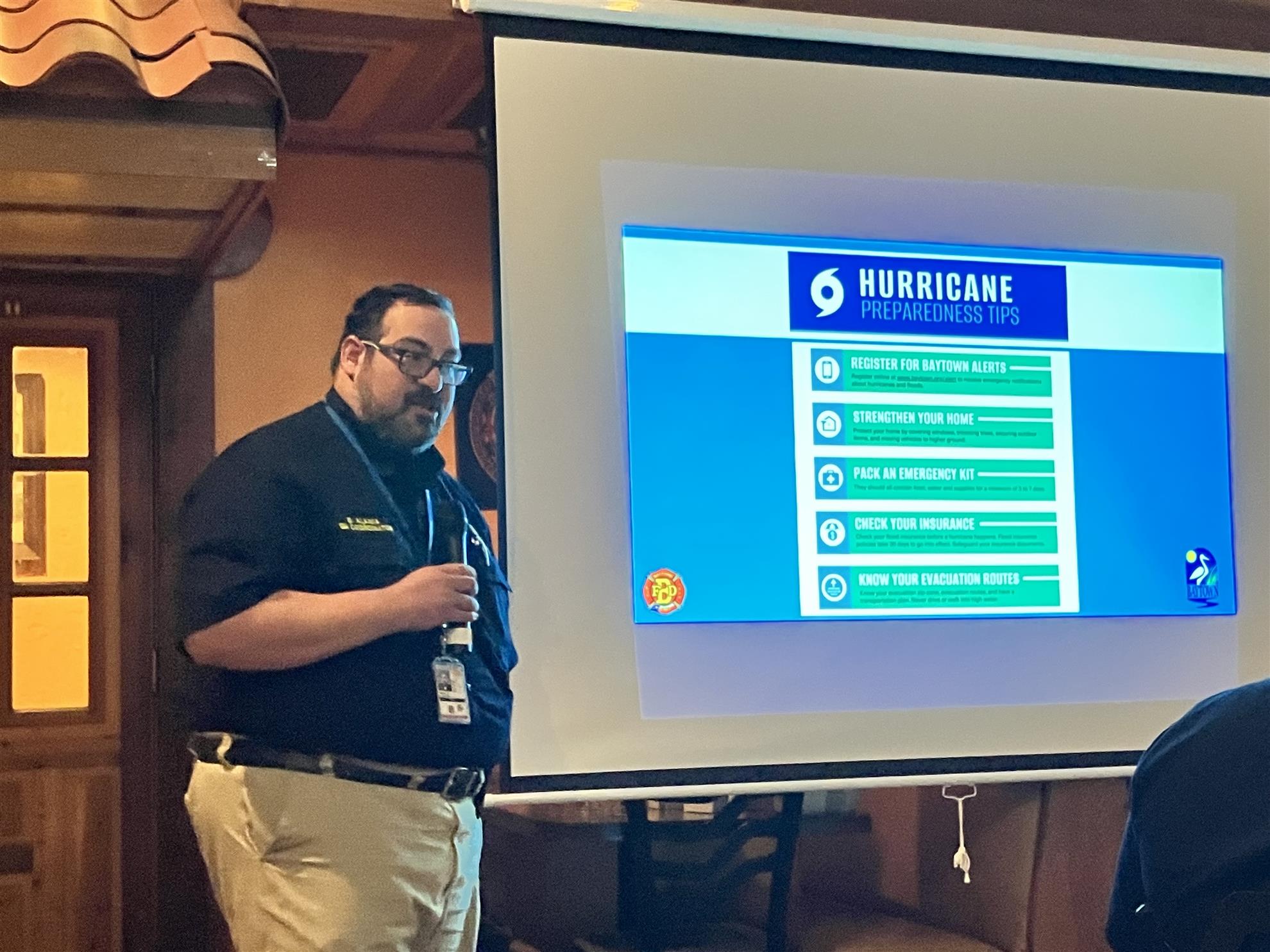
Alamia was at the Kiwanis meeting as part of National Emergency Management Awareness Month, giving tips on hurricane hazards, forecasts, evacuations, preparedness tips and how to stay informed.
Among the hurricane hazards Alamia discussed, he said to be wary of storm surges, which can cause catastrophic flooding. The storm surges can cause water to rise as high as nine feet along the shorelines around Baytown, according to a map he showed.
He said rip currents, which are powerful currents of water that move away from the shore, can sweep even the strongest of swimmers away from the beach.
There is also inland flooding, which occurs when powerful storms move over land and dump massive amounts of rain into streams, rivers and lakes despite losing strength.
This causes inland flooding that accounts for more than 50% of hurricane-related deaths every year, according to the National Oceanic and Atmospheric Administration. Tornadoes are another hazard to be watchful for in the event of a hurricane, as well as strong winds.
In the Atlantic Ocean, Hurricane Erin has been unleashing rip currents and waves along the North Carolina coast on Wednesday. It is the fifth named storm of the season.
The next storm will be called Fernand.
The 2025 Atlantic Hurricane season is expected to have between 13 and 19 named storms, with six to 10 hurricanes and between three and five major hurricanes. It also has a 60% chance of being an above-normal hurricane season.
Alamia emphasized the importance of knowing your evacuation routes in case you ever need to use them. You can find out about evacuation routes by visiting the Texas Department of Transportation Statewide Planning Map at https://bit.ly/45NVnjG.
“The other thing is, don’t wait for us to tell you to evacuate,” Alamia said. “If you look at those five hazards and you say this is going to be a risk, a threat to my home, my family, and you think you need to evacuate, then you probably should evacuate.
“It is wise to have a contingency in place to make a quick decision, but know your evacuation route.”
Alamia also recommended that folks register for Baytown Alerts.
“That is the way that we officially communicate during an emergency,” Alamia said.
People can register for the alerts at www.baytown.org/alert.
“You can download the app. You can register your cell phone, your home number, your email, and receive different information,” he said.
Alamia said that under Government Code 418, the county judge and the mayor will serve as the emergency management director.
“They are ultimately responsible for additional evacuation orders of the disaster declaration,” he said. “And they appoint us as emergency managers for the community.”
Alamia also encouraged people to check up on their homes.
“You can cover up your windows, trim some trees and secure any of your outdoor items so they don’t become projectiles during high winds,” he said.
Alamia recommended roofing clips for your home that help with high wind situations. He added that it was a good idea to pack an emergency kit.
“Always be prepared,” he said. “Make sure you have water and some extra medications up to three to seven days. We always tell people to be prepared.”
Alamia said they maintain a supply warehouse in Baytown for disasters.
“We have cases of products of water, MREs (Meals Ready to Eat), shelter and care kits and more,” Alamia said. “But we always promote self-reliance as well.”
Alamia recommended that folks check their insurance policy to make sure it covers damage during a hurricane.
“This is a big one for homeowners these days because it seems like prices are going up and up every time we have our policies coming at the end of the year,” Alamia said. “And people are looking and shopping for cheaper bargains out there and not necessarily realizing what they’re changing in their policy, and what’s covered.”
Alamia said to see if your insurance policy covers wind damage and flooding.
“Whether you’re in a flood zone or not, we know that the flood maps are not necessarily a true depiction of risk,” he said.
Kiwanis member Mike Wilson said it was important to remind people that a standard homeowner’s insurance policy does not include flood insurance.
“Even if you have never flooded, pay the $500 to $600 for flood insurance,” Wilson said.
Alamia said this was invaluable.
“Your homeowners’ insurance is not the same as a flood insurance policy,” he said. “They are separate policies.
“The flood zone maps are just insurance risk maps. They’re not necessarily based on the latest and greatest information on maximum risk precipitation and downstream effects. They’re just a set of insurance rates.”
Alamia said also to check insurance policies before a storm hits the Gulf of Mexico, “because your insurance policy, unless you’re buying a brand new home, does not go into effect automatically.
“If you buy an insurance policy today, it won’t go into effect until about 30 days after you start that policy.”
Kiwanis Secretary Renee Rhodes said that, regarding flood policies, there is usually a 30-day waiting period before the coverage goes into effect, but if there is a new loan on that property, they will waive that 30-day waiting period.
One issue that many encountered last year when Hurricane Beryl hit the area was the aftermath of waiting on CenterPoint to restore power. Some went about two weeks with no electricity. Alamia said CenterPoint was its own entity, but the city partners with them when it comes to a disaster.
“So, we’re in direct communication with the two service area managers,” Alamia said.
“We make contact with them every time we have a disaster and have direct contact with them. And then the headquarters office down in Houston.”
Alamia said he and Mark Guzman, deputy emergency management coordinator, joined the CenterPoint team and other local emergency managers to participate in their new hurricane exercise.
“They have a new emergency operations center they established over here in the Greenspoint area,” Alamia said. “But they made a huge investment in terms of a new emergency ops center downtown, which will be open in the next month or so, I believe.”
Alamia said he hopes that the restoration time goes down.
“(CenterPoint says) they’ve made a lot of investments into resiliency,” Alamia said. “They actually installed two weather stations. One near North Main over by Faith Family Church, right in front of it and another one over in the Beach City area. The city has also established three new weather stations. Those all help us in terms of making sure we know where the greatest wind impacts would be to help us pinpoint where we would have most wind damage on our infrastructure.”
Photo:
David Alamia, City of Baytown’s emergency management coordinator, recently spoke to members of the Kiwanis Club of Baytown about hurricane preparedness.
Sun photo by Matt Hollis