Promoting and Supporting Canadian Companies – Presented by Marnie Scott
Nancy Morris introduced our speaker for the evening.
Marnie graduated from John Taylor Collegiate in St. James and went on to attend the University of Manitoba, Faculty of Arts. As she took a few geography and economics courses, Marnie quickly found that she was interested in figuring out how to develop the economy and create business and employment opportunities for Manitobans and Canadians.
Marnie earned her Master’s Degree in Regional Economic Development as well as various Masters of Business Administration credits. Throughout her entire career she has been involved in identifying economic and business development opportunities, developing strategic capture plans and executing those plans to grow and support Canadian business.
Marnie has worked for the Government of Canada, the Government of Manitoba, corporate Canada and most recently as a consultant.
CANADIANCOOLFOODS.COM is the result of her experience and interest in supporting the Canadian agri-food sector. What still drives and inspires her personally and professionally is to help create good jobs for Canadians.
The agriculture and agri-food industry’s GDP is $111 Billion ($11 Billion in Manitoba). It is the 3rd largest employer in Canada (agri-food sector):
• Agri-Food employs 2.3 million Canadians
• 1 out of 8 jobs in Canada is dependent on agri-food
• 12.5% of total employment in Canada is agri-food related
Canada imports almost as much food as we export. In the past, Marnie travelled a lot for her employment. During her travels she was not very impressed with the food production practices and quality control in some of the countries that we import our food from. This was one of the reasons that Marnie developed CANADIANCOOLFOODS.COM. She quickly realized, that we weren’t:
- feeding ourselves
- supporting value-added processing
- manufacturing using Canadian ingredients
- promoting actual Canadian foods to Canadians.
Canada is the 5th largest agricultural exporter in the world. In 2016 Canadian exports reached $62.6B and included seafood. In Canada, 90+% of farmers are dependent on exports. These are raw, unprocessed commodities. 40% of our food processing sector is dependent on exports. These are for the most part, limited processed foods such as dairy, eggs, meat, canola oil. Just like in Canada`s resource sectors, most of our products are basically raw material for other countries to add value and make the big profits.
The following are our top exports (mostly to the U.S.A.):
- 50% of our beef/cattle. (There are 10.1 million beef cattle Canada)
- 70% of our soybeans
- 70% of our pork. (26 million pigs are raised in Canada each year and is the world’s 3rd largest exporter behind the US and the European Union. MB exports $450M annually.)
- 75% of our wheat. (MB exports $1B per year)
- 90% of our canola. (In 2016, Canada contributed 67% to global canola exports. MB exports $1.1+ B per year.)
- 95% of our pulses
Canada imports many products that we could produce ourselves:
- Canada imported $43B in agriculture and agri-food products in 2015 - 23% more than in 2013. Most products are sold directly in supermarkets and used in restaurants.
- Canada is one of the top 10 importers of food in the world.
- 50% or $20B comes from the US. Canada is the 2nd largest export target for the US, with number 1 being China (only $2B difference).
- $16.3B of these US imports are high-value and support tens of thousands of US jobs.
Process and add value to the exports - replace imports:
- 17.3% of Canadian manufacturing jobs are in the food sector.
- 94.1% of these establishments are small businesses.
- The degree at which we add value to commodities is fairly limited.
- In Ontario and Quebec, more than 65 per cent of agricultural production is processed and sold as a value-added product.
- In the West, that number barely reaches 40 per cent. Typical of all sectors.
There are considerable opportunities for value add and growth of the industry across the country – turning commodities into products and selling to export markets but more importantly – selling Canadian to Canadians.
Labels in the Canadian food market can be very confusing:
Packaged in Canada, Grown in Canada, Prepared in Canada, Distributed in Canada, Product of Canada, Canada Grade A, Made in Canada, 100% Canadian, The list goes on….
What does ‘Made in Canada’ mean? Made in Canada can mean almost anything, from some or no domestic ingredients, to some or considerable offshore “transformation”. According to the Government of Canada, the ‘Made in Canada’ claim may be used when the food product is manufactured or processed in Canada regardless of whether the ingredients are imported or domestic or a mix of both.
If the food product contains some food grown by Canadian farmers, it can use the claim "Made in Canada with domestic and imported ingredients." If all of the ingredients have been imported, it can use the claim "Made in Canada from imported ingredients.”
To use these qualified claims, the last substantial transformation of the product must have occurred in Canada.
To be a ‘Product of Canada’ the item must have no less than 98% Canadian ingredients, processing and labour. The web site was created to assist the consumer identify those products that are truly ‘Products of Canada’. Marnie had a new personal mission: To help Canadians find truly Canadian foods and beverages by developing a website to make the information public. The site is essentially a big database. The site is free to use and free to have product listed. There are currently 3,500 products and 370 companies in the database. Marnie now has a free, unique and independent website designed to help Canadian companies satisfy the growing demand of Canadian consumers, chefs, retailers, wholesalers, distributors and manufacturers who are looking for truly Canadian ingredients, foods and beverages – as well as new business opportunities.
Manitoba has 64 companies with a total of 405 products listed on the website. Use the site to help ‘Canadianize your Meals’.
The site does not accept advertising. The pages include: Home, Welcome, Who We Are, Shopping List, News, Cook Book, Contact, Our Companies, Supporters, Wish List.
- The company page has 330 companies listed that have forwarded their logo.
- The Shopping List page allows you to search for organic, non-gmo, gluten free
- You can search for food items by product type or by company name.
- The Future page will have product coupons made available as well as blogs for companies to post on.
Please be advised that the data / stats in this article have been sourced from various government publications and other sources. Some material may be outdated.
(DGM for Marnie Scott)
Q/A
1. Bob Antymniuk surmised that the web site is a passion of hers, what is/was your actual employment?
A. Worked in the aerospace defence sector in procurement. She was involved in analyzing the offsets (Value Proposition) as it related to purchase contracts. For example, Canada will purchase $3 Billion worth of a company’s airplanes. How will the company do $3 Billion worth of business in Canada to offset the purchase? This is done to try to develop jobs and economic activity in Canada.
2. Will Kurtz questioned how a company gets evaluated to get on the web site?
Lloyd Talbot thanked Marnie for her informative presentation. Lloyd stated that he “loved her enthusiasm”. Marnie was advised that a donation in her name would be made to ShelterBox in appreciation of her time spent with us tonight.



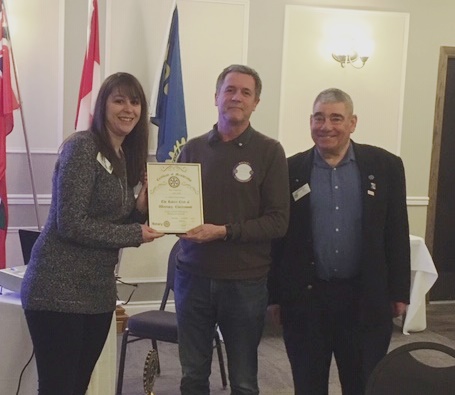 President Mandy asked Iain Scott to come forward with his proposer, Ed Thompson. President Mandy read through the new member induction ceremony document and placed emphasis on the ‘Service above self’ portion of the statement; as the club likes to encourage this ideal. Ed Thompson placed the Rotary wheel pin on Iain`s collar, after the presentation of the framed certificate of membership.