|
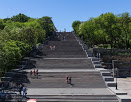
Nancy Morris introduced our guest speaker and his wife to the club. David was a Charleswood Rotary Club member prior to their move to Whistler, B.C. He joined a local Rotary club in Whistler when he arrived in the community. David started by thanking the club for the invite to come out and speak about their travels to Ukraine. They wanted to get on the ground and learn something on their own. They were interested in the historical and political stories of the area. David has had a keen interest in Russian history from way back. His presentation included many pictures of the areas that they traveled to with a little history of each location. The trip had them visiting 9 cities in Ukraine that varied greatly in size and age. Ukraine is situated along the 49th parallel, so similar weather there as here in Canada. The land mass of the country, if lined up at the Manitoba/Ontario border, would stretch out to the west to the Calgary area. There are 42 million people in the Ukraine. There are 7 countries neighbouring its borders with 235 million people in those countries. The Ukraine has access to deep water shipping, Black Sea ports – Mediterranean Sea – Atlantic Ocean. 1.-Lviv (Lvon, Lemburg) was their starting point. The international airport here is very close to the Ukraine / Polish border. They met their local, private guide here for their custom tour. The city was settled in year 850. There are ~ 1 million residents. The city has changed flags many times over the years. Vikings, Polish, Hungarian, Russians. Independence was declared in 1991 from Russia. The architecture in the city is very typical for Europe with 4 story buildings standing in rows along the streets. 2.- Ternopil was the second city visited. The city was smaller with only 219 thousand residents. It was founded in 1540. It considers itself a University town. 3.- Khmelnytsky is a city that was named after the Cossack leader that fought for the independence of Ukraine lands in 1648-1657. The city was founded in 2000B.C. This is an industrial city. 4.- Kiev is the capital city of Ukraine with a population of 3 million. A village was founded at the site of the city in the year 450. Kiev was declared a city in the year 900. The city sits along the Dnieper River that flows to the Black Sea. This is where the Malahers boarded a Viking River cruise. Kiev is a glamour and money city. 5.-Kremenchuk has a population of 224,000 and was founded in 1571. The first printed book in Ukraine came from here in 1437. The literacy rate in Ukraine is very high. 6.- Dnipropetrovsk (Dnipro -2017) was founded in 870 and was accepted by Empress Catherine of Russia in 1787. This is a large size city with a vibrant Arts scene. Dnipro is a city on the Dnieper River in central Ukraine. Missiles in Rocket Park mark the city's role in the Soviet-era space and defense industries. The Jewish Memory and Holocaust in Ukraine Museum is part of the Menorah Center, a Jewish cultural and business complex. The Art Museum includes paintings and sculptures. Nearby, the D.I. Yavornytsky National History Museum explores archaeology and Cossack history. (Google Search) The City has a population just short of one million people. 7.-Zaporizhia, location of the Dnieper Hydroelectric Station, which was built between 1927 and 1932. Power was generated in 1932. The dam was destroyed by the retreating Soviets in WWII. It was rebuilt between 1944 and 1950. 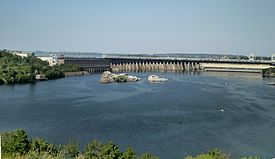 At the time of its initial construction, the Dnieper Hydroelectric Station was the 3rd largest in the world, 550MW, following the Hoover Dam, 705 MW, and the Wilson Dam, 663 MW, in the United States. Stalin hired engineers from General Electric to help with the construction as well as provide the actual generators. This dam allowed the Dnieper River to be navigable, flooding rapids in the area. There is a single lock at the dam. It moves vessels through the ~ 100-foot elevation change at the dam. Zaporizhia was founded in 1770 and has a population of 800,000. It is an important industrial centre producing steel, aluminium, aircraft engines, automobiles, transformers for substations, and other heavy industry goods. All possible due to the readily available hydro-electric power. 8.- Kherson was founded in 500B.C. by the Greeks. This is where the Silk Road split into northern and southern routes. The city is on the northern route. It has a population of 295,000. The city is in the south of Ukraine and is an important port on the Black Sea and Dnieper River, and the home of a major ship-building industry. There are corn mills as well as oil infrastructure. This city was also accepted by Catherine the Great in 1778 and occupied by the Russians at that time. 9.- Odessa is located on the northwestern shore of the Black Sea. The first settlement here was ~450B.C. by the Greeks. The current population is 1.2 million. In 1794, the city of Odessa was founded by a decree of the Russian Empress Catherine the Great. The Duc de Richelieu was appointed as Governor of Odessa in 1803. Its early growth was due to the work of the Duc de Richelieu, who served as the city's governor between 1803 and 1814. Having fled the French Revolution, he had served in Catherine's army against the Turks. He is credited with designing the city and organizing its amenities and infrastructure and is considered one of the founding fathers of Odessa. Richelieu is commemorated by a bronze statue, unveiled in 1828, at the top of the Odessa Steps. To see Swan Lake performed at the Odessa Opera House was truly grand! Of interest is that all the photos shown during David`s presentation were taken with a cell phone. What is next for Ukraine? The Ukrainian cultural identity is solid. The art, music, dancing and food are all in good shape and look to be strong going into the future. Education is also strong. Lviv University is thriving. The tragic events in the country`s history should be mentioned here: 1.- Holdomor; a famine in 1931-1933 when one million Ukrainians died. This is when the Dnieper River Hydro-electric dam was being built. Stalin wanted the grain to be sold abroad for an input of cash to pay for the dam. He ordered that the farms be operated as collective farms. This did not work. More wheat was put on the market, the dam was paid for, but the Ukrainian people were left to starve without that wheat. 2.- Holocaust; In 1941 -1945, WWII Jewish people as well as others were systematically murdered. This happened across Ukraine as well. The major cities of the Ukraine had Jewish populations at the start of the war in the 10% to 30% range. Most were dead by the end of the war. 3. Chernobyl disaster; On April 25 -26, 1986…The event occurred during a late-night safety test which simulated a station blackout power-failure, in the course of which safety systems were intentionally turned off. A combination of inherent reactor design flaws and the reactor operators arranging the core in a manner contrary to the checklist for the test, eventually resulted in uncontrolled reaction conditions. 70,000 people were poisoned, and 150,000 people were relocated. The prevailing winds were to the east during the explosion and fire, resulting in most of the fall-out landing in Belarus, Russia and Ukraine. There was measurable radiation in all of Europe and around the globe. There is a lure to the past in Ukraine. There is no shortage of churches, monasteries and fortresses to view. One photo shown was a huge, ornate interior of a church. The church was actually new. Millions of dollars are being spent on such structures. This would seem to be an attempt to soften the burden of the very hard life that many Ukrainians live. On June 13, 2018 the Minister of Agriculture in Ukraine stated that the Ukraine has “extensive fertile lands and is one of the largest grain exporters in the world”. They need to improve grain movement logistics. Ukrainians have the lowest personal incomes as well as the lowest GDP in Europe. Poverty is on the increase as is corruption. Photos of ½ starts of construction projects were shown. A bridge foundation with no bridge, and a “super-highway” that is way under-built. Most roads are in terrible condition, but roadside stops are excellent because they are built by the big oil companies. Ukraine should have elections every 5 years. The Ukrainian presidential election of 2010 was Ukraine's fifth presidential election since declaring independence from the Soviet Union in 1991. The first round was held on January 17, 2010. The run-off between Prime Minister Yulia Tymoshenko and opposition leader Viktor Yanukovych followed on February 7, 2010. On February 14, Viktor Yanukovych, with 48.95% of the popular vote, was declared President-elect and winner of the 2010 Ukrainian Presidential election. Most of his support came from the Russian speaking areas of the Ukraine. The northeast and the south. Eventually Yanukovych chose to align with offers from Russia regarding financial aid and gas pricing. He rejected aligning with the European Union. This caused uprising and riots in Kiev. The end result was Yanukovych leaving Ukraine for the safety of Russia. (Wiki) During this period of unrest, the Russians took advantage of the situation and invaded Crimea and eventually annexed it. Crimea is an area that is closely aligned with Russia by language and history. They were being ignored by the Ukrainian government since the 1991 independence of Ukraine. Crimea was the forgotten land. There is only a 9Km. wide swampy piece of land connecting Crimea to the rest of the Ukraine. Very much like an island. There is now a new bridge (May 15th, 2018) over the Straight of Kerch as well as regular ferry service to Turkey to the south. The bridge at the Straight of Kerch is actually the best thing that could have happened to Crimea. The Russians wanted Crimea for transportation reasons. They gain a deep-water port at Sevastopol. David told a story of a family that lived in the middle of Crimea and didn`t want to become Russian citizens. As part of leaving, they suffered financially as their home was expropriated for ½ of the actual market value that it had prior to the annexation by Russia. The GDP in Ukraine is $8,667 pp/yr The GDP in Russia is $25,000 pp/yr The GDP in Poland is $29,000 pp/yr The GDP in Moldova is $5,700 pp/yr Very corrupt place. Black market is thriving, no taxes being paid, or income declared. Countries like this are a free for all. Q/A - Jim Forestell questioned where the money was coming from to build the ornate churches?
A.- The Church itself, Government, Russian 2.-Nancy Morris questioned where the people settling villages in 2000B.C. came from? A.- Asiatic peoples coming from the east moving westward, crossing the Volga River and raising cattle. Archeological digs confirm these findings. 3.-Lyle Miller, where did the displaced people from Crimea go? A.- Anywhere…Ukraine, Poland, Germany. They were accepted into Ukraine as a family refugee. Peter Tonge thanked both David and Rosemary Malaher for visiting with us tonight. We all know so much more now than we ever did about the Ukraine. We truly appreciated your talk. David was advised that a donation would be made to ShelterBox in his name. |