Understanding The Past – Moving Forward Together
Presented by John Currie
Nancy Morris introduced our speaker for the evening. Mr. John Currie is the Executive Director of HIP. He lists the following about himself: Executive Director (ED) | Board of Director (AGE) | Cultural Adviser | Global Goodwill Ambassador (GGA) | Community Builder | Humanitarian | Speaker | Nonprofit | Fundraiser | Entrepreneur | Volunteer | YIR.
As Executive Director for HIP, John is passionate about ensuring all youth have equitable education opportunities and believes every student should have access to digital learning. John is also currently serving as Vice-Chair for AGE Inc. Board of Directors, a national non-funded not-for-profit social enterprise committed to enhancing the care of older adults through dementia education products and services.
Prior to joining HIP and AGE, John was an Associate with Casual Effects, Managing Director with the IT Agency and CIO of the Ontario Safety Association of Community & Healthcare, where he is accredited with directing business transformation and generating a notable uplift in revenue to decrease the agency’s reliance on government funding and fortifying data collection and retrieval.
John has received a certificate of appreciation from Ontario MPP Tracey MacCharles, as well as the recipient of multiple Symantec Corporation Management Excellence awards. He is the recipient of Financial Excellence award and the recipient of Rotary’s Service Above Self award.
John started his presentation with an explanation of why he and others were wearing orange shirts today.
Orange shirt day is a movement that officially began in 2013 but in reality, it began in 1973 when six-year-old Phyllis Webstad entered the St. Joseph Mission Residential School, outside of Williams Lake, BC. Young Phyllis was wearing a brand new orange shirt for her first day of school – new clothes being a rare and wonderful thing for a First Nation girl growing up in her grandmother’s care - but the Mission Oblates quickly stripped her of her new shirt and replaced it with the school’s institutional uniform.
While she only attended for one year the impact affected Ms. Webstad’s life for many years. “I finally get it, that feeling of worthlessness and insignificance, ingrained in me from my first day at the mission, affected the way I lived my life for many years. Even now, when I know nothing could be further than the truth, I still sometimes feel that I don’t matter.”
Ms. Webstad’s story is the nucleus for what has become a national movement to recognize the experience of survivors of Indian residential schools, honour them, and show a collective commitment to ensure that every child matters. The initiative calls for every Canadian to wear an orange shirt on September 30 in the spirit of healing and reconciliation.
The date, September 30, was chosen because that was the time of the year the trucks and buses would enter the communities to “collect” the children and deliver them to their harsh new reality of cultural assimilation, mental, sexual and physical abuse, shame and deprivation.
Rotarians are people of action. There are 720 Rotary clubs in Canada. There are 634 (Aug. 2019) First Nations in Canada. John thought it would be fantastic for each club to be closely associated with at least one of these First Nations. When First Nations peoples are asked what they would like more action on, the answer is most often asking for a focus on education.
HIP board has 20 members. The board is comprised of 50% Indigenous and 50% Rotary. It is also 50% female and 50% male. HIP has many partnerships which include Canada Life and Siemens.
HIP has a three-part mission;
- Promote Awareness
- Build Relationships
- Support Education
Promote Awareness – as simple as going out and talking to various groups. Change the narrative. A good example is the ‘1st Contact’ series available on APTN.com. Two seasons of 3 episodes each. Six random people are selected to experience a 28-day immersive experience as to what it is like to be aboriginal in Canada. The presentation to a group would include the presentation of the first episode of ‘1st Contact’ then have a panel discussion.
Build Awareness – The KAIROS Blanket Exercise is a workshop that explores the nation-to-nation relationship between Indigenous and non-Indigenous peoples in Canada. Blankets arranged on the floor represent land and participants are invited to step into the roles of First Nations, Inuit and later Métis peoples. As part of the exercise, the blankets are removed over time, forcing participants into smaller isolated spaces.
Another way to build awareness is to bring non-aboriginal youth together with aboriginal youth in their home communities and schools.
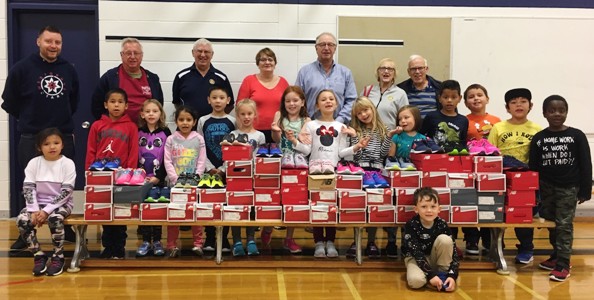
Support Education – HIP / Rotary wants to take action following what indigenous peoples have requested. The students in the north must travel to southern high schools. When arriving in areas like Timmins or Thunder Bay the students are billeted into homes. The homeowner gets $750 / month for taking in the student. The students have routinely asked for a new pillow and sheets without holes in them. Rotarians in the south have been putting together kits including pillow, blankets, school supplies. The kit box is then sent to the northern Rotary clubs for them to distribute the kits to the billeted students. The Rotary clubs act as a contact point for the students.
Rotary is supplying bursaries, computers for students, books (many with dual languages).
Student to Student Engagement
Nine students from Toronto wanted to take their STEM – robotic knowledge to the far north and share / teach the students there. They traveled to Moose Factory which is an isolated community and shared their knowledge with the indigenous students. In return the indigenous students taught the Toronto kids land based knowledge. They parted with contact information to be ‘study buddies’. The plan is to reverse this travel next year.
The school in the north can actually be in better shape than the school the southern students came from. The issue is that there is a lack of a full compliment of teachers to provide a complete curriculum. The hope is to have students from the northern communities become teachers and return to their home communities after graduation.
HIP Impact
- Awareness – 100 talks | 10 events | 31 newsletters
- Support education – 600 computers* | 500 books | $8K bursaries** | $2M+ education and wellness supplies*** | 1 Student to Student trips
- Building Relationships – 80+ Indigenous communities | 225+ Rotary Clubs | 100+ Partners | 1 MoU / MoF
{*refurbish computers / Siemens replaces all it’s computers every two years. Refurbished and donated}
{**trying to raise $25K for bursaries. This would be doubled by government to $50K. All to be managed by INSPIRE}
{***HIP has sent $2million + of supplies for students / education to the north. Partnership with trucking companies to ship pallets in empty space on truck loads heading into communities}
This all leads to CHANGE.
Most Rotary clubs have a trail or park that they are associated with. If each club could put up a plaque promoting HIP in these areas, the recognition factor for HIP would go way up! It would be fantastic if the plaque was made with English and a selected aboriginal language.
Funding
Almost all funding goes directly into programs. John is employed on a part time basis as well as one more individual (part time as well). These are the only employees. There are no brick and mortar spaces to pay for.
There is a 10 times multiplier related to value on any cash that is raised for programming.
The cost to join HIP is $100.00 for an individual and $250 for a club. There is only one organization working on reconciliation in this way, it is Rotary through HIP.
Q/A
1.-Chuck Crocker asked if any Manitoba Rotary clubs are members of HIP.
A.- There are four clubs in Winnipeg with HIP committees. Mr. David Newman (R.C. of Wpg. Downtown) is the Regional Director for Western Canada. This is the area west of Thunder Bay, Ontario. HIP supports the actions of HIP chairs in each of these four clubs in Winnipeg. The Winnipeg – Downtown club has seven members on the HIP committee. They each automatously take on a project for HIP. The downtown club has a $40K fund for reconciliation projects.
The four Winnipeg club HIP chairs meet every 2 months in an aboriginal centre. Clubs share ideas and work along best practices.
2.- John Melnyck had an observation to bring forward. He advised that most young people join groups to support a cause they believe in. Rotary needs to spend time talking to younger people about HIP. This will potentially get them into Rotary meetings which could lead to them becoming member prospects. All to support HIP.
3.- Jim Forestell asked if there are partnerships with government agencies.
A.- Need to be cautious of this. HIP does not want to take money away from existing programs. HIP wants to build new opportunities. There is a federal government program to teach financial literacy. Programs exist, but the issue is delivery of the program. HIP needs to teach the teachers.
David Newman advised that there are memorandums of understanding existing with U. of Winnipeg, U. of Manitoba, CMHR, 1st Contact, Manitoba Sports and Recreational Council. Also, the alliance with Rotary. HIP needs to hear what the needs are from the communities. The best way to deliver the programming / support is through the schools. HIP wants to develop trusting relationships with young people and teachers in schools. Do not treat ourselves as a charity.
HIP is a charity as far as taxation is concerned only.
4.- Ed Thompson mentioned our club working with Westgrove School.
A.- David Newman said this is an excellent program. If the Charleswood club joins HIP we would get the newsletters. This is a library that provides a history of what HIP has done in the past. This will give joining clubs ideas for action.
Martin Labossiere thanked John Currie for his informative and thought-provoking presentation. He advised John that a donation in his name would be made to ShelterBox.
President Mandy Kwasnica thanked John Currie for his presentation as well. She stated our appreciation for his coming out to Breezy Bend to talk to us tonight.