|
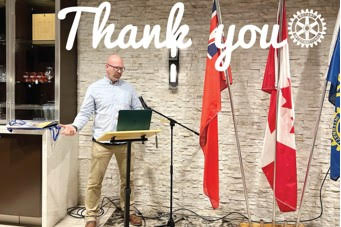 Tonight's guest speaker is Graham Todd, owner of Reliable Mobility. Tonight's guest speaker is Graham Todd, owner of Reliable Mobility.
Graham became an entrepreneur in the healthcare field in 2012 after many years in the hospitality industry to chase a more community minded focus as he started a family with his wife, Anita. Graham started as an advocate for people living with disabilities professionally and focused on brain injury both on a provincial and federal level through his work as Co-Chair of Brain Injury Canada, Board Member for Stroke Recovery Association of British Columbia as well as March of Dimes Canada. The focus on brain injury came through his own issues receiving services and support for concussion and post-concussion complications from years of rugby, equestrian and other youthful endeavours. Graham told us “My goal when starting my journey with the Manitoba Brain Injury Association (MBIA) was to focus the organisation on what could effectively have the most impact on Manitoba and grow that focused service throughout Manitoba. The hope is to increase the number of services provided in the years to come. This will make us an indispensable member of the brain injury community, not only for our clients as service providers but for funders and government to finally understand the value of the services that brain injury has been lacking provincially. This goal is not a small undertaking and may take many generations of Directors to solve so I look forward to watching this organization's progress for a long time to come”. Graham advised that he would explain how he got into the mess of being on 6 different boards from B.C. to Ottawa. He immigrated to Canada on Nov. 8, 1998. He had experienced his first concussion on the streets of Belfast because he was wearing the wrong soccer jersey in the wrong part of Belfast. He would experience 26 more concussions over the years. Most of his injuries occurred at the ages of 22 to 23. A history of his employment includes working for Peter Nygard in the Bahamas. Then many years of employment at Lake Louise – Fairmont where he had great mentors. Next was a move to Delta Hotels where he was the youngest Executive Director at the time. He then became a consultant in the Hospitality Industry. He would change things up by becoming a member of a ‘Close Protection’ company providing service to the Royal Family in Qatar. Then providing the same service to Russian oil company executives. Graham believed it was time to settle down and have a family. He could think of no better place to do that than in Winnipeg. He originally wanted to develop a company along the lines of Diamond Athletics. However, a slight change of direction took place, and he has developed ‘Reliable Mobility’ in Winnipeg. Retail store and assistance for seniors and pediatric complex rehab situations. He now has time to give back to the community. Brain Injury would be the focus of that work. His ongoing pain had caused him to scratch his scalp violently to the point of bleeding. This was in the attempt to get rid of his chronic pain. Something similar to the action known as ‘cutting’. He worked his way up in the Manitoba Brain Injury Association (MBIA) to becoming the President of the Board last year. This was something that he could take across Canada. He was invited to the Canadian Board. The federal and provincial Brain Injury Boards are completely separate. The goal would be to bring them together. Talk at the National level while fundraising at the local level. The programming run by MBIA are not covered by provincial funding. The MBIA operates through grants, group fundraising walks, Winnipeg Foundation. In order, the three main causes of brain injury are: - Car Accident
- Intimate Partner Violence
- Sports
There are 200,000 concussions per year in Canada. 55,000 brain tumors per year in Canada. Stroke is the third leading cause of death in Canada. The Brain Injury Board wants to bring more attention to ‘Stroke’. The Board wants to get brain injuries such as these recognized as a priority for treatment. In senior care, a patient that has fallen and broken a hip will have almost all the medical focus on the hip, nothing on the possible head injury until it may be too late. MBIA focuses in three areas: - Support
- Advocate
- Education
During and after Covid, MBIA lost youth and caregiver support groups. They are working to bring them back. When there is a brain injury, the entire family is affected. Support groups exist in Winnipeg (2x / week), Steinbach, Brandon, Selkirk. A major event produced by the Manitoba Brain Injury Association is the P.A.R.T.Y. Program (Prevent / Alcohol / Risk related / Trauma in / Youth). This event has 300 to 400 youth attend to take part in a mock car crash and all the associated events that would include. RCMP and STARS helicopter / staff are present. There is a mock dog death included, a funeral and full burial. Right now, this is only in Winnipeg, but they hope to expand to other locations. The PARTY program has the largest impact on youth. The MBIA organizes 150 Wellness Calls twice a week in Winnipeg. There are many volunteer opportunities available. They are working towards the National and Provincial associations working together. Q/A: Lloyd- is cerebral palsy considered a brain injury?
A. Yes & No. The MBIA will work with the Cerebral Palsy Association. Dave S.- Just some advice to never apologize for emotions coming forward during your speech. Jagdish – concussion symptoms vary widely. What symptoms did you experience?
A. Sensitivity to noise, light and headaches. Always advise to seek out assessment from a doctor. General rule would be: avoid sugar, avoid T.V., increase sleep and increase healthy fats in diet for awhile. Len- support groups are very important. Finding humour in those support groups is very important as well. Ed Thompson – contact sports have come a long way regarding helmets. Are you involved in helmet design?
A. At the National level this exists. There is currently a study at University of Calgary funded by CFL, NHL, NFL. Caroline – is there a time limit for diagnosis to be done?
A. The longer you leave it, the longer recovery time will be. Jack D. – We have come a long way. Most do wear helmets now for contact sports and biking, skiing.
A. 100% agree. Those that didn’t were ignorant of the consequences of not wearing a helmet. Coaches were to blame in the past but have increased their understanding now. |

.png)