|
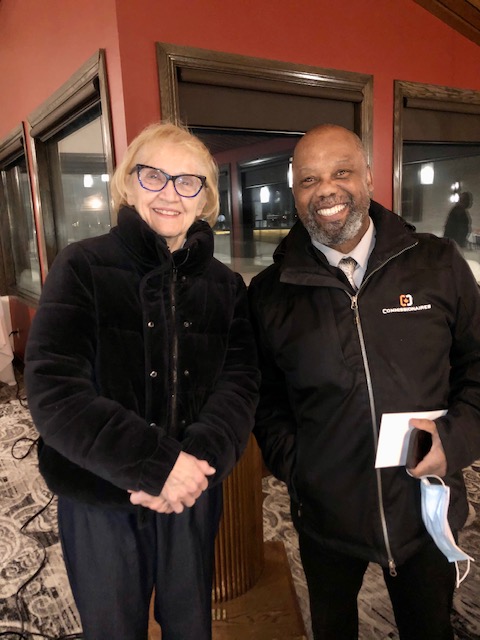 Andre Sheppard - a member of Black History Manitoba’s Celebration Committee whose function is to educate the youth and everyone else about Canadian Black History (which is not in the curriculum). Andre Sheppard - a member of Black History Manitoba’s Celebration Committee whose function is to educate the youth and everyone else about Canadian Black History (which is not in the curriculum).
- He is a presenter of the Community Voices Series project, a program that was created by the Manitoba Museum and Black History Manitoba.
- He retired from the Royal Canadian Navy after 36 years of service.
Black History Month was started in 1926 as Negro History Week in the United States by Dr. Carter Woodson. He chose February because it was the birthday month of both Abraham Lincoln and Frederick Douglass (an abolitionist). Black History Month arrived in Canada in 1995. The Manitoba Museum got together with Black History Manitoba in 2021 to teach virtual lessons on Canadian Black History. These started in February and went on into June, with schools between Vancouver and Ontario participating. This year the program is booked up to the end of March and involves schools from Vancouver to Halifax. Andre’s talk covered Black history and migration at each Canadian province, starting with BC. British Columbia: The government of BC invited freed slaves in California to come to Canada and start a new life. Blacks that came to BC were treated as equals when they arrived. They had their own militia (since Blacks were not allowed to join the military in Canada until 1916 – and even then, they were in a construction battalion – not allowed to carry guns or have bullets, just shovels and pick-axes). Hogan Alley, where the Blacks settled in Vancouver, was eventually destroyed in order to build a viaduct. There’s a move afoot to get rid of that viaduct and build a national historic park there. Alberta: The migration of Blacks to Alberta came up from Oklahoma as cattle drives worked their way into that province. Among them was the folk hero John Ware, a cowboy who started off as a slave in South Carolina, moved to Montana with the cattle drive, from Montana to Texas then to Alberta where he ended up having his own ranch in the Red Deer area. He died after being bucked off his horse one day. (Interesting notes: At ranches, white men were called “cowhands”, black men were called “cowboys”, and at one point it was illegal to be Black in Edmonton.) Saskatchewan: Like in Alberta, Blacks came up from Oklahoma to Saskatchewan with the cattle drives. In addition, like in BC, freed Black slaves had been invited to come to Saskatchewan to start a new life. About 800 of them immigrated all at once and settled in the Lloydminster area. Manitoba: Andre could find no history of freed slaves coming to Manitoba. Every so often one hears about George Bonga, who was a Black fur trader working for the Hudson Bay Company. William Beal was a well known photographer of rural life in Manitoba. John Arthur Robinson came to Manitoba from the West Indies in 1909 and when he learned that Black train porters were excluded from the railway union, he started the Order of Sleeping Car Porters in 1917 for the black workers. It was the first black union in all of Canada. Apparently, the largest immigration of Blacks in Canada is in Manitoba. Current students with African roots call themselves “African-Americans” because they learn all about Black history in America on TV but nothing about Black history in Canada. When he speaks to those students from Africa, he explains that they are not American and if they are Canadian – and have only one citizenship, then they are Canadian. If they have dual citizenship, that would make them African-Canadian (as opposed to African-American). He encountered this when he worked as a recruiter for the military. By exploring Black history in Canada, he learned a lot himself. For example, he learned that the first Black man who joined the Royal Canadian Navy joined in Winnipeg. This was Percy Haynes (owner of the restaurant called Haynes Chicken Shack), who was born in British Guyana in 1911. Ontario: The immigration into Ontario came from two directions -mainly from the “underground railroad” (the different routes taken by Black Loyalists – i.e. freed slaves - from the US to southern Ontario after the American Revolution). Richard Pierpoint was one of those freed slaves who settled in the Niagara Region then participated on the Color Corps with the British in the War of 1812. The other route was the one Black Loyalists took into Nova Scotia, New Brunswick and PEI. Quebec: The first black slave in Canada was – seven year old Olivier Le Jeune, who was sold in Quebec, where he spent the rest of his life. The kind of jobs available for black people in Quebec later in life were either to be a porter or a barber (i.e. not many opportunities!). New Brunswick: had many Black communities of people that had fought for the British side (i.e. Black Loyalists) during the American Revolution and had been promised land and a new life. Willie O’Ree (born in Fredericton, NB) was the first Black hockey player in the NHL. The arena in Fredericton has been named after him in 2008. In January 2022, Willie watched remotely as his Boston Bruins jersey (#22) was retired to the rafters of TD Garden in Boston. Apparently its replica hangs from the rafters of every NHL arena. There are still a few Black communities in New Brunswick. Nova Scotia used to have all the large black communities – but this is down to just one – North Preston. Halifax had Africville (no running water, no sewage, all old houses) which has been there since the Loyalists came to the province and which consists of prime real estate. The city of Halifax wanted the Black community to move from Africville and become part of the city. Because the Africville residents refused to move, Halifax established a city dump in the middle of Africville. The residents of Africville, seeing what all the white people were throwing away, used the dump as a resource (e.g. furniture) for their own purposes. So the dump didn’t work in getting the Africville citizens to move out. Then, realizing the importance of Africville’s church to the community, the city destroyed the church then helped the community members move into the slums of the city. Africville is now a national historic park. However, the city has also designated the area as an off-leash dog park. Every year, every August, when they do “Africville Days”, the area has to be cleaned up for visitors. In the Halifax area, the communities are all mixed now with the exception of North Preston. Prince Edward Island: There is one Black community left in PEI and that’s in Charlottetown. Newfoundland: There are no Black communities in Newfoundland. Following the presentation, in response to questions, we learned: That there is a separate history of the Blacks that experienced the Halifax explosion versus the Whites that experienced the same blast. |
.png)