Jack Wilson introduced our guest speaker tonight, Mr. Henry Nelson. Jack believes they met over 30 years ago and in addition to that connection to the Charleswood Rotary Club, Henry is related to Sarge Lyle through Lyle`s wife, Norine.
Henry Nelson- Retired Vice-Chair Manitoba Forage and Grassland Association (MFGA), was Project Manager, Phase one, MFGA Aquanty Modelling Project on the Assiniboine River Basin (ARB) which ended March 31, 2018.
Henry is a retired Agrologist with a BSA (animal and plant science) and MSc (weed science) and permanent employment experience with University of Manitoba, Monsanto and the Manitoba Government in weed control, crop insurance, farm mediation, farmland ownership, sustainable agriculture and agri- energy. One of his responsibilities in sustainable agriculture was administrative support to the Market Incentives and Fiscal Policy Sub- Committee of the Premier's Round Table on the Environment and the Economy.
Henry and his wife Lynda own a small farm along the Assiniboine River near Portage la Prairie, where they have produced grains and oilseeds along with forage crops and raised sheep and direct marketed lamb. Now that the land is rented and the sheep are sold they spend their spare time tending to their dog, cat and 3 horses. He met Jack Wilson (a few years ago) in Portage la Prairie through the Chamber of Commerce.
The study of the Assiniboine River Basin (ARB) starts with the story of AQUANTY. A company developed to manage water resources with advanced computer simulation. This is a company that was developed out of a collaboration of individuals at the University of Waterloo, Ontario. The founders were Ed Sudicky, PhD, P.Eng., Rene Therrien, PhD, Peter Forsyth, PhD.. There are a total of 19 individuals listed on the company website. The original work was done with models. This did not allow for interaction of the different layers in the ground. Complicated formulas needed to be developed to allow for how the water would flow from one level in the soil to the next. This would not transfer very well to the real world outside of the lab. A decision was made to team with IBM to use computers for the calculations. This was in a time where computers were just found in university settings. AQUANTY was created to bring the science out into the real world. The process is called HydroGeoSphere (HGS) modeling. HGS users are world wide.
Many factors go into the computer modeling such as; topography, surface moisture, soil moisture, ground water, geology - to list just a few.
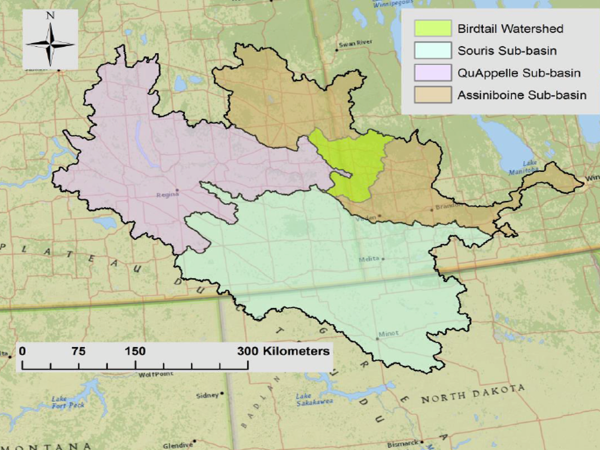
There are 3 to 5 million data points in the Assiniboine River Basin (ARB). This covers 155,000 squ.kms. in Manitoba, Saskatchewan and North Dakota. There are 3 sub-basins in the ARB; the Qu`Appelle, Souris and Assiniboine. There was an extra effort put into the data recorded from the Birdtail watershed area as it affects the Virden area. Due to flood and drought, the financial losses in agriculture and personal material losses have added up over the years. The Manitoba Forage & Grassland Association (MFGA) Aquanty Project can help to identify the mitigation potential of perennial forages and grasslands in the Assiniboine River Basin.
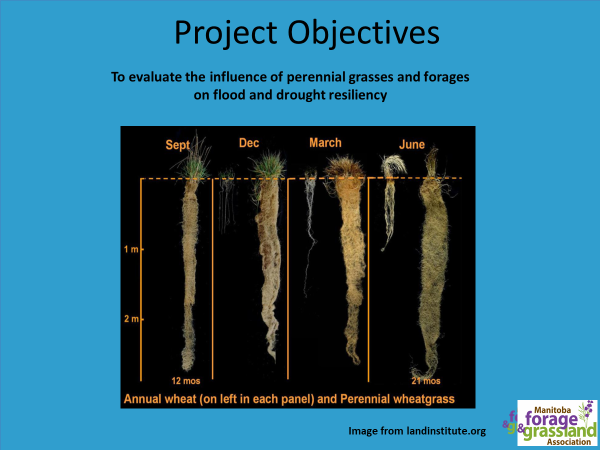
The difference in the root structure of annual grasses vs perennial grasses is incredible. The annual grasses are very short and provide very limited moisture holding capacity. The perennial grasses have huge root structures and have high moisture holding capacity as well as help to hold snow cover in the winter.
There is a web based portal being developed by Information Systems Management (I.S.M. an IBM company) in Regina. Their dashboard will allow multiple users to use the HGS data for their own farm/land or a region of the ARB.
The MFGA`s Aquanty project has a budget of $1.7 million. There is $1.1M from the Federal Government and $180,000 provided by Manitoba Agriculture for the two-year project. The remaining funding was provided by partners and supporters.
Manitoba Forage & Grassland Association is working with key stakeholders through a small Project Management Team and a broader Steering Committee to create awareness/interest in the model and obtain feedback on future development needs.
Steering Committee
- Manitoba Forage & Grassland Association (MFGA) Co-Chair
- Assiniboine River Basin Initiative (ARBI) Co-Chair
- Keystone Agricultural Producers (KAP)
- Agricultural Producers Association of Saskatchewan (APAS)
- Manitoba Beef Producers (MBP)
- Manitoba Conservation Districts Association (MCDA)
- Upper Assiniboine River Conservation District (UARCD)
- Brandon University (BU)
- Assiniboine Community College (ACC)
- Manitoba Agriculture
- Manitoba Infrastructure
- Manitoba Sustainable Development
- City of Minot
- Town of Virden
Additional Support / Cash or Letters of Support
- Manitoba Canola Growers Association (MCGA)
- International Institute for Sustainable Development (IISD)
- Manitoba Habitat Heritage Corporation
- Manitoba Agricultural Services Corporation (MASC)
- Prairie Improvement Network (PIN)
Present and Future
-First phase complete March 31, 2018
(mitigation potential of perennial & annual crops)
-Future - More detail development like Birdtail within the ARB (Virden/Scallion Creek)
-Perennial F&G (native & tame), (legumes & grasses), (haying , grazing & idling), (cover crops)
-Infrastructure scenarios and drainage questions
-Water quality and nutrient movement (Lake Winnipeg)
-Insurance product development (crop, overland flooding)
-Networking potential with other HGS models in Canada
-Other basins and watersheds in MB and Canada
The HGS study data gives land managers, governments and stakeholders the ability to predict how changes to the land, land use (plant cover), and the weather will prevent or reduce floods or droughts in the future. The HGS model uses forages and grasslands for their risk mitigation values and potential to reduce losses in the Assiniboine River Basin.
Henry Nelson, hlnelson@shaw.ca / (204) 896-3759
Duncan Morrison ~ Executive Director MFGA, duncan@mdga.net / (204) 475-2241
Q/A
1.-Bob Eilers, have the wetland drainage issues been brought into the study data?
A.-Not yet, possible in the future by another organization
2.-Jack Wilson, the goal is to slow the surface water flow?
A. Yes, plants / large roots hold the water until it has the opportunity to soak into the soil where it can do some good. Drainage is counter productive to this goal.
3.-President Bob Antymniuk, is Centre Port using enough water to impact this study?
A. Would need more information to answer that. Henry`s belief is that it has no effect.
The Assiniboine River Basin has a great amount of evaporation. Only 1% to 2% of the water that enters the ARB actually flows out of the Assiniboine River into the Red River.
Catherine Moltzan thanked Henry for his presentation tonight. She was advised that a donation in his name will be made to ShelterBox.