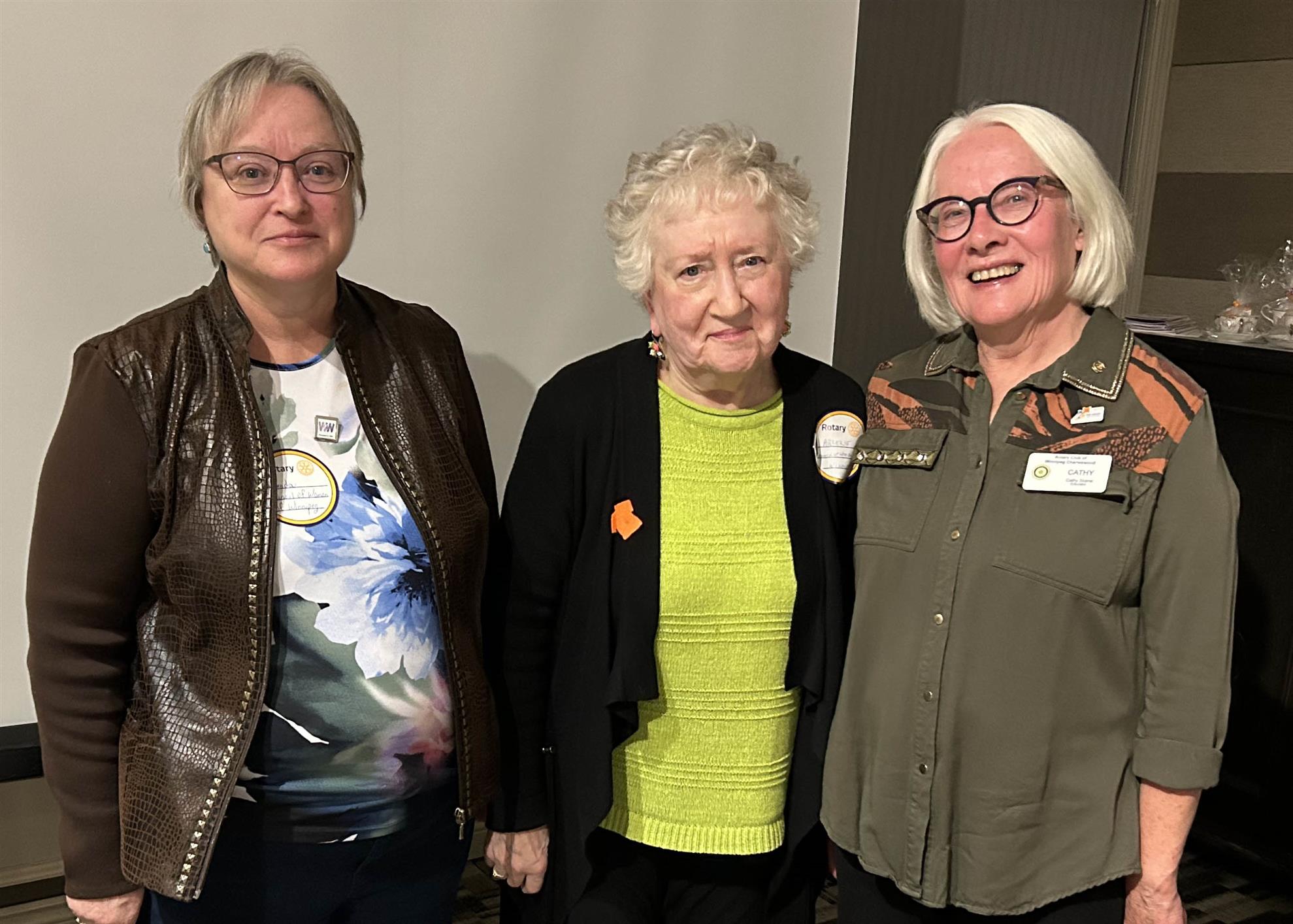
 After dinner, President Cathy introduced our guests.
“On September 28th, the Council of Women of Winnipeg held a luncheon to celebrate their 130th anniversary. You may remember that I shared that I held the door for the Lieutenant Governor. As you can see, she got in safely. This evening, we have with us two women from their group, who will tell us more about the CWW. Please welcome Brenda Buleziuk and Past President, Arlene Draffin Jones to present to the members the history of the Councils of Women.”
Brenda explained that the Council of Women of Winnipeg (CWW) was established in 1894, the organisation is a non-profit, non-partisan, non-sectarian, volunteer network of organisations (called federates) and individuals who advocate to improve the quality of life for women, families and the community. Through this network they liaise with the Provincial Council of Women of Manitoba, the National Council of Women of Canada and the International Council of Women, and are one of the few women’s organisations who have status at the United Nations - a voice for women around the world. Locally they hold workshops, forums, conduct research, present briefs on the environment, health, housing, safety and other issues.
They develop resolutions about issues impacting our community, work with the Provincial Council of Women of Manitoba if they relate to provincial concerns and for those that have national relevance take them to the National Council of Women where they are debated which then become “policy”. For 130 years they have continued to work in many ways to help improve life in our city.
Recently CWW presented a brief to Mayor Scott Gillingham which highlighted some current issues in the city. It included:
- Women and safe, affordable housing
- Women and safe, accessible transportation
- Women and security
- Safe injection sites, illegal drug use and harm reduction
On-going CWW concerns: safety, affordable housing, environment, green spaces, reduction of carbon footprint to minimise climate crises, relocation of the railyards, public washrooms, and homelessness.
There are challenges as they have chosen some pretty difficult issues. Factors such as:
- Women today are working outside of the home whereas years ago while there was lots of work at home, they somehow managed to be able to meet.
- Communication methods are constantly changing.
- It is costly to carry out the activities needed to operate a volunteer organisation.
- They do not have a charitable number. They are an advocacy organisation! They do not receive any government funding.
So funding is always an issue. To raise money to help cover costs of the work doing research, preparing briefs, holding workshops, and holding fundraising events. keeping their small office open. They do have a membership fee for individuals and federate organisations.
A Pink Tea in the history of women's movements. "Pink tea" was a code for women gathering to organise and strategize in their quest for women's rights. Then Arlene shared some of the history of the women who made and continue to make the council a force to be reckoned with.
The council has a storied history as well as a “reputation” as the group to go to. They also have some pretty feisty gals who were and are part of the story of Winnipeg.
Lady Agnes Schultz - It all started in 1894 with Lady Agnes Schultz as the first president when the council was called the Winnipeg Council of Women. Lady Schultz’s husband had been arrested by Louis Riel after fighting with the settlers. She rounded up some of her “friends” and helped him escape jail. Then she was arrested. They were a colourful pair but eventually Sir Schultz was the province’s first Lt. Governor.
Mrs. Annie Bond (4th President) - Annie Bond, a former British military nurse, had moved to Winnipeg with her husband. She was concerned about the number of sick children in the city due to serious outbreaks of disease. She asked the Council of Women to provide the funds to pay for the very first children’s hospital in 1909. The house was on Beaconsfield in Point Douglas. She became the matron of the children’s hospital.
A story (heard from her grandmother) is that some of the council women helped push the streetcar over in the 1919 strike!
Nellie McClung was a member. She was part of the “Famous Five” who helped get women the vote (Manitoba was the first province to win the vote in 1916). She went on to live in Alberta and became one of the first women to be elected an MLA in the Alberta legislature.
Recent presidents have been involved in many efforts to deal with safety, especially for murdered and missing women, aboriginal reconciliation, women and affordable housing, homelessness, drug use, climate issues, preservation of green spaces, transportation, relocation of the railway, and many other issues. CWW supported the need for women to be the guards in women’s prison, child care initiatives, the Phoenix Sinclair Daycare on Selkirk Avenue.
The council is continuing to work to improve the quality of life for women, families and the community.
If you wish to support this worthwhile organisation and to learn more, please visit https://councilofwomen-winnipeg.ca
After the presentation, President Cathy thanked Brenda and Arlene for taking the time to visit our club. They were both presented with forest grocery bags with an explanation of the work we do to preserve and maintain Assiniboine Forest.