Sergeant at Arms David Leslie opened this week’s meeting with our acknowledgement of the Treaty 7 peoples, while President Rick Erven called the meeting to order.
Michael Pierson and Manon Mitchell led the singing of O Canada, while Madeleine King delivered the invocation.
President Rick thanked our volunteers Jill Conroy, David Leslie and Murray Young.
Jennifer Lavier Jankovic welcomed this week’s guests and acknowledged the two members celebrating birthdays this week.
Announcements:
Garry Murray's wife Carol, who has late-stage cancer, is home from the hospital. She has been undergoing treatment.
The life celebration for Julie Visser's stepdaughter will be at 2:00 pm on Wednesday, March 18th, at the McInnis & Holloway Funeral Home at 5008 Elbow Drive SW.
Western Canada High School's Interact Club held its Harmonies for Health benefit concert on March 11th.
Jill Conroy reminded us that the Stay in School Charity Golf Classic still needs sponsorships and prizes. Please reach out to the tournament committee if you can help.
Eve Robertson from the Rotary Club of Calgary Heritage Park announced that club's Second Chance Art Sale. Please drop off any donations of wall art (framed and unframed prints and paintings) at any Calgary Michaels store by April 19th. The art auction takes place on April 24th and 25th at the Acadia Recreation Complex.
Our April 28th meeting will have a different setup to provide better fellowship opportunities. On joining, you will automatically enter a breakout room where you will be able to speak with fellow Rotarians as you would when sitting at a table at the Palliser.
This setup requires a different sign-on link that eliminates the panellists we have seen in our last several webinars. Please use the following link to join the meeting on Tuesday.
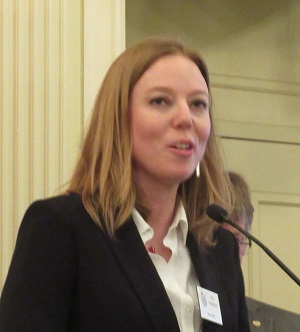
Therese Takacs introduced Louise Bradley, President and CEO of the Mental Health Commission of Canada. The mission of the MHCC is to meaningfully contribute to Canadians' wellness by providing world-class mental health courses. The MHCC courses offer Mental Health First Aid (MHFA) to people developing mental health problems or experiencing mental health crises.
Ms. Bradley delivered a thought-provoking presentation addressing the state of mental health in Canada, why everyone should care about it, and what we can all do about it. She described how the stigmatization of mental health problems and discrimination against people suffering through them are alive and well in Canada. She also highlighted the prevalence of mental health issues in Canada, noting that 6.7 million Canadians experience mental health issues at some point in their lives, as compared to 1.4 million Canadians with heart disease or 2.4 million Canadians with Type 2 diabetes. While mental health conversations are certainly more prevalent than in the past, actions still lag the discussions. It typically takes eighteen months to see a mental health specialist.
People do not consider mental illnesses as terminal conditions, but there are, on average, eleven suicides in Canada every day. There are probably many more, but medical professionals often do not recognize suicides and record other causes of death. Additionally, mental health issues underpin the opioid crisis. In these circumstances, eighteen-month wait times constitute real health risks.
One solution to this problem is Stepped Care 2.0. Adapted from a UK model, Stepped Care 2.0 aims to reduce the burden of mental illness on society through more efficient self-corrective systems of care offering the lowest level of intervention intensity warranted by the initial and ongoing assessments. Treatment intensity can be either stepped up or down depending on the level of client distress or need. Rapid access to required care is essential.
Mental health apps represent solutions to this problem; however, the MHCC has evaluated many mental health applications and found them wanting. The guidance provided in many popular mental health apps does more harm than good. Despite this, E-mental health can deliver timely, effective mental health services through apps and other technologies. Alongside face-to-face mental health support, e-mental health can provide the right care solutions when and where people need it. E-mental health offers shorter wait times, quick access in rural and remote areas and inner cities, availability in many languages, cost-effective delivery, and services tailored to specific habits and genetic profiles.
Additionally, the MHCC offers a wide array of mental health toolkits and training. Its Roots of Hope project develops community-led initiatives that aim to reduce the impacts of suicide within communities across Canada. The project builds upon community expertise to implement suicide prevention interventions tailored to the local context.
The prevalence of mental health issues should concern us all. In any given week, 500,000 Canadian workers call in sick because of mental health issues, and mental health is the leading cause of disability claims. In addition to workplace absenteeism, "presenteeism," low workplace productivity due to mental health issues, is an equally costly problem. Estimates place the cost of presenteeism at $51 billion per year and growing exponentially. Alberta workers in the oil and farming sectors, and survivors of the Fort McMurray wildfires, experience increasing mental health issues each year.
The MHCC promotes programs known to be effective in treating mental illness. These include The Working Mind First Responders(TWMFR), formerly known as Road to Mental Readiness, an education-based program designed to address and promote mental health and reduce the stigma of mental illness in a first-responder setting. This training program improves short-term performance and long-term mental health outcomes, reduces barriers to care, and provides the tools and resources required to manage and support employees who may be experiencing a mental illness.
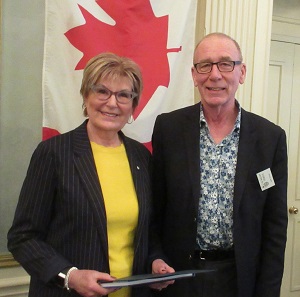
After a lively question and answer session, Dr. Wally Temple thanked our speaker for her information-packed presentation.
COG Staff - March 10th, 2020
Editor
Craig Henderson
Photography
Ralph Lundberg
Rotary Club of Calgary - Chartered April 1914 as Club #949

.png)