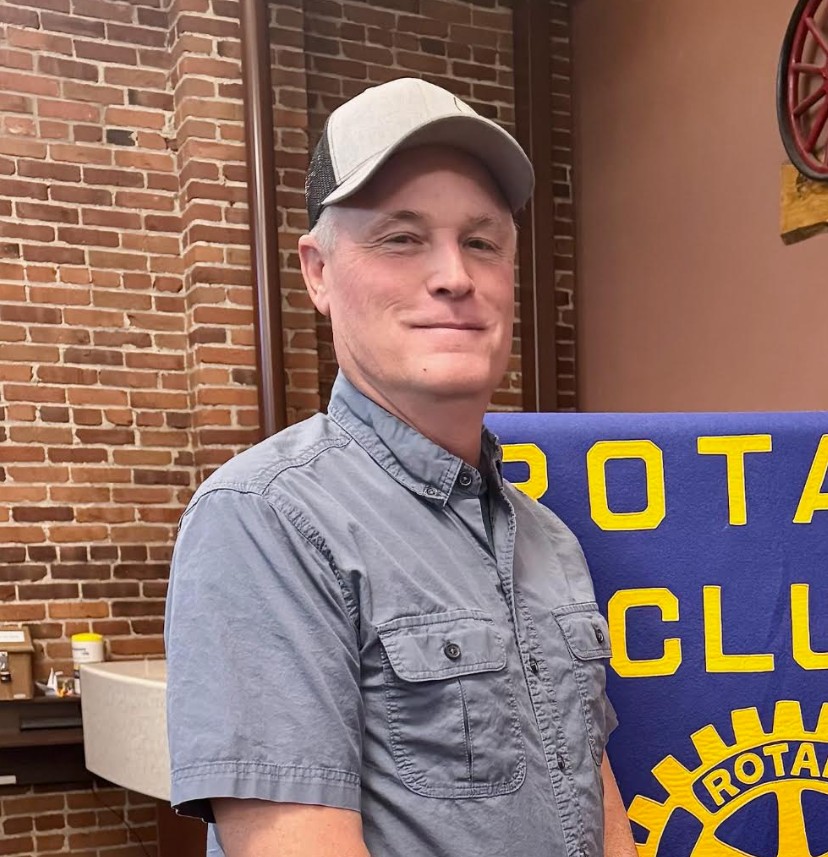
Brian Parks, Local Rancher
Carson Valley Ranching, Water, and What It Takes to Stay in Agriculture
Brian Parks offered Rotary members a candid look at ranching as it exists today in the Carson Valley: a hands-on business shaped by water, land, markets, and long-term family decisions. His remarks traced his family’s roots in the valley, how the ranch evolved over generations, and why the future of local agriculture depends as much on practical economics and water administration as it does on tradition.
Ranching economics are inverted: producers often buy inputs at retail prices and sell outputs at wholesale prices. Water is the defining constraint: senior surface-water rights matter most in drought years, and administration is complex. Markets change quickly: hay demand, horse ownership, and cattle programs rise and fall, forcing constant adaptation. Entry barriers are high: land values and operating costs make it difficult for new ranchers to get started locally.
Roots in the Valley: Homesteads, Expansion, and an Unusual Inheritance
Parks’ family story in Carson Valley reaches back to the late 1850s, when his great-great-grandfather, H.H. Springmeyer, arrived in the region as part of a broader wave of settlement and ranch development. Parks notes that many newcomers came under arrangements that helped them travel to the valley, homestead property, and then sell it—an approach that allowed large operators to consolidate significant acreage over time. His family’s early foothold included land known as the Nesmith Ranch, which Parks says had previously been held by a Mormon family that left the valley for Utah and later attempted to reclaim the property. Over time, the family’s core operation settled near what is now the edge of Minden—land that, importantly, carried some of the oldest water rights in the valley. In drought years, those senior rights can determine whether a ranch can still irrigate at all.
At its peak, Parks says the broader family operation once reached roughly 10,000–12,000 acres—far smaller than some of the valley’s largest historic landholdings, but substantial by any measure. As the next generation came of age, the ranching “empire” was divided so that each son received land, while the home ranch took a different path: it went to Springmeyer’s daughter, an uncommon outcome for the era. She later married Parks’ great-grandfather, Maurice Mack, and the operation became known as Mack Land and Cattle Company.
Parks places the mid-20th century as another turning point. He recalls a great-grandfather who trained as a lawyer, served in the Navy during World War II, and later served in the Nevada State Assembly before returning to ranch management. By Parks’ childhood, the ranch operated with several employees on roughly 800 acres. In more recent years, ownership and leadership also reflected another “oddity” in ranch culture: after Parks’ parents divorced, his mother ran the operation until her passing—an experience Parks describes as both formative and humbling as he stepped fully into responsibility.
The Ranch Today: Smaller Footprint, Same Work
Today, Parks says the ranch is about 600 acres and operates without hired employees—he is effectively the entire workforce. Over the years, portions of the original property were subdivided to offset costs and keep the remaining agricultural operation viable. In his telling, development didn’t replace ranching so much as help finance what remained of it, especially for operations close enough to town to take advantage of existing infrastructure.
The Business Problem at the Heart of Agriculture
Parks frames agriculture’s economic challenge in blunt terms: it is a business that typically buys its inputs at retail prices and sells its products at wholesale prices. That gap—fuel, equipment, feed, labor, veterinary costs on one side and commodity pricing on the other—creates constant pressure, especially in high-cost regions. Ranching, he emphasizes, can be deeply rewarding work, but it is not an easy business model in the modern market.
Water in Douglas County: Senior Rights, Drought Years, and the Alpine Decree
In Douglas County, Parks argues, water is the central constraint. His operation draws surface water from the East Fork of the Carson River, fed by snowmelt and supplemented by what is stored in upstream reservoirs. In poor winters, he says, irrigation water can run out early—sometimes as soon as June—changing what can be grown and how livestock can be managed.
He pointed to a defining legal framework known as the Alpine Decree, which he described as one of the nation’s longest-running federal water cases and the document that governs how Carson Valley water is adjudicated. Under that system, a water master’s office oversees allocation and resolves disputes, and deputy water masters monitor diversions through a complex ditch and canal network that has been altered repeatedly over time. Even as the valley irrigates fewer acres than it once did, Parks believes distribution challenges persist, in part because of the condition and configuration of that shared infrastructure. Parks also distinguishes surface rights from groundwater rights in Nevada, describing them as separate systems with separate rules. He notes that while new wells can be difficult to permit, the Carson Valley aquifer remains comparatively strong. He also describes rare older agricultural wells that predate certain modern restrictions—assets that can carry significant value because of their flexibility.
Hay, Cattle, and Changing Markets
Parks’ work life has included public service as well as agriculture. He describes a period working in law enforcement, returning later to the ranch while continuing as a reserve deputy. On the agricultural side, he recalls years when the family operation focused heavily on hay—at times leasing pasture to other ranches while running a strong hay business.
He points to how quickly markets—and even crops—can change. Parks says timothy hay, once a valuable product for racehorse and equestrian markets, no longer grows as well locally, which he attributes to hotter conditions and reduced water availability. He also recalls a boom in horse ownership in the 1990s, followed by a sharp decline after the 2006 crash. With the local horse-driven market reduced, he describes shifting hay sales outward, including shipments into California. Eventually, Parks says he wanted to run his own cattle rather than care for someone else’s, building up a cow-calf operation that, in typical years, sits around 160 mother cows. He describes reducing numbers temporarily while he works to rejuvenate pastures that had gone many years without major improvement—an effort complicated by the reality that timing in agriculture rarely aligns neatly with commodity prices. For about 15 years, he also ran a registered Angus program aimed at producing higher-value breeding stock, including a period relying on artificial insemination. Over time, he concluded the added labor, schedule demands, and cost structure outweighed the benefits for his operation, and he returned to a more traditional breeding approach. The lesson, he says, is that “better” in the cattle business is often defined by what fits the ranch’s time, labor, and cash flow—not by what looks best on paper.
Where the Money Goes—and Why Local Producers Feel the Squeeze
Parks describes a supply chain in which the producer is rarely the top beneficiary of price spikes. Calves, he says, typically leave the ranch after weaning and are sold through auction yards, where buyers bid and then move cattle into the next stage of the system. When cattle prices rise, he argues, much of the margin ends up captured by intermediaries and large-scale operations positioned between the ranch and the retail counter.
He also expresses concern about consolidation in food production and processing, warning that fewer companies controlling more of the food supply can reduce resilience and choice. Parks argues that importing large volumes of beef and food ingredients may make the system more vulnerable over time, and he frames domestic food production as a matter of long-term security as much as economics.
What Comes Next: Fewer Ranches, and a Need for Understanding
Looking ahead, Parks expects the region to lose ranches, largely because land values and operating costs make entry nearly impossible for newcomers who don’t already own property. He notes that some younger producers attempt to get started by leasing land, but purchasing enough acreage to ranch in Douglas County is out of reach for most without significant outside wealth. When asked what the broader community can do, Parks returns to a simple idea: learn before judging. He encourages residents to talk with local agricultural producers, understand why certain practices exist, and recognize the constraints—especially water and markets—that shape decisions. As one practical option, he points to supporting agricultural advocacy and education through organizations such as the Farm Bureau. For Parks, the throughline is continuity under pressure. A ranch can survive drought, price swings, and growth at the valley’s edge—but only by adapting again and again. In that sense, his message is not just about one family’s history. It is about how a community decides what it values, and whether working landscapes still have a place in the Carson Valley’s future.
- Thank you to Heidi Duggan and AI for this week's presenter article.