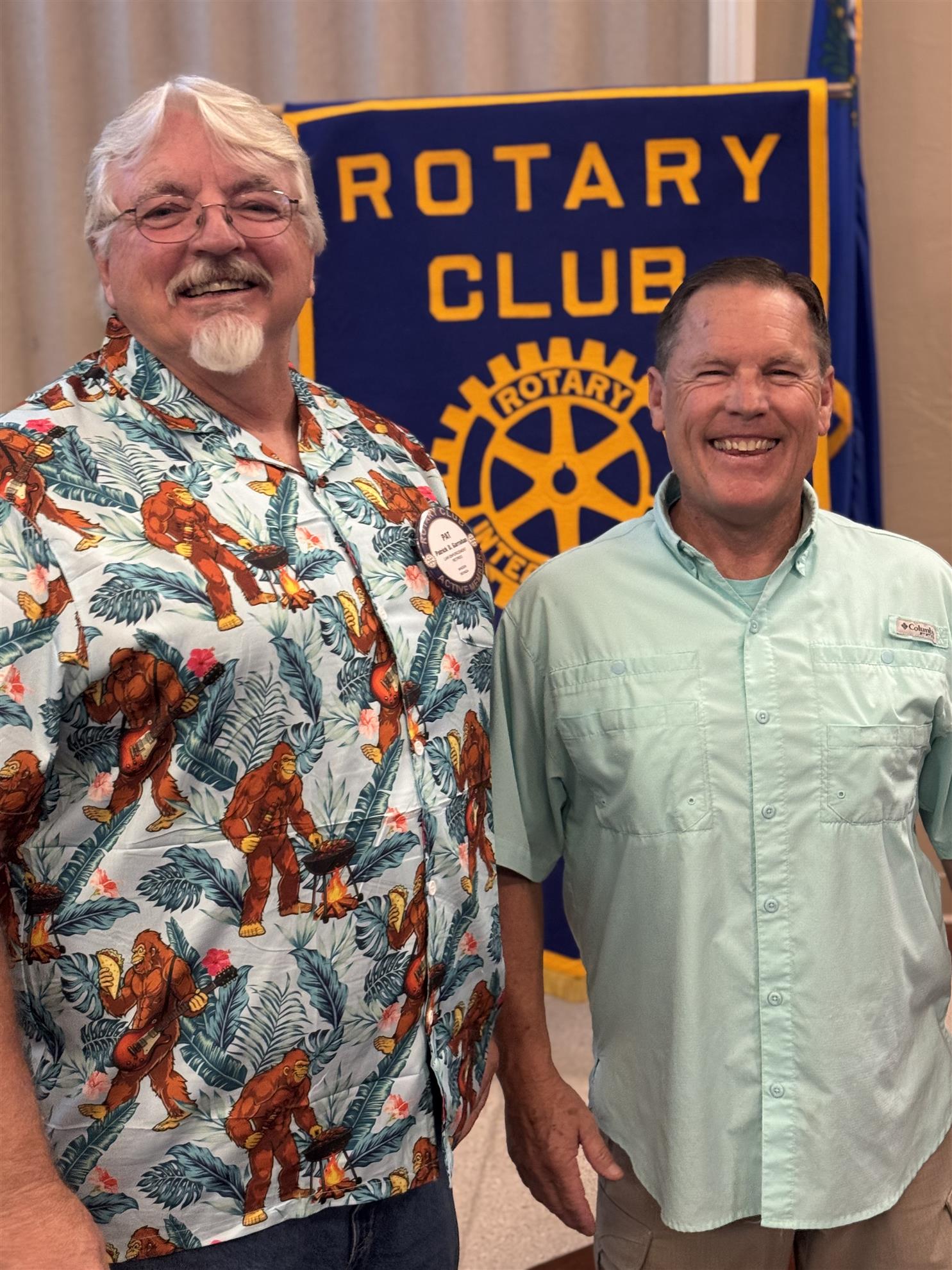
Minden Rotary Club President Pat Garrahan and NES founder Jerry Bucklin
SYNTHETIC DRUG PRODUCTION AND USE OVER THE LAST 5 DECADES
Today’s Rotary speaker was Jerry Bucklin, founder of Network Environment Systems (NES). He has spent the last 37 years as the lead contract instructor for the U.S. Department of Justice Drug Enforcement Administration in Quantico, Virginia. He has instructed over 145,000 International, Federal, state and local officers in 8 countries on the health hazards, manufacturing methods, and current synthesis trends. He authored the DEA program in 1988 and spent the next 37 years instructing, modifying and updating the contents of the 5 drug lab certification programs taught at the DEA Training facility in Quantico, Virginia. He currently works as a part-time instructor for NES and TBI.
In the 70s pharmaceutical amphetamine (beans, uppers) in the form of pills were an epidemic problem. They were popular with users like truck drivers who needed to stay awake for long drives and those who just needed a “pick-me-up”. As a result of wide abuse, amphetamine became more controlled and difficult to obtain which, along with other factors would lead to a shift to both illicitly manufactured amphetamine and (primarily) methamphetamine in the 80’s and onward.
Both amphetamine and methamphetamine are central system stimulants. Amphetamine effects last a couple hours and then their effects are mostly gone. But methamphetamine can last six to fourteen hours depending on the dose you take.
Illegal methamphetamine are synthesized in clandestine labs in many cases on an industrial scale. For example, there are labs in South America orchestrated by the cartels that make metric tons of it and then smuggle it to countries around the world, including the United States.
There are several ways to use methamphetamine including snorting and injection but predominantly they are consumed by smoking. Methamphetamine along with cocaine and heroin were the predominant illegal drug issue in the 70s – 90s.
In the 2000 - 2010 time frame we saw miscellaneous illicit manifestations of synthesized drugs. These drugs often resulted from criminal enterprises acquiring expired patents from pharmaceutical companies. Many patents expired because the drugs covered by the patents were too potent to use. The criminal enterprises used the patents as blueprints to illegally produce and then distribute their product. These drugs can loosely be sorted in two categories: hallucinogenics and opioids.
In the hallucinogenic category were primarily drugs that were synthetic variations of cathinone. These drugs are popularly called “bath salts”. Bath salts are created by modifying cathinone, which is a central nervous system stimulant, to add hallucinogenic properties. Bath salts alter a user’s sense of reality.
In the opioid category we had synthetic opioids like fentanyl. Profits for synthetic opioids dwarf those of drugs like methamphetamine. A kilogram of fentanyl can sell for $200,000-$300,000 while a kilogram of methamphetamine sells in the range of $800-$1,000.
There are several ways to consume fentanyl but it is typically injected. Fentanyl is extremely toxic. A single dose can be as little as 60 to 125 micrograms. For perspective, a single grain of salt weighs about 60 micrograms. Double that dosage (2 grains of salt) and you have an overexposure. Five times that exposure (5 grains of salt) and you have death.
There are hundreds of related cousins to fentanyl called analogs. These analogs include alfentanil, sufentanil, lofentanil, carfentanil, and ohmefentanyl. They have varying levels of toxicity. For perspective, fentanyl is 50 – 300 times more potent than morphine, alfentanil is 72 times more potent, carfentanil is 7,000 – 10,000 times more potent and ohmefentanyl is 20,000 – 50,000 times more potent. As the potency increases sellers can cut the dosage to very small amounts compared to fentanyl greatly increasing the profit margin. Some supposed fentanyl overdoses are actually from one of its analogs.