Rotary Visit to The RBA Field Program at Gogeldrie
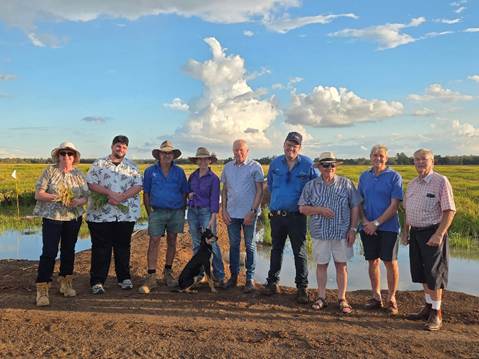
On Thursday a small keen group carpooled their way to Rice Breeding Australia’s (RBA) homesite located at Knagge’s farm at Gogelderie.
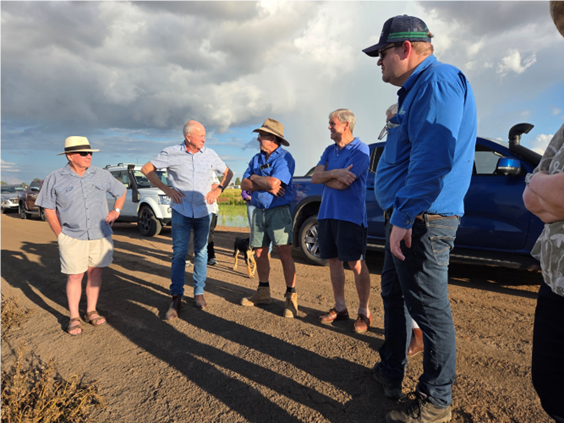
We were hosted by RBA’s Senior Breeder, Dr Christopher Proud, Garry and Marg Knagge.Also in attendance Bindi aka everyone’s friend the 6mth old puppy, who is lucky she didn’t end up in someone’s car.
RBA currently employees a CEO, five Technical Officers, one Senior Breeder with an Assistant Breeder to commence work next week.
Rice Breeding Australia is a Not-For-Profit, established to support the sustainability of rice production in Australia, with the goal of transforming the industry through innovation in rice breeding, taking a commercial focus to practice and deploy new strategies, tools and technologies. RBA has three members, Ricegrowers Ltd (SunRice), AgriFutures Australia and Ricegrowers Association of Australia.
Dr Proud advised that RBA’s aim is to improve varieties for growers, with the main impact being water, the volume available and the cost of. New practices including alternate wet/dry periods are being reviewed to reduce the amount of water required.
Another impact is the issue of cold tolerance or low temperature at a critical time in the rice heads development being, young microspore, and the use of deep water to protect the plant with a blanket of water. Water saving management practices can’t be sustainably implemented without the improvement of cold tolerance of existing varieties.
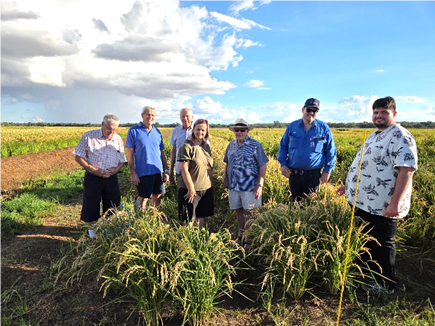
Plant crosses are undertaken in the glasshouse with potential varieties developed being planted in the field under normal farming conditions and practices. Hill plots are a new method RBA is utilising whereby a whole rice head rather than individual grains are planted. Currently the RBA has approximately 40,000 hill plots, which represent 40,000 potential varieties (or commonly known as breeding lines). Selected hill plots which meet the strict criteria are identified (usually by spray painting) for harvesting by hand.
Breeding is a numbers game, with large number of breeding lines generated each year.Plants which do not meet the strict criteria are eliminated throughout the process.Only potential varieties are progressed to the next stage.RBA has various trials in different regions including the Riverina, Murray and Northern Rivers to ensure potential varieties meet expectations when grown under normal farming conditions.Hill plots are used to bulk up seed for trials.
Garry Knagge proudly told the group about his impressive Topaz crop, which is a long grain fragrant rice.
The recording of flowering dates is a labour intensive process used to evaluate traits.With the use of drones and photo imaging it is hoped the manual component of this process can be reduced.Another benefit of drone photography is the use of GPS data points allowing RBA to fly over a field to identify any potential issues via colour imaging more quickly
RBA is also testing for quality, whole grain yield and the eating quality of the rice.Lodging (where the rice plant falls over) is another area identified as having a significant impact, with the RBA also investigating this area.
One of the tools in RBA’s arsenal is genomic testing, which enables them to make better decisions faster increasing the genomic gain in the breeding process.The rice variety known as Matilda took 18 years from development to commercialisation.With the adoption of best practice, and adoption of genomic testing among other things, it has sped up the process to about 10 years with the possibility of further reducing it to 6 or 7 years in specific cases.
Dr Proud also provided information on other areas of RBA’s focus including aerobic rice, commercialisation process, yield trials, deep root traits and pure seed bulk up process to get the seed to growers.
(Editor’s Note: A big thank you to Carmel for the stories and pics.)
******************************
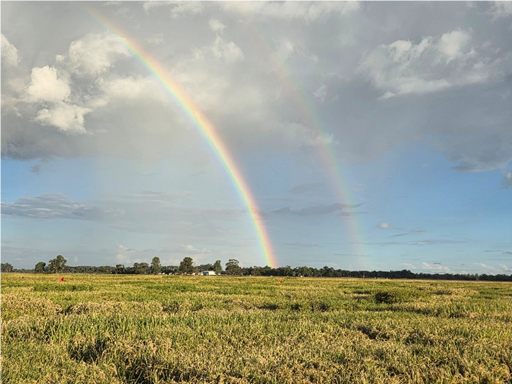
Somewhere under the Rainbow
A Rotarian will be searching for the pot of gold
******************************
Brain Teaser
The alphabet goes from A to Z but I go Z to A. What am I?
******************************
Director’s Reports (mostly from last week)
President Jennifer
Nominations are now open for Community Leader positions
Geoff
‘Griffith Avanti Rotary Club is turning 20 this year. Our plan is to hold our celebratory dinner on 23 May 2026 at Griffith Aeroclub. Invites to be circulated in near future’
‘On behalf of the SunRice Festival Committee, I would like to formally invite your club to assist us by providing support at the Street Parade on Saturday, 4th April. We are seeking your help in providing security along the main street to ensure the safety of the public attending the parade. The committee is pleased to offer your club a payment of $350 for this assistance. A briefing will commence at 12:30pm at Jarrah Mall, after which you will walk the main street as part of the safety team. There is no maximum number of volunteers required, and we would greatly appreciate as many participants as your club can provide on the day.
Peter
Nominations are open for RYLA.We may get an application from Reece but we have sponsorship for a further one.Please think about anyone who may be interested.
Greg
A Dinner meeting at the Hydro this week.
Brian/Carmel
******************************
Aussie Aussie Aussie
*****************************
“It” Takes a Stand
Two archaeologists were exploring a remote mountainous region when they came upon a huge rocky mass that resembled the statue of a sitting man.
It was about 100 metres high and appeared to have accurate details right down to fingernails.
"Looks real enough to talk to", said the first archaeologist, jokingly.
"Lets try", said the second, and turning to the statue said, "What’s your name?"
There was no reply, so he tried with "How old are you?"
Still no reply, so the second one asks, "What’s the square root of 64?"
For a moment nothing happened, then there was a loud rumbling, the ground started shaking, and slowly the statue rose to its feet, towering above the men it
put one hand on its chin, gazed into the distance for a few seconds, and then said, "Eight."
"Aha", said the first archaeologist, "It only stands to reason."