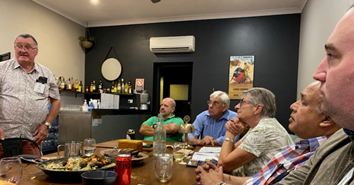
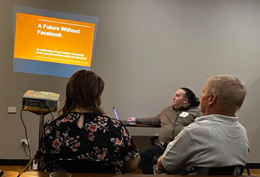
Our very own Nicholas Wright presented this week with an interesting concept, ‘a future without Facebook’. An exploration of how Leeton’s community sector can communicate safely and effectively. Leeton is made up of individual people, families, voluntary associations, small businesses, large businesses, and local, state, and national government agencies. It is also composed of the natural and built environment.
The issues are that Facebook isn’t good enough and our time is valuable. The good news is we have options especially as a united Leeton community.
How do we use Facebook and other communications software today? What works well, what doesn’t?
Facebook is open to 83% of the world’s population. It provides extraordinary connectivity between people who would otherwise never meet. It’s a way for businesses and organisations to have a presence online without needing a website.
The reach of Facebook is overstated. Everyone may have access but are they really paying attention? The sheer quantity of content, including advertising, means that most messages are lost in the noise. Every Facebook user can be approached by every other user, which creates risk of harm, but it also creates enough fear of harm that people limit their own engagement. The limited engagement, the lack of attention, ultimately makes Facebook unsuitable as a community platform, because community means everyone.
Like Facebook, email is still useful, but do we need to use it so much? Currently most private, direct communications happen via SMS/ text messages, phone and video calls, chat apps or email. While group communications happen via Facebook groups, video calls or email. Less often by broadcast SMS or in person. Riddle: Nothing
Let’s stop moving with the inertia of the world, and give ourselves and our communities a respectful analysis of our needs. We need to connect privately 1:1, connect as closed groups, need a public square, want every space to be safe, need to coordinate activities and we need our workload to be sustainable.
At this stage, public, mass participation platforms are likely to remain as the ‘town square’ of choice.
But that doesn’t mean we have to base our activities there.
Any software solution, or combination of solutions, must maximise safety of its participants. This means tight control of who has access, at every level. Transparency and accountability can be built in to technological systems. Genuine safety, not box-ticking, is what will give participants the confidence to let their guard down.
There are no shortage of project management applications. The trick is finding some options that can satisfy the previously listed requirements. Any solution should try and reduce the amount of time that leaders and participants have to deal with administrative tasks. We have to be able to afford it. Most free solutions aren’t free - you either pay by losing control of your personal data, or you pay for upgrades.
Nicholas provided us with some things to consider both good and bad about different types of apps:
- Email Apps (ActiveCampaign, MailChimp) - Used for sending out emails to and tracking who opens them. Includes a contact database that recipients can update themselves.
- Social Apps (Facebook, MeWe, Instagram, Twitter) - Allow members to communicate online, share news, links, media, to collaborate, and have discussions. Mostly very commercialised, poorly moderated for adverse content.
- Private Social Apps (Circle, Raklet, Flock, MightyNetworks, Tribe, Hivebrite, Higher Logic, Slack) - Allows members of specific organisations to interact with some of the features of social networks, with a work or purpose-driven focus.
- Volunteer Management Apps (Volaby , ClubRunner) - Narrower scope, deeper functionality. Focus on recruiting and managing org members and casual volunteers, and the associated events and projects. For further information and to view the video Nicholas referred to click on the link below:https://volaby.org/tutorial-videos/?wvideo=8ti1xinlsp
- CRM Apps (Zoho, Hivebrite, Google Contacts) - Store contacts and track interactions with contacts, for the purposes of making commercial sales. Can be stand-alone products, or add-ons to bookkeeping & website management apps.
********************************





 Carmel’s Riddle of the Week
 Member Update


 Laurie’s Quote of the Week