In The Chair: President Carmel
Members: 11
Guests: Dr Georgina Pengilley, Dr Chris Proud, Esther Van Meeuwen (all from Rice Breeding Australia Ltd).
********************************
Vocational Visit – Rice Breeding Australia Glasshouse
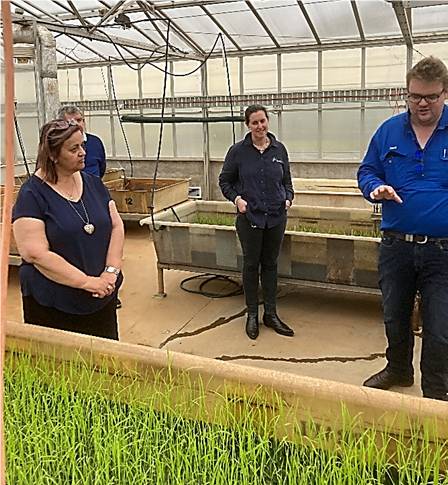
We were welcomed to the rice glasshouses by Georgie, Chris and Esther. Each had a role to play in explaining what we were to see.
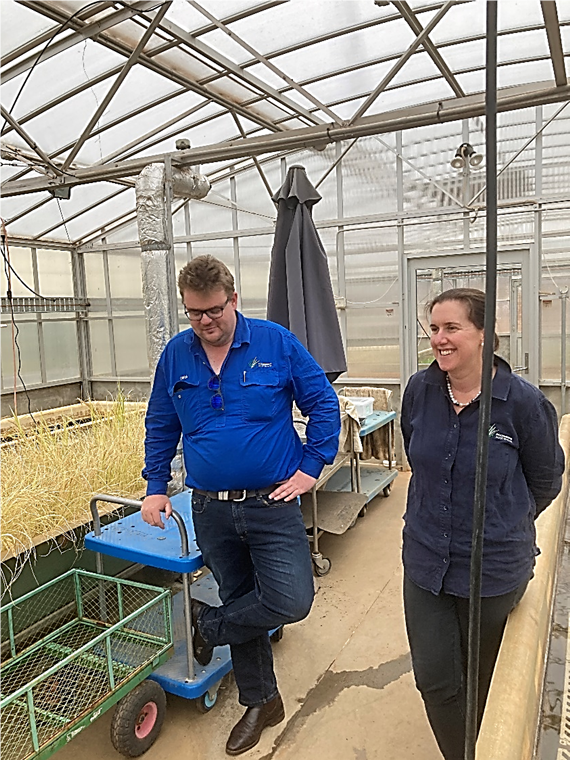
Georgie explained that Rice Breeding Australia Ltd came into being around 2 years ago. It came about because the rice industry realised that the challenges surrounding water demanded an improved breeding program and a more streamlined variety development program. This could only be achieved through a private breeding program. Rice Breeding Australia was formed by SunRice, the Ricegrowers’ Association and AgriFutures (the entity that collects and manages grower and Government contributions). RBA has an office on Brady Way, has part of the field program on a grower’s field near Leeton with variety testing throughout the rice growing area. They lease the glasshouses from the NSW Department of Agriculture but have plans to build their own near the main office. RBA employs 9 staff, including CEO Georgie; Chris, the rice breeder; and Esther a technical officer responsible for the glasshouse program. They are particularly focused on varieties with high yield and appropriate grain quality but with much better water productivity – aiming to eventually produce varieties with the ability to grow in non-flooded conditions. An important requirement is tolerance to cold as standing water provides protection to the developing panicle (rice head) when we sometimes get cold nights (below about 15C) during the critical panicle development period.
Chris came to RBA from the University of Queensland where he worked on a research program looking at rice cold tolerance and ability to grow in anaerobic conditions. He explained that we were looking at the single seed descent program. Rice is a self-pollinated plant, and it takes about 9 – 10 generations from cross to new variety. In single seed descent, plants are sown into little cells in a tray in a glasshouse with the objective of harvesting just a single seed from each panicle to plant in the next generation. Three generations can be achieved in a single year using this technique, thus speeding up the process. The aim is to grow about 200 -300 lines from each cross. About 40,000 to 50,000 lines can therefore be sown in a very small area.
Chris also talked about a backcrossing program. This aims to incorporate single genes from a ‘donor’ parent into an otherwise acceptable ‘recurrent’ parent. He is transferring cold tolerance from the resistant donor to a recurrent commercial variety (eg VO71, the most popular commercial variety) After the first cross, the progeny containing the required gene is crossed again to the recurrent parent. This will be repeated for 4 – 6 backcrosses when the progeny contains about 95% of the recurrent parents genes, but has the required gene from the donor parent. Backcrossing is also being used to transfer disease resistance into commercial varieties (after a ‘blast’ outbreak in the Northern Rivers last year).
He also talked about the importance of genetic markers in the selection process. Markers are sections of DNA that indicate the presence of particular genes.
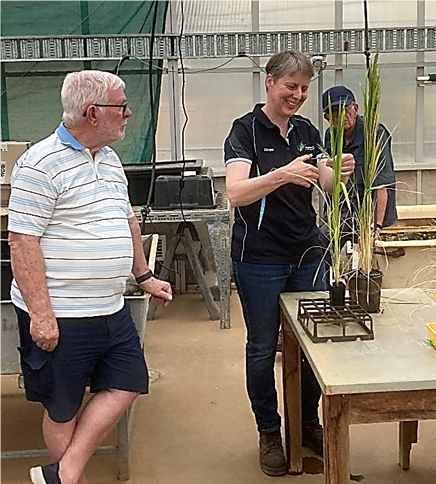
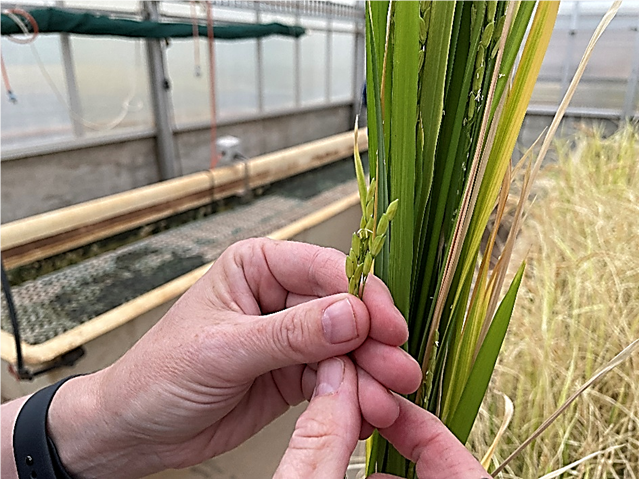
Esther demonstrated the crossing technique. A plant that has just begun to flower is selected as the female parent. Florets that have already flowered are removed because these will be self-pollinated. The whole head is then immersed in hot water for a period. This kills the pollen, but the ovary remains un-affected. The florets are then clipped to allow free entry of pollen from the selected male parent. The two panicles are then tied together and covered with dialysis tube that allows light and air to the panicles but excludes other pollen.
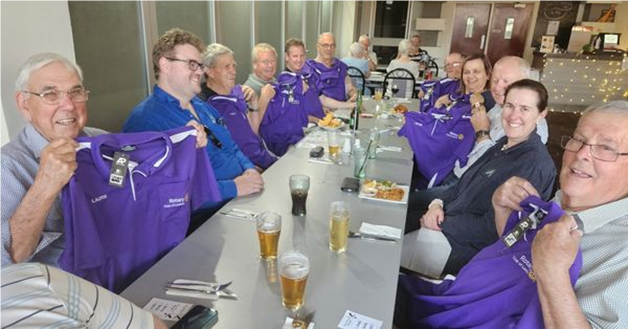
President Carmel then thanked Georgie, Chris and Esther on behalf of the club before we adjourned to the Yanco Club for a meal and the distribution of our new shirts.