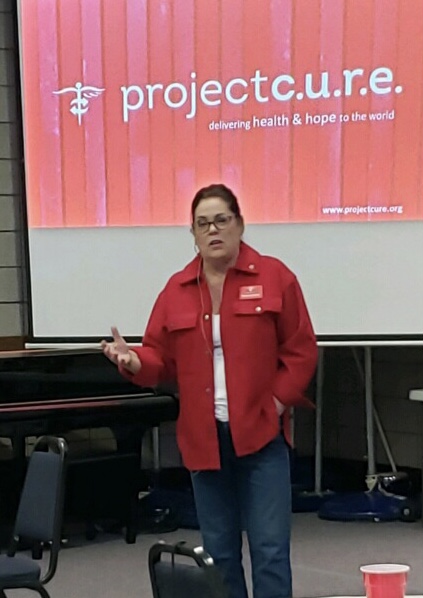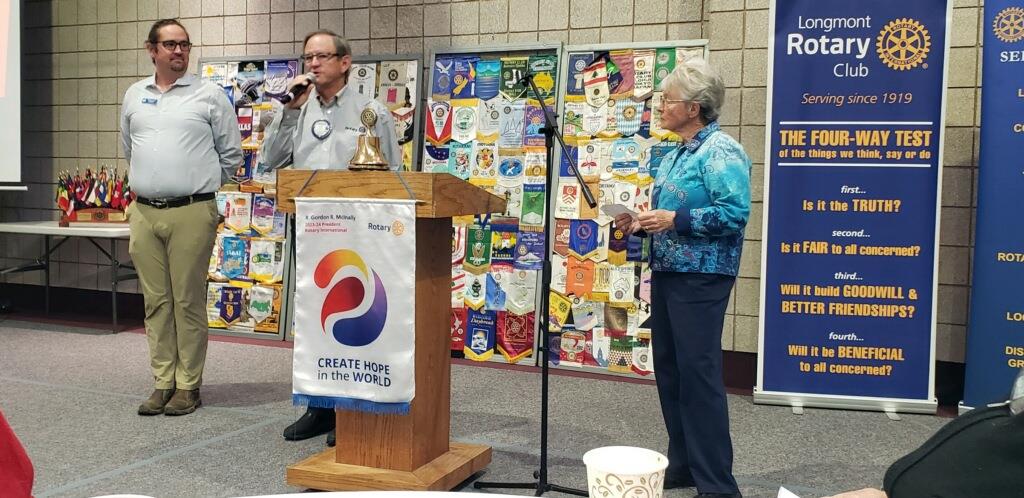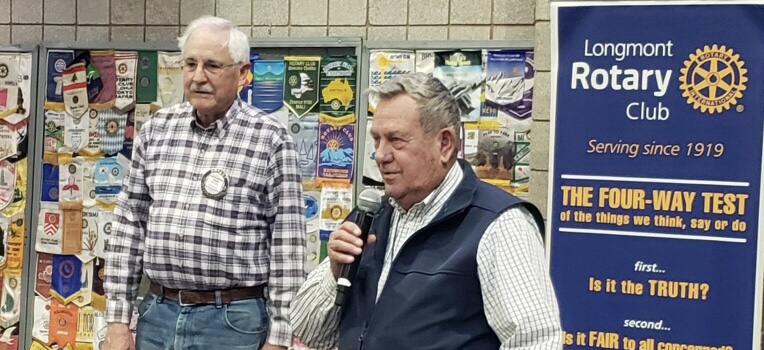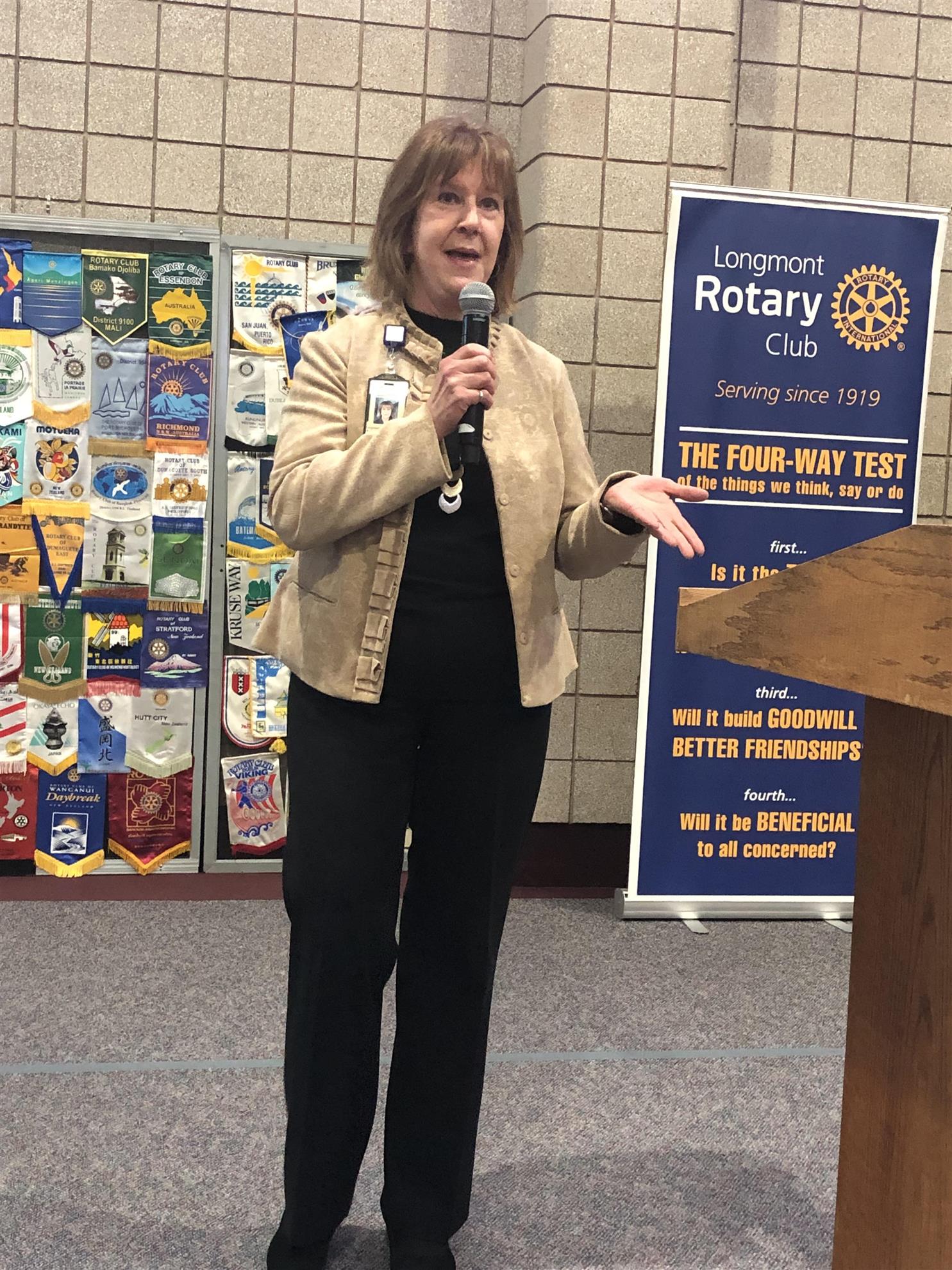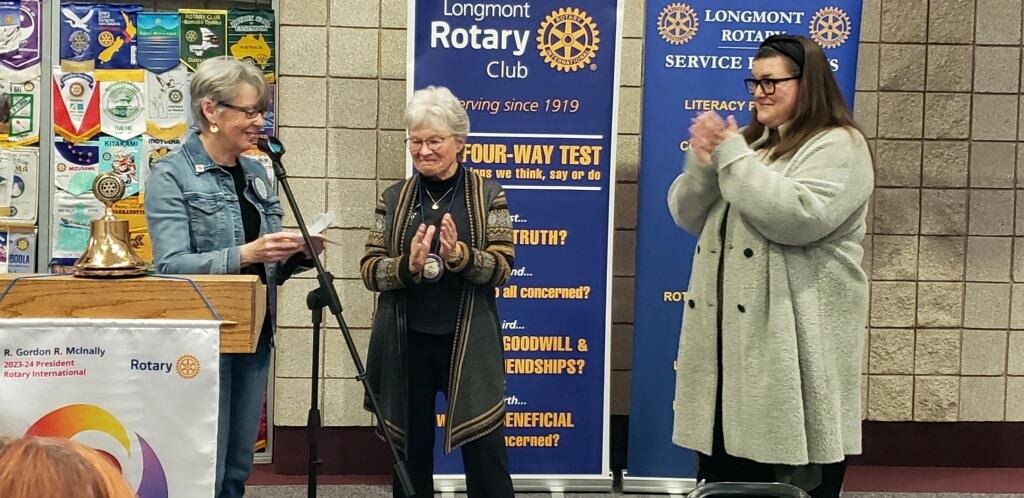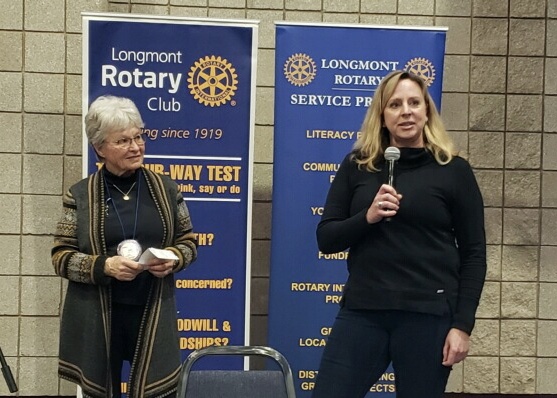




Longmont Rotary officially welcomed SVSD Superintendent Dr. Jackie Kapushion and Chief of Staff Kerri McDermid in an orientation led by Co-President Roger Lange. Their induction highlights a leadership philosophy of civic humilityand authentic integration. Despite the rigors of leading a large school district, both leaders expressed a deep commitment to being "good Rotarians," prioritizing the club’s "Service Above Self" mission. Drawing on their past Rotary experience, they view this membership as a vital platform to model volunteerism and express gratitude for the community’s support of St. Vrain Valley Schools. Welcome Jackie and Kerri!
PRE-ORDER OPTION COMING SOON
Longmont Rotary officially welcomed SVSD Superintendent Dr. Jackie Kapushion and Chief of Staff Kerri McDermid in an orientation led by Co-President Roger Lange. Their induction highlights a leadership philosophy of civic humilityand authentic integration. Despite the rigors of leading a large school district, both leaders expressed a deep commitment to being "good Rotarians," prioritizing the club’s "Service Above Self" mission. Drawing on their past Rotary experience, they view this membership as a vital platform to model volunteerism and express gratitude for the community’s support of St. Vrain Valley Schools. Welcome Jackie and Kerri!
In his presentation, Dr. Bickers emphasized that election rules act like the rules of a sport—they determine who plays, what strategies they use, and which "fans" (voters) engage. Beyond Ranked Choice Voting, he outlined several other frameworks used in the U.S. and abroad:- Plurality (First-Past-the-Post): The most common U.S. system, where the candidate with the most votes wins, even if they don't reach a 50% majority.
- Simple Majority with Runoff: A two-stage process. If no one hits 50% in the first round, the top two finishers face off in a subsequent election.
- Sequential Runoff: An iterative process where the lowest-ranking candidate is eliminated over multiple rounds of revoting (historically used by the House of Representatives to settle contested presidential elections).
- Cumulative Voting: Often used for multi-member boards. Voters are given multiple votes (e.g., three votes for three open seats) and can "cluster" them all on one candidate or split them up.
- Proportional Representation: Common in European parliaments and the Democratic Party’s nomination process, where the percentage of votes a group receives directly translates into the number of seats or delegates they win.

Dominguez highlighted Longmont’s independence and stability. Unlike neighboring areas facing proactive power shutoffs from Xcel Energy during wind events, Longmont Power & Communications maintains a resilient "Level 11" system that manages risks in real-time without de-energizing the city. He also touted Longmont’s status as a national leader in internet service (NextLight) and its top-tier water and public safety departments.
The city faces significant "financial headwinds," including decreased property tax revenue and a 30% drop in use tax due to interest rates and tariff uncertainties. To combat the housing crisis, Dominguez highlighted the True North project—a pioneering partnership providing 185 affordable and workforce for-sale homes. He noted that currently, only 40% of city staff can afford to live within Longmont.
Major upcoming initiatives include:
* Transit: The development of a new RTD transit hub and the success of the RideLongmont microtransit system.
* Regional Growth: Preparing for the regional impact of the Sundance Film Festival in Boulder.
* Public Safety: Continuing innovative diversion programs like "CORE" to prioritize mental health and restorative justice.
Dominguez concluded by reinforcing that while the city manages the foundation, it is the collective partnership of the community that drives Longmont forward.

Longmont Fire Chief Dan Higgins gave an engaging update on the city’s fire department and fielded questions from Rotary members.
“When I was hired, Longmont had just three fire stations,” said Higgins. “As the city expanded in the '90s, we kept pace. Today, we have six stations spread across the city.” Recently, two stations were rebuilt—one on Ken Pratt Blvd. and another formerly at Hover and Mountain View, now relocated to 17th Avenue. The old Station 2 is now a dedicated training facility.
Q&A Highlights:
Why do fire trucks respond to EMS calls?
Fire trucks are like “rolling toolboxes,” equipped to handle a variety of emergencies. Dispatch determines the right mix of units for each call. A typical medical call might involve two trucks and an ambulance, bringing eight personnel to the scene. Of Longmont’s 12,000 calls last year, about two-thirds were medical. Many fire personnel are trained in Advanced Life Support.
How much does it cost to build a fire station or buy a truck?
Costs vary. The two most recent stations cost about $12 million total. Today, building a single station would likely require $10 million. Fire trucks also come at a premium—basic engines run around $900,000, while ladder trucks can exceed $1.3 million and take years to deliver. For comparison, Lafayette’s ladder truck recently cost $2.2 million.
How is Longmont managing extreme weather and wildfire risk?
Since the 2013 flood, the city has invested heavily in flood mitigation and water flow management. Longmont’s Emergency Management Office also plays a key role in community preparedness. At the state level, additional aerial firefighting resources have been acquired to assist with wildfire response.
What’s the role of fire suppression systems?
Their main purpose is to control fires long enough for people to safely evacuate. In many cases, they also help extinguish fires before firefighters arrive.

District Governor Cindy Rold spoke to Longmont Rotary Club on DATE about her recent visit to Kenya, where she viewed several Rotary water projects and saw first-hand the impact that Rotary has had on the lives of local residents.Cindy spoke about the importance of the educational component of water projects, because people who have never been educated about the importance of clean water don’t understand why they should invest effort to maintain the cleanliness of the water.
Rotary projects provide both clan water and education. For example,Rotary has undertaken a program of spring protection at 58 spring sites, so that the water which flows out of the ground will remain clean. Local residents are empowered and trained to maintain the clean area around the spring. Residents come to fill containers of water at the spring head, often carrying 20 liters of water on their head up to 8 times a day!
In Nairobi, Cindy went on, there are over one million people living in slums, with entire families sharing 10x10 shacks with no running water. She visited the largest school in that city, which serves 6000 students, also without running water. The Littleton Rotary club had sponsored a water filtration project for that school. Cindy said that the filtered water “tasted delicious!” The educational component of that project included training 100 students as “wash champions” who educate their classmates about the importance of clean water and how to maintain the pipes. One of the students told her gleefully that “we don’t have stomach aches any more.”
Cindy also told us about some unmet needs in the area, for example a school with 400 students that has only 4 hole-in-the-ground latrines. They requested help to replace those “disgusting” latrines with more hygienic facilities. She also visited an orphanage that has no running water. The children must carry in buckets of water to wash themselves. That orphanage and 6 local schools have all requested water filtration systems.
Cindy’s talk provided clear evidence that Rotary is, indeed, “United for Good!”
Longmont Rotary is stepping into its next era as two new presidents prepare to guide the club through its next phase.Francesco Arezzo, a member of the Rotary Club of Ragusa, Italy, has been selected by the Board of Directors to become Rotary International’s president for 2025-26. Arezzo will become president on 1 July.
The Board conducted a special session following the unexpected resignation of RI President-elect Mário César Martins de Camargo on 8 June. Guided by the RI code and policies, the Board selected the new president-elect from a pool of candidates who were considered by the Nominating Committee for President of Rotary International in August 2023.
The 2025-26 presidential message, announced at the 2025 Rotary International Assembly in February, will remain Unite for Good, which calls on Rotary members to be a force for unity in a world increasingly divided by politics, geography, and ideology. Through service projects, Rotary brings together people of every background — across races, religions, and professions — in a shared mission to do good in their communities.
Arezzo is an orthodontist in private practice. He is active internationally as a member of the Italian, European, and American orthodontics associations. He is vice president of the National Association of Italian Dentists for the province of Ragusa and was the founder and head for seven years of the delegation for Ragusa of the National Trust for Italy. He is a Knight of Honor and Devotion in Obedience within the Sovereign Order of Malta.
A Rotary member for more than 30 years, Arezzo has served as vice chair of the Joint Strategic Planning Committee and as RI director, learning facilitator, and as district conference presidential representative.
Arezzo is a Benefactor of The Rotary Foundation. He is married to Anna Maria Criscione, an entrepreneur in the tourism field. They have two children
Following a spirited round of “Who Wants to Be a Millionaire?”—which, yes, we did win—Foundation Chair Ryan Mason took the mic to share some equally exciting news: Longmont Rotary has officially met this year’s giving goal to The Rotary Foundation (TRF), contributing an impressive $13,188 to support both the Annual Fund and Polio Plus campaigns.
But the big headline?
We are within striking distance of a historic $1 million in total lifetime giving to TRF!
Ryan reported that our club has contributed $911,640 since its founding, leaving just $88,360 to hit the million-dollar mark. That’s right—just one final stretch to go.
He also reminded us of our bold 2021–22 fundraising campaign, which brought in a remarkable $65,589 in a single year. With the Bill & Melinda Gates Foundation's 2:1 PolioPlus match, our impact can stretch even further.
Let’s make this happen, Longmont Rotary—
$1 million is within reach. Let’s cross that finish line together!
The honored tradition of the Slick Haley Awards continued with the recognition of four outstanding high school students. The award is given to students who have overcome adversity while still achieving academic success. Dr. Al Carr shared the story of Dr. James “Slick” Haley—an accomplished athlete, physician, and dedicated Rotarian. Known as the “Paonia Peach” for his athletic achievements at CU. During WW II, Slick served three years as an Army surgeon, receiving his nickname for becoming an accomplished surgeon, performing surgeries for a very large Mash-like hospital quickly and effectively. Slick later pursued medicine and became Longmont’s first surgeon. A longtime Rotary member, he was passionate about helping young people succeed. Dr. Carr concluded, “You are receiving this award in the name of a truly outstanding individual—Rotarian, surgeon, and community leader."


Service Above Self
Longmont, CO 80501
United States