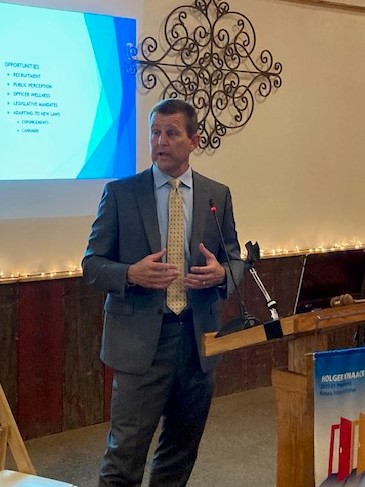
Sycamore Police Chief Jim Winters continually linked police priorities and actions with community interaction and service during an overview of his department at the August 12 meeting of Rotary. Winters and his family have lived in the Sycamore area since 1993. He spent 27 years with the State Police prior to joining the Sycamore department four years ago. He became chief three years ago. His background includes criminal and narcotics investigations along with commanding multi-jurisdictional task forces. The Sycamore department has 30 members including patrol officers, investigators, and two school resource officers (noting a particularly close working relationship with the school district to help build trust between officers and students). Patrol officers work four 12-hour shifts a week giving 24-hour services to residents. Coverage for special events is a large part of the department’s duties. Normally they have 40 such gatherings a year ranging from citywide events like Pumpkin Fest and the Turning-Back-Time car show to neighborhood celebrations. Police also go through an estimated 3,600 hours of training a year. Winters said all these activities are focused on enhancing ties to the community.
Winters gave some examples of the Sycamore department’s experience with recent national police issues. Regarding COVID-19, he said there have been shifts in numbers for types of crimes (for example, noticeably fewer people driving meaning a decline in traffic incidents) but the overall crime rate is about the same. His department had implemented a mental health partnership with Northwestern Medicine prior to the pandemic which has proved beneficial under current circumstances. He said his department recently received a grant to update dash cameras in squad cars and hopes to get a grant in the future for body cameras. Regarding concerns about excessive force, Winters said Sycamore already had policies in place prohibiting choke holds and requiring officers to intercede in disputes between other officers and the public. He also noted how his department was able to work collaboratively during recent events so public protests remained peaceful. Going forward, Winters said he hopes to build on community support for the police and continue strong government/inter-agency relations so that officials and the public have a positive perception of police activities.
Our speaker this week will be Rose Tremi from the Sycamore Chamber of Commerce, discussing the state of business in the community.
Following is our schedule of upcoming speakers/presentations:
Wednesday, February 3 (Hybrid meeting: In-person at Blumen Gardens, pending status of Covid mitigation efforts, and online via Zoom): Sycamore Chamber of Commerce (Rose Tremi)
Wednesday, February 10 (Hybrid meeting: In-person at Blumen Gardens, pending status of Covid mitigation efforts, and online via Zoom): Kishwaukee YMCA (Mark Spiegelhoff)
Wednesday, February 17 (Hybrid meeting: In-person at Blumen Gardens, pending status of Covid mitigation efforts, and online via Zoom): Northwestern Medicine Kishwaukee Hospital & Northwestern Medicine Valley Hospital (Jay Anderson)
Wednesday, February 24 (Hybrid meeting: In-person at Blumen Gardens, pending status of Covid mitigation efforts, and online via Zoom): Farm Bureau (Greg Millburg)
Dial by your location +1 312 626 6799 US (Chicago) +1 646 558 8656 US (New York) +1 301 715 8592 US (Germantown) +1 346 248 7799 US (Houston) +1 669 900 9128 US (San Jose) +1 253 215 8782 US (Tacoma)
A new and easy test for COVD-19 is doing the rounds and it's simple, quick and positive (or negative if you see what I mean).
Take a glass and pour a decent dram of your favorite whisky (gin or rum) into it; then see if you can smell it, if you can then you are halfway there; then drink it and if you can taste it then it is reasonable to assume you are currently free of the virus.
I tested myself 12 times last night and was virus free every time thank goodness. I will have to test myself again today though, as I have developed a headache which can also be one of the symptoms.
Well, just see how smart you are with the last 3 sections of this 8th Grade Final Exam...
This is the eighth-grade final exam from 1895 in Salina, KS. It was taken from the original document on file at the Smokey Valley Genealogical Society and Library in Salina and reprinted by the Salina Journal.
8th Grade Final Exam (continued)
U. S. History (Time, 45 minutes)
1. Give the epochs into which U.S. History is divided. 2. Give an account of the discovery of America by Columbus. 3. Relate the causes and results of the Revolutionary War. 4. Show the territorial growth of the United States. 5. Tell what you can of the history of Kansas. 6. Describe three of the most prominent battles of the Rebellion. 7. Who were the following: Morse, Whitney, Fulton, Bell, Lincoln, Penn, and Howe? 8. Name events connected with the following dates: 1607, 1620, 1800, 1849, 1865.
Orthography (Time, one hour)
1. What is meant by the following: Alphabet, phonetic, orthography, etymology, syllabication? 2. What are elementary sounds? How classified? 3. What are the following, and give examples of each: Trigraph, sub vocals, diphthong, cognate letters, linguals? 4. Give four substitutes for caret 'u'. 5. Give two rules for spelling words with final 'e.' Name two exceptions under each rule. 6. Give two uses of silent letters in spelling. Illustrate each. 7. Define the following prefixes and use in connection with a word: bi, dis, mis, pre, semi, post, non, inter, mono, sup 8. Mark diacritically and divide into syllables the following, and name the sign that indicates the sound: card, ball, mercy, sir, odd, cell, rise, blood, fare, last. 9. Use the following correctly in sentences: cite, site, sight, fane, fain, feign, vane, vain, vein, raze, raise, rays. 10. Write 10 words frequently mispronounced and indicate pronunciation by use of diacritical marks and by syllabication.
Geography (Time, one hour)
1. What is climate? Upon what does climate depend? 2. How do you account for the extremes of climate in Kansas? 3. Of what use are rivers? Of what use is the ocean? 4. Describe the mountains of North America. 5. Name and describe the following: Monrovia, Odessa, Denver, Manitoba, Hecla, Yukon, St. Helena, Juan Fernandez, Aspinwall & Orinoco. 6. Name and locate the principal trade centers of the U.S. 7. Name all the republics of Europe and give the capital of each. 8. Why is the Atlantic Coast colder than the Pacific in the same latitude? 9. Describe the process by which the water of the ocean returns to the sources of rivers. 10. Describe the movements of the earth. Give the inclination of the earth.
Also notice that the exam took five hours to complete.
How would you do on this test today? Pretty embarrassing isn't it!
August 10, 1874 – Herbert Hoover, the 31st U. S. President, is born in West Branch, Iowa. He is the first President born west of the Mississippi River.
August 11, 1921 – “Roots” author Alex Haley is born in Ithaca, New York.
August 12, 1881 – Film pioneer (“The Ten Commandments” and “The Greatest Show on Earth”) Cecil B. DeMille is born in Ashfield, Massachusetts.
August 13, 1860 – Wild West performer Annie Oakley, known for her shooting ability, is born in Darke County, Ohio.
August 9, 1974 – Effective at noon, Richard M. Nixon resigned from the Presidency as a result of the Watergate scandal.
August 11, 1965 – Six days of riots begin in the Watts area of Los Angeles triggered by a traffic stop and subsequent fight between an African American motorist and a white member of the California Highway Patrol. The rioting results in 34 deaths, more than 3,000 people arrested, and damage to property listed at $40 million.
August 14, 1935 – President Franklin Roosevelt signs the Social Security Act guaranteeing a pension supplement to workers retiring at age 65.
August 14, 1945 – V-J Day; President Harry Truman announces the Japanese surrender to the Allies to end World War II.
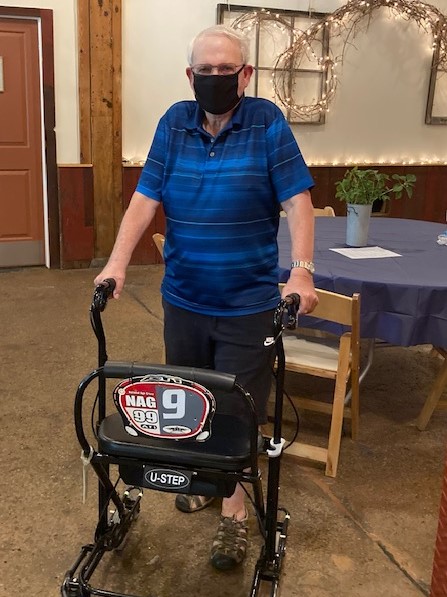
Lavarre Uhlken continues to sport his #9 racing number! GO, LAVARRE!