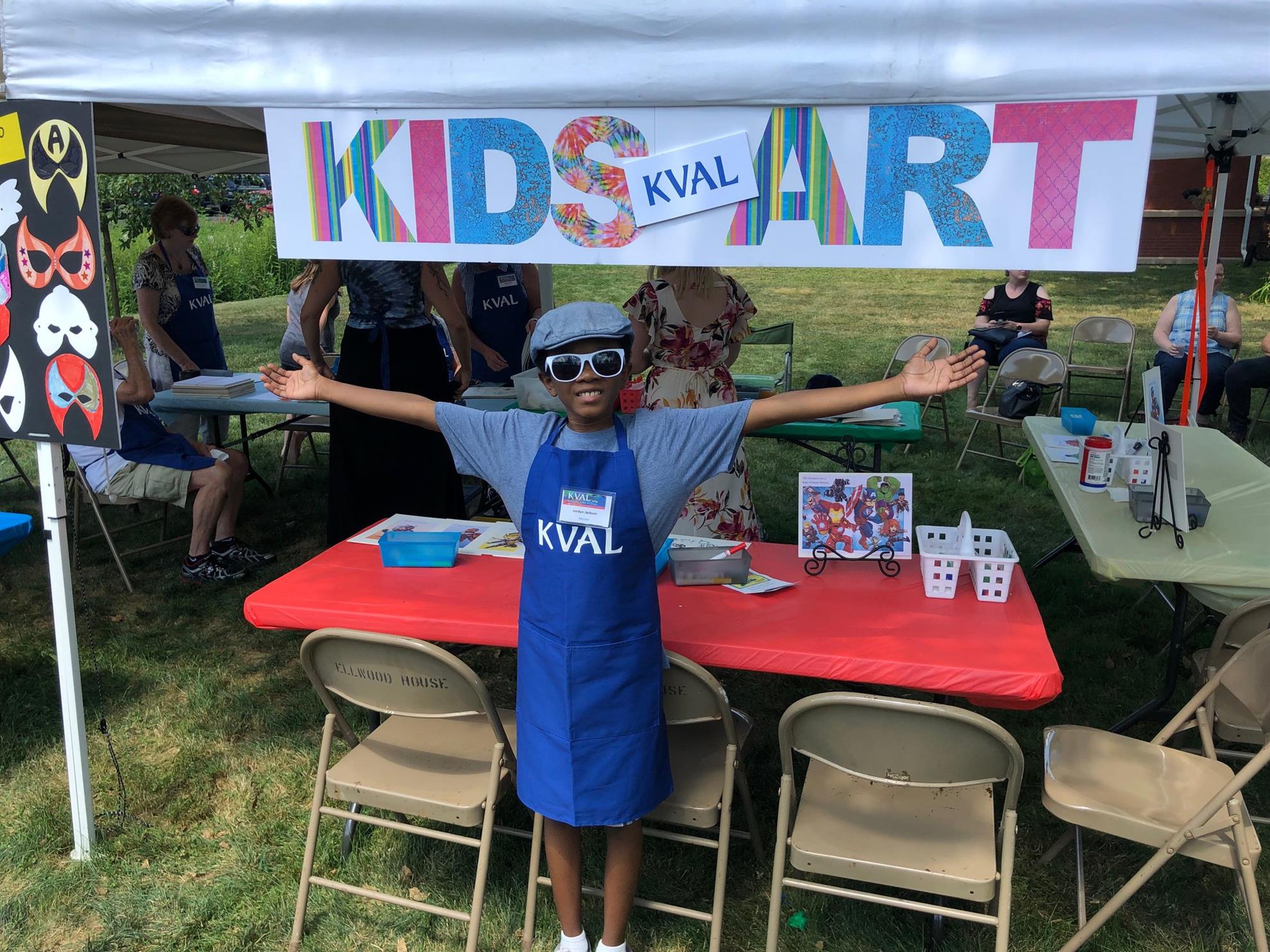
Flashing the words “Inspire, Explore, and Create” from a video, Julie Olson of KVAL (Kishwaukee Valley Art League) shared the artists organization’s latest activities during this week’s Sycamore Rotary Club meeting. Founded in 1972, the organization embraces expressions of all forms of arts and crafts. Its premier public event is the Northern Illinois Art Show traditionally held in June on the lawn of the County Courthouse in Sycamore. The Covid-19 pandemic forced cancellation of last year’s event, although Olson said KVAL hopes an event will be possible in 2021.
Olson serves as treasurer of the group. She said it was officially classified as a 501(c)(3) non-profit organization in 2015. This opened the door for tax-deductible donations to help their cause, including the opportunity to be part of the ”Give DeKalb County” non-profit fundraiser day on May 6th coordinated by the DeKalb County Non-Profit Partnership through the Dekalb County Community Foundation. Olson herself moved to the area several years ago from Nebraska. She does acrylic painting on wood.
In 2020 KVAL opened the “Gallery on State”. This storefront at 322 West State Street in downtown Sycamore provides space for local artists to display and sell their art works. It also provides a meeting place where members can learn more about various art techniques and observe visiting professional artists demonstrating their unique talents. The Gallery is open to the public Tuesday through Saturday.
Besides being a support organization for the local artist community, KVAL shares its mission of promoting the arts with schools and non-profits. This includes KVAL raising funds to provide supplies to students and adults just learning how to express themselves through art.
Details about KVAL and its programs are available at the organization’s web site: www.kval-nfp.org.
Attending any art fairs in the near future? Please collect business cards and share the information with Paul Stromberg (pstromborg@mac.com) so the Sycamore Rotary can establish our own vendor database for our upcoming event in June! Thanks!
Posted by Elizabeth Schroeder, Rotary International on Apr 20, 2021
As COVID-19 vaccinations are administered around the globe, you’ve probably seen your social media feeds fill up with joyful vaccine selfies and excited appointment updates. Chances are, you also have someone in your life who’s skeptical. Most of us do — and that has public health officials concerned.
Vaccine hesitancy is often fuel for heated public debate, but conversations about vaccines don’t have to be contentious. In fact, being willing to have them is one of the most impactful ways we can influence global health. As with many emotionally-charged topics, knowing how to start the conversation can be the hardest part. These tips may help you open up a dialogue and get your loved ones thinking differently about being vaccinated.
Find shared values. We all want similar things — healthy families, thriving communities, and a sense of control over our health. Demonizing vaccine-hesitant individuals only creates further division and exacerbates an “us vs. them” mentality. Try explaining why you choose vaccinations. Is it to protect the most vulnerable members of your community? To shield your children from preventable disease? Relatable motivations like these can help forge a human connection and get to the emotional heart of the issue.
Seek to understand. Just as there are many reasons to be vaccinated, there are many reasons a person might feel dubious. A prevalent one is misinformation, which is more contagious than ever in our digital age. Others are more complicated and riddled with an ugly history. Marginalized communities have spent centuries being mistreated by the medical establishment. Expecting these communities to immediately trust the same institution to have their best interest at heart is unfair and dismissive of historic trauma.
Know your “C’s.” The World Health Organization (WHO) has outlined three “C’s” that contribute to vaccinate hesitancy: complacency, convenience, and confidence. We could also add a fourth: culture. Rates of vaccine hesitancy, as well as contributing factors, vary widely based on a person’s location, background, and community. Being cognizant of these differences can prevent us from making incorrect assumptions. If someone is skipping recommended vaccines due to religious beliefs, opening a conversation with safety statistics may not be helpful or relevant to them.
Lead with facts. Mythbusting can be tempting, but did you know that repeating misinformation can actually give it more weight? Instead of focusing on why that meme or blog post is incorrect, stick to simple statements of fact. For example: “large-scale scientific studies find no link between the HPV vaccine and auto-immune symptoms.”
Be the voice of the majority. Social norms are an incredibly powerful force, but the key is to keep it positive. If you try to convince someone that not enough people are receiving vaccines, they may feel that their hesitancy has been validated by others. A more effective approach is to focus on how many people are choosing to vaccinate and why. Remind them that large-scale inoculation is a group effort and we want them on the team.
Identify the problem and the solution. If you’ve ever stood at the edge of a diving board, unable to move, you know that fear can be paralyzing. Fear of severe illness can have similar effects. When we talk about vaccine-preventable disease, simply scaring someone is likely to backfire. Instead, it’s important to acknowledge two facts simultaneously: these diseases are serious and being vaccinated is a simple and effective countermeasure. Help put power back into their hands by identifying an action they can take — being vaccinated!
Vaccines bring us closer to a world where everyone thrives, but it’s a team effort. By having conversations, you can bring your friends and family along on our global health journey.
April 19, 1775 – It was dawn and 70 armed militiamen stood face to face with a British advance guard unit on Lexington Green when an unordered shot from the British became “the shot heard round the world” and the American Revolution began. Eight Americans died and ten were wounded in the melee that followed.
April 22, 1889 – The Oklahoma land rush began at noon with a single gunshot starting a mad dash by thousands of settlers seeking to stake their claim to a portion of two-million acres of land.
April 22, 1970 – An estimated 20 million people turn out for locally-organized environmental educational events promoted by Wisconsin Senator Gaylord Nelson. Nelson was trying to call attention to the inaction of Congress on environmental issues and inaugurated the first “Earth Day”.
April 20, 1999 – Two students armed with guns and explosives carried out an attack at Columbine High School in Littleton, Colorado, killing 12 classmates and a teacher and leaving 20 people wounded before killing themselves.