Dial by your location +1 312 626 6799 US (Chicago) +1 646 558 8656 US (New York) +1 301 715 8592 US (Germantown) +1 346 248 7799 US (Houston) +1 669 900 9128 US (San Jose) +1 253 215 8782 US (Tacoma)
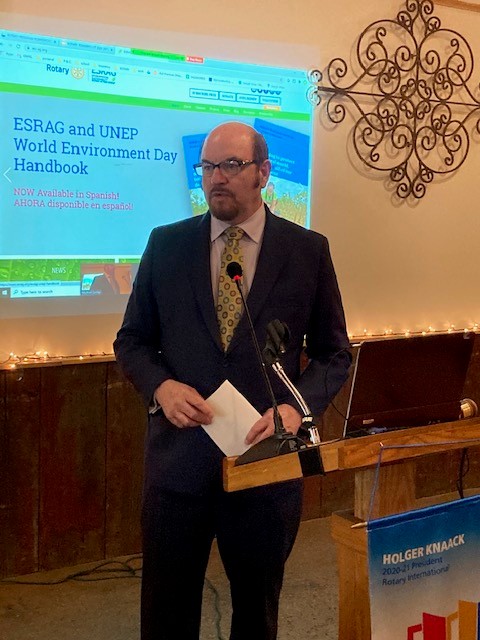
Madison, Wisconsin Rotarian Patrick Marsden this week gave a first-hand account on how “Supporting the Environment” became the seventh official focus area for Rotary International in June of this year (joining “Promoting Peace”; “Fighting Disease”; “Providing Clean Water and Sanitation”; “Saving Mothers and Children”; “Supporting Education”; and “Growing Local Economies”). As Marsden explained, the initiative began as a social group affiliated with the main Madison club doing environmental sustainability projects. But participants soon felt the need to have greater impact. Inspired by the phrase “work locally but think globally”, they pursued a closer link to Rotary International. In 2015, just two years after launching their local group, they won acceptance as one of only 25 officially recognized Rotary Action Groups. They developed a handbook to make it to easy implement a project that addressees the environment in a sustainable fashion. This way a local club does not have to “recreate the wheel” when getting started with their project. Marsden said the response is exciting with over 1,000 members from 50 different countries and representing a full range of age groups being part of the Environmental Sustainability Rotarian Action Group (ESRAG). More details and examples of impact may be found at their website: www.esrag.org.
Our speaker this week will be Ryan Janisch, North Grove Elementary School Principal, with updates on EarlyAct Club activities and plans.
Following is our schedule of upcoming speakers/presentations:
Wednesday, January 20 (Hybrid meeting: In-person at Blumen Gardens, pending status of Covid mitigation efforts, and online via Zoom): EarlyAct Club (Ryan Janisch)
Wednesday, January 27 (Hybrid meeting: In-person at Blumen Gardens, pending status of Covid mitigation efforts, and online via Zoom): Classification Speech (Jonelle Bailey)
Wednesday, February 3 (Hybrid meeting: In-person at Blumen Gardens, pending status of Covid mitigation efforts, and online via Zoom): Sycamore Chamber of Commerce (Rose Tremi)
Wednesday, February 10 (Hybrid meeting: In-person at Blumen Gardens, pending status of Covid mitigation efforts, and online via Zoom): TBD
Wednesday, February 17 (Hybrid meeting: In-person at Blumen Gardens, pending status of Covid mitigation efforts, and online via Zoom): Northwestern Medicine Kishwaukee Hospital & Northwestern Medicine Valley Hospital (Jay Anderson)
Wednesday, February 24 (Hybrid meeting: In-person at Blumen Gardens, pending status of Covid mitigation efforts, and online via Zoom): TBD
Dial by your location +1 312 626 6799 US (Chicago) +1 646 558 8656 US (New York) +1 301 715 8592 US (Germantown) +1 346 248 7799 US (Houston) +1 669 900 9128 US (San Jose) +1 253 215 8782 US (Tacoma)
Posted by From Old Farmer's Almanac submitted by Bob Brown
Centuries ago, farmers and others observed animal behavior and recognized patterns that corresponded to weather events. these observations were passed down through generations as advice. Are they true? do they work? See below; you decide...
Can Cows Forecast the Weather?
If a cow stands with its tail to the west, the weather is said to be fair.
If a cow grazes with its tail to the east, the weather is likely to turn sour.
If the bull leads the cows to pasture, expect rain; if the cows precede the bull, the weather will be uncertain.
There is some truth here. Animals graze with their tail toward the wind so that if a predator sneaks up behind them, the wind will help catch the scent of the predator and prevent an attack.
Other Animal Indicators
Expect rain when dogs eat grass, cats purr and wash, sheep turn into the wind, oxen sniff the air, and swine are restless.
When cats sneeze, it is a sign of rain.
When cattle lie down in the pasture, it indicates early rain.
When horses and cattle stretch out their necks and sniff the air, it will rain.
Woolly caterpillars are said to be winter weather predictors: the more brown they have on their bodies, the milder winter will be.
If a mole digs its hole 2 1/2 feet, expect severe weather; if two feet deep, not so severe; if one foot deep, a mild winter.
When pigs gather leaves and straw in fall, expect a cold winter.
When rabbits are fat in October and November, expect a long, cold winter.
If sheep ascent hills and scatter, expect clear weather.
Bats flying late in the evening indicates fair weather.
July 26, 1856 – Prolific Irish playwright George Bernard Shaw is born in Dublin, Ireland.
July 28, 1929 – Jacqueline (Jackie) Bouvier Kennedy is born in Southampton, New York.
July 30, 1863 – Automotive pioneer Henry Ford is born in Dearborn Township, Michigan.
August 1, 1779 – Star-Spangled Banner poem author Francis Scott Key is born in Frederick County, Maryland. His verse, “Defense of Fort McHenry” is later put to song and officially becomes the U. S. National Anthem by an Act of Congress in 1931.
July 26, 1953 – Fidel Castro begins his “26th of July Movement” to topple the dictatorship of Cuba by Fulgencio Batista. He is eventually successful when Batista flees Cuba on New Year’s Day 1959.
July 27, 1953 – The Korean War ends with the signing of an armistice at Panmunjom, Korea.
July 30, 1975 – Former Teamsters Union leader James “Jimmy” Hoffa is last seen outside a restaurant in Detroit, Michigan. He is declared officially dead in 1982.
July 31, 1790 – The U. S. Patent Office opens and issues the first patent to Samuel Hopkins for a new method of making potash (fertilizer). The patent is signed by George Washington and Thomas Jefferson.
Patrick Marsden, member of the Rotary Club of Madison and guest of Sycamore Rotarian Paulette Renault, traveled from Wisconsin to speak with our club about ESRAG, the Environmental Sustainability Rotary Action Group. Photo credit: Bob Brown