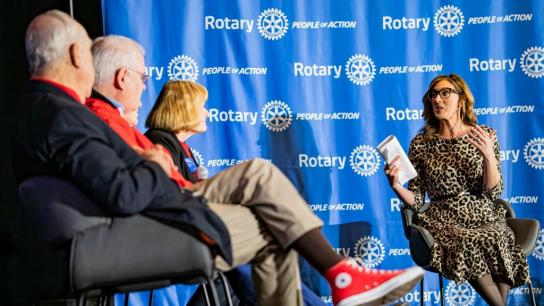
Thank you to all our Rotarians who came together to help put on another successful event!
UPCOMING EVENTS: Watch your email for notifications of upcoming events and service opportunities.
If you have any announcements you would like to share, please email me at chuck.gore@stahlinsurance.com and I will include it in the bulletin.
======================
We have several open dates coming up. Please be aware if these are programs you are responsible for and reach out to Steve Solomon or Kayla Drawdy to let them know what you have planned.
=====================
If you have an announcement that you would like to share with the club, please email me the details by Thursday afternoon so it can be included in this weeks bulletin!
=================
Famous Rotarians
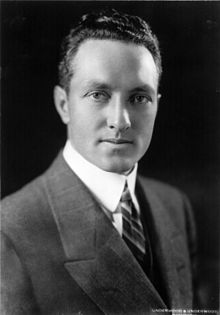
Richard Evelyn Byrd Jr. (October 25, 1888 – March 11, 1957), an American naval officer,[1] was a pioneering American aviator, polar explorer, and organizer of polar logistics. Aircraft flights in which he served as a navigator and expedition leader crossed the Atlantic Ocean, a segment of the Arctic Ocean, and a segment of the Antarctic Plateau. He is also known for discovering Mount Sidley, the largest dormant volcano in Antarctica.
Byrd claimed to be the first to reach both the North and South Poles by air. However, there is some controversy as to whether or not Byrd was actually the first person to reach the North Pole. It is generally believed that the distance Byrd claimed to fly was longer than the possible fuel range of his airplane.[2][3]
On May 9, 1926, Byrd and Navy Chief Aviation PilotFloyd Bennett attempted a flight over the North Pole in a Fokker F.VIIa/3m tri-motor monoplane named Josephine Ford after the daughter of Ford Motor Company president Edsel Ford, who helped finance the expedition. In addition to Ford contributions, John D. Rockefeller also notably provided funding for the expedition.[19] The flight left from Spitsbergen (Svalbard) and returned to its takeoff airfield, lasting 15 hours and 57 minutes, including 13 minutes spent circling at their Farthest North.[5] Byrd and Bennett said they reached the North Pole, a distance of 1,535 miles (1,335 nautical miles).[20]
When he returned to the United States from the Arctic, Byrd became a national hero. He was thrown a parade in New York City, and Congress passed a special act on December 21, 1926, promoting him to the rank of commander and awarding both Floyd Bennett and him the Medal of Honor.[21] The Josephine Ford was flown around the country in celebration.[22] Bennett was promoted to the warrant officer rank of machinist. Byrd and Bennett were presented with Tiffany Cross versions of the Medal of Honor on March 5, 1927, at the White House by President Calvin Coolidge.[23]
In 1927, Byrd announced he had the backing of the American Trans-Oceanic Company, which had been established in 1914 by department-store magnate Rodman Wanamaker for the purpose of building aircraft to complete nonstop flights across the Atlantic Ocean. Byrd was one of several aviators who attempted to win the Orteig Prize in 1927 for making the first nonstop flight between the United States and France.[33]
Once again, Byrd named Floyd Bennett as his chief pilot, with Norwegian Bernt Balchen, Bert Acosta, and Lieutenant George Noville as other crewmembers. During a practice takeoff with Anthony Fokker at the controls and Bennett in the co-pilot seat, the Fokker Trimotor airplane, America, crashed, severely injuring Bennett and slightly injuring Byrd. As the plane was being repaired, Charles Lindbergh won the prize by completing his historic flight on May 21, 1927. (Coincidentally, in 1925, then Army Air Service Reserve Corps Lieutenant Charles Lindbergh had applied to serve as a pilot on Byrd's North Pole expedition, but apparently, his bid came too late.)[34]
Byrd continued with his quest to cross the Atlantic nonstop, naming Balchen to replace Bennett, who had not yet fully recovered from his injuries, as chief pilot. Byrd, Balchen, Acosta, and Noville flew from Roosevelt Field, East Garden City, New York, in the America on June 29, 1927. On board was mail from the US Postal Service to demonstrate the practicality of aircraft. Arriving over France the next day, they were prevented from landing in Paris by cloud cover; they returned to the coast of Normandy and crash-landed near the beach at Ver-sur-Mer (known as Gold Beach during the Normandy Invasion on June 6, 1944) without fatalities on July 1, 1927.[35] In France, Byrd and his crew were received as heroes and Byrd was invested as an Officer of the French Legion of Honor by Prime Minister Raymond Poincare on July 6.[36]
After their return to the United States, an elaborate dinner in their honor was held in New York City on July 19. Byrd and Noville were awarded the Distinguished Flying Cross by Secretary of the Navy Curtis D. Wilbur at the dinner.[37] Acosta and Balchen did not receive the Distinguished Flying Cross because, at that time, it could only be awarded to members of the armed services and not to civilians.[citation needed]
Byrd wrote an article for the August 1927 edition of Popular Science Monthly in which he accurately predicted that while specially modified aircraft with one to three crewmen would fly the Atlantic nonstop, another 20 years were needed before it would be realized on a commercial scale.[38]
He was a recipient of the Medal of Honor, the United States Armed Forces' highest military decoration, and the Navy Cross, the second highest honor for valor given by the U.S. Navy.
Admiral Byrd was an active member of the Rotary Club of Boston, MA.
Rotary is committing US$500,000 to bolster the initiative, channeling these funds through a dedicated Polio Outbreak Response Fund. This contribution represents Rotary's sustained support to the World Health Organization in combating polio globally.