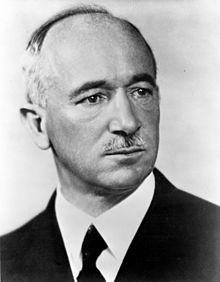
Prince Edvard Benes, the President of Czechoslovakia 28 May 1884 – 3 September 1948) was a Czech politician and statesman who served as the president of Czechoslovakia from 1935 to 1938, and again from 1939 to 1948. During the first six years of his second stint, he led the Czechoslovak government-in-exile during World War II.
As president, Beneš faced two major crises, which both resulted in his resignation. His first resignation came after the Munich Agreement and subsequent German occupation of Czechoslovakia in 1938, which resulted in his government's exile in the United Kingdom. The second came about with the 1948 Communist coup, which created a Communist regime in Czechoslovakia. Before his time as president, Beneš was also the first foreign affairs minister (1918–1935) and the fourth prime minister (1921–1922) of Czechoslovakia. The de facto leader of the Czech National Social Party, he was known as a skilled diplomat.[1]
During World War I, Beneš was one of the leading organizers of an independent Czechoslovakia from abroad. He organized a pro-independence and anti-Austrian secret resistance movement, Maffia. In September 1915, he went into exile in Paris, where he made intricate diplomatic efforts to gain recognition from France and the United Kingdom for Czechoslovak independence. From 1916 to 1918, he was a Secretary of the Czechoslovak National Council in Paris and Minister of the Interior and of Foreign Affairs in the Provisional Czechoslovak government.
In May 1917, Beneš, Tomáš Garrigue Masaryk and Milan Rastislav Štefánik were reported to be organizing a "Czechoslovak Legion" to fight for the Western Allies in France and Italy, recruited from among Czechs and Slovaks who were able to get to the front and also from the large emigrant populations in the United States, which was said to number more than 1,500,000.[12] The force grew into one of tens of thousands and took part in several battles, including the Battles of Zborov and Bakhmach in Russia.[13]
From 1918 to 1935, Beneš was the first and longest-serving Foreign Minister of Czechoslovakia. On 31 October 1918, Karel Kramář reported from Geneva to Prague: "If you saw our Dr. Beneš and his mastery of global questions ... you would take off your hat and say it was truly marvelous!" His international stature was such that he held the post through 10 successive governments, one of which he headed himself from 1921 to 1922. In 1919, his decision to pull demoralized Czechoslovak Legions out of the Russian Civil War was denounced by Kramář as a betrayal. He represented Czechoslovakia at the 1919 peace conference in Paris, which led to the Versailles Treaty.
A committed Czechoslovakist, Beneš did not consider Czechs and Slovaks to be separate ethnicities. He served in the National Assembly from 1920 to 1925 and again from 1929 to 1935, representing the Czechoslovak National Social Party (called the Czechoslovak Social Party until 1925). He briefly returned to the academic world as a professor, in 1921. After Jan Černý's first stint as prime minister, Beneš formed a government (cs) for a little over a year from 1921 to 1922.
In the early 1920s, Beneš and his mentor President Masaryk viewed Kramář as the principal threat to Czechoslovak democracy, seeing him as a "reactionary" Czech chauvinist who was opposed to their plans for Czechoslovakia as a multi-cultural, multi-ethnic state. Masaryk and Beneš were openly doubtful of Kramář's commitment to "Western values" that they were committed to such as democracy, enlightenment, rationality and tolerance, seeing him as a romantic Pan-Slavist who looked towards the east rather than the west for ideas.
Kramář very much resented the way in which Masaryk openly groomed Beneš as his successor, noting that Masaryk put articles into the Constitution that set 45 as the age limit for senators, but 35 as the age limit for the presidency, which conveniently made Beneš eligible for the presidency. The charge of Czech chauvinism against Kramář had some substance as he openly proclaimed his belief that the Czechs should be the dominant people in Czechoslovakia, denounced Masaryk and Beneš for their belief that the Sudeten Germans should be equal to the Czechs, and made clear his opposition to having German as one of the official languages of Czechoslovakia, views that made him abhorrent to Beneš.
In 1927 Beneš was initiated in freemasonry at the Ian Amos Komensky Lodge No. 1.[17]
Between 1923 and 1927, Beneš was a member of the League of Nations Council, serving as president of its committee from 1927 to 1928. He was a renowned and influential figure at international conferences, such as those at Genoa in 1922, Locarno in 1925, The Hague in 1930 and Lausanne in 1932.
Beneš had been in poor health since the spring of 1945, when he suffered a minor stroke. He suffered two more strokes in 1947, and seeing the undoing of his life's work left him completely broken. In a 2018 interview with Radio Prague International, historian Igor Lukes recalled that by February 1948, Beneš' poor health left him "a shell of a man" who did not have the emotional or physical stamina to hold out against the "rough, rough players" of the KSČ.[77][3]