If you have any announcements you would like to share, please email me at chuck.gore@stahlinsurance.com and I will include it in the bulletin.
======================
We have several open dates coming up. Please be aware if these are programs you are responsible for and reach out to Steve Solomon or Kayla Drawdy to let them know what you have planned.
=====================
If you have an announcement that you would like to share with the club, please email me the details by Thursday afternoon so it can be included in this weeks bulletin!
Guglielmo Giovanni Maria Marconi[11][12] was born in Palazzo Marescalchi in Bologna on 25 April 1874, the second son of Giuseppe Marconi (an Italian aristocratic landowner from Porretta Terme who lived in the countryside of Pontecchio) and his Irish wife Annie Jameson (daughter of Andrew Jameson of Daphne Castle in County Wexford, sister of ScottishnaturalistJames Sligo Jameson, and granddaughter of John Jameson, the Scottish founder of whiskey distillers Jameson & Sons).[13][14] His father, who was a widower with a son, Luigi, married Jameson on 16 April 1864 in Boulogne-sur-Mer, France. Alfonso, Marconi's older brother, was born in 1865. Between the ages of two and six, Marconi and Alfonso lived with their mother in the English town of Bedford. Having an Irish mother helped explain Marconi's many activities in Great Britain and Ireland. When he was three years old, on 4 May 1877, Giuseppe Marconi decided to obtain British citizenship. Marconi could have thus also opted for British citizenship anytime, as both his parents had British citizenship.[15]
Marconi did not attend school as a child and did not go on to formal higher education.[16][17][18] Instead, he learned chemistry, mathematics, and physics at home from a series of private tutors hired by his parents. His family hired additional tutors for Marconi in the winter when they would leave Bologna for the warmer climate of Tuscany or Florence.[18] Marconi noted an important mentor was professor Vincenzo Rosa, a high school physics teacher in Livorno.[19][17] Rosa taught the 17-year-old Marconi the basics of physical phenomena as well as new theories on electricity. At the age of 18 and back in Bologna, Marconi became acquainted with University of Bologna physicist Augusto Righi, who had done research on Heinrich Hertz's work. Righi permitted Marconi to attend lectures at the university and also to use the university's laboratory and library.[20]
From youth, Marconi was interested in science and electricity. In the early 1890s, he began working on the idea of "wireless telegraphy" – i.e., the transmission of telegraph messages without connecting wires as used by the electric telegraph. This was not a new idea; numerous investigators and inventors had been exploring wireless telegraph technologies and even building systems using electric conduction, electromagnetic induction and optical (light) signalling for over 50 years, but none had proved technically and commercially successful. A relatively new development came from Heinrich Hertz, who, in 1888, demonstrated that one could produce and detect electromagnetic radiation, based on the work of James Clerk Maxwell. At the time, this radiation was commonly called "Hertzian" waves, and is now generally referred to as radio waves.[21]
There was a great deal of interest in radio waves in the physics community, but this interest was in the scientific phenomenon, not in its potential as a communication method. Physicists generally looked on radio waves as an invisible form of light that could only travel along a line of sight path, limiting its range to the visual horizon like existing forms of visual signalling.[22] Hertz's death in 1894 brought published reviews of his earlier discoveries including a demonstration on the transmission and detection of radio waves by the British physicist Oliver Lodge and an article about Hertz's work by Augusto Righi. Righi's article renewed Marconi's interest in developing a wireless telegraphy system based on radio waves,[23] a line of inquiry that Marconi noted other inventors did not seem to be pursuing.[24]
Marconi's first transmitter incorporating a monopole antenna. It consisted of an elevated copper sheet (top) connected to a Righi spark gap (left) powered by an induction coil(centre) with a telegraph key(right) to switch it on and off to spell out text messages in Morse code.
At the age of 20, Marconi began to conduct experiments in radio waves, building much of his own equipment in the attic of his home at the Villa Griffone in Pontecchio (now an administrative subdivision of Sasso Marconi), Italy, with the help of his butler, Mignani. Marconi built on Hertz's original experiments and, at the suggestion of Righi, began using a coherer, an early detector based on the 1890 findings of French physicist Édouard Branly and used in Lodge's experiments, that changed resistance when exposed to radio waves.[25] In the summer of 1894, he built a storm alarm made up of a battery, a coherer, and an electric bell, which went off when it picked up the radio waves generated by lightning.
Late one night, in December 1894, Marconi demonstrated a radio transmitter and receiver to his mother, a set-up that made a bell ring on the other side of the room by pushing a telegraphic button on a bench.[26][25] Supported by his father, Marconi continued to read through the literature and picked up on the ideas of physicists who were experimenting with radio waves. He developed devices, such as portable transmitters and receiver systems, that could work over long distances,[24] turning what was essentially a laboratory experiment into a useful communication system.[27] Marconi came up with a functional system with many components:[28]
A wire or metal sheet capacity area suspended at a height above the ground;
A coherer receiver, which was a modification of Édouard Branly's original device with refinements to increase sensitivity and reliability;
A telegraph key to operate the transmitter to send short and long pulses, corresponding to the dots-and-dashes of Morse code; and
A telegraph register activated by the coherer which recorded the received Morse code dots and dashes onto a roll of paper tape.
In the summer of 1895, Marconi moved his experiments outdoors on his father's estate in Bologna. He tried different arrangements and shapes of antenna but even with improvements he was able to transmit signals only up to one half-mile, a distance Oliver Lodge had predicted in 1894 as the maximum transmission distance for radio waves.[29]
A breakthrough came in the summer of 1895, when Marconi found that a much greater range could be achieved after he raised the height of his antenna and, borrowing from a technique used in wired telegraphy, grounded his transmitter and receiver. With these improvements, the system was capable of transmitting signals up to 2 miles (3.2 km) and over hills.[30][31] The monopole antenna reduced the frequency of the waves compared to the dipole antennas used by Hertz, and radiated vertically polarized radio waves which could travel longer distances. By this point, he concluded that a device could become capable of spanning greater distances, with additional funding and research, and would prove valuable both commercially and militarily. Marconi's experimental apparatus proved to be the first engineering-complete, commercially successful radio transmission system.[32][33][34]
Marconi applied to the Italian Ministry of Post and Telegraphs, then under the direction of Maggiorino Ferraris,[35] explaining his wireless telegraph machine and asking for funding, but never received a response. An apocryphal tale claims that the minister (incorrectly named first as Emilio Sineo, later as Pietro Lacava[36]) wrote "to the Longara" on the document, referring to the insane asylum on Via della Lungara in Rome, but the letter was never found.[37]
In 1896, Marconi spoke with his family friend Carlo Gardini, Honorary Consul at the United States Consulate in Bologna, about leaving Italy to go to Great Britain. Gardini wrote a letter of introduction to the Ambassador of Italy in London, Annibale Ferrero, explaining who Marconi was and about his extraordinary discoveries. In his response, Ambassador Ferrero advised them not to reveal Marconi's results until after a patent was obtained. He also encouraged Marconi to come to Britain, where he believed it would be easier to find the necessary funds to convert his experiments into practical use. Finding little interest or appreciation for his work in Italy, Marconi travelled to London in early 1896 at the age of 21, accompanied by his mother, to seek support for his work. (He spoke fluent English in addition to Italian.) Marconi arrived at Dover, and the Customs officer opened his case to find various apparatuses. The customs officer immediately contacted the Admiralty in London. With worries in the UK about Italian anarchists and suspicion Marconi was importing a bomb, his equipment was destroyed.
While in the UK, Marconi gained the interest and support of William Preece, the Chief Electrical Engineer of the General Post Office (the GPO). Marconi applied for a patent on 2 June 1896. British Patent number 12039 titled "Improvements in Transmitting Electrical impulses and Signals, and in Apparatus therefor", which became the first patent for a communication system based on radio waves.[38]
British Post Office engineers inspect Marconi's radio equipment during a demonstration on Flat Holm Island, 13 May 1897. The transmitter is at the centre, the coherer receiver below it, and the pole supporting the wire antenna is visible at top.
Marconi made the first demonstration of his system for the British government in July 1896.[39] A further series of demonstrations for the British followed, and, by March 1897, Marconi had transmitted Morse code signals over a distance of about 6 kilometres (3.7 mi) across Salisbury Plain. On 13 May 1897, Marconi sent the first ever wireless communication over the open sea – a message was transmitted over the Bristol Channel from Flat Holm Island to Lavernock Point near Cardiff, a distance of 6 kilometres (3.7 mi). The message read "Are you ready".[40] The transmitting equipment was almost immediately relocated to Brean Down Fort on the Somerset coast, stretching the range to 16 kilometres (9.9 mi).
Plaque on the outside of the BT Centre commemorates Marconi's first public transmission of wireless signals.
Impressed by these and other demonstrations, Preece introduced Marconi's ongoing work to the general public at two important London lectures: "Telegraphy without Wires", at the Toynbee Hall on 11 December 1896; and "Signalling through Space without Wires", given to the Royal Institution on 4 June 1897.[41][42]
Numerous additional demonstrations followed, and Marconi began to receive international attention. In July 1897, he carried out a series of tests at La Spezia, in his home country, for the Italian government. A test for Lloyd's between The Marine Hotel in Ballycastle and Rathlin Island, both in County Antrim in Ulster, Ireland, was conducted on 6 July 1898 by George Kemp and Edward Edwin Glanville.[43] A transmission across the English Channel was accomplished on 27 March 1899, from Wimereux, France to South Foreland Lighthouse, England. Marconi set up an experimental base at the Haven Hotel, Sandbanks, Poole Harbour, Dorset, where he erected a 100-foot high mast. He became friends with the van Raaltes, the owners of Brownsea Island in Poole Harbour, and his steam yacht, the Elettra, was often moored on Brownsea or at The Haven Hotel. Marconi purchased the vessel after the Great War and converted it to a seaborne laboratory from where he conducted many of his experiments. Among the Elettra's crew was Adelmo Landini, his personal radio operator, who was also an inventor.[44]
In December 1898, the British lightship service authorised the establishment of wireless communication between the South Foreland lighthouse at Dover and the East Goodwin lightship, twelve miles distant. On 17 March 1899, the East Goodwin lightship sent the first wireless distress signal, a signal on behalf of the merchant vessel Elbe which had run aground on Goodwin Sands. The message was received by the radio operator of the South Foreland lighthouse, who summoned the aid of the Ramsgate lifeboat.[45][46]
SS Ponce entering New York Harbor 1899, by Milton J. Burns
In the autumn of 1899, his first demonstration in the United States took place. Marconi had sailed to the U.S. at the invitation of The New York Herald newspaper to cover the America's Cup international yacht races off Sandy Hook, New Jersey. The transmission was done aboard the SS Ponce, a passenger ship of the Porto Rico Line.[47] Marconi left for England on 8 November 1899 on the American Line's SS Saint Paul, and he and his assistants installed wireless equipment aboard during the voyage. Before this voyage the Second Boer War had begun, and Marconi's wireless was to bring news of the conflict to passengers at the request of "some of the officials of the American line."[48] On 15 November the SS Saint Paul became the first ocean liner to report her imminent return to Great Britain by wireless when Marconi's Royal Needles Hotel radio station contacted her 66 nautical miles off the English coast. The first Transatlantic Times, a newspaper containing wireless transmission news from the Needles Station at the Isle of Wight, was published on board the SS Saint Paul before its arrival.[49]
At the turn of the 20th century, Marconi began investigating a means to signal across the Atlantic to compete with the transatlantic telegraph cables. Marconi established a wireless transmitting station at Marconi House, Rosslare Strand, County Wexford, in 1901 to act as a link between Poldhu in Cornwall, England, and Clifden in Connemara, County Galway, Ireland. He soon made the announcement that the message was received at Signal Hill in St. John's, Newfoundland (now part of Canada), on 12 December 1901, using a 500-foot (150 m) kite-supported antenna for reception – signals transmitted by the company's new high-power station at Poldhu, Cornwall. The distance between the two points was about 2,200 miles (3,500 km). It was heralded as a great scientific advance, yet there also was – and continues to be – considerable scepticism about this claim. The exact wavelength used is not known, but it is fairly reliably determined to have been in the neighbourhood of 350 metres (frequency ≈ 850 kHz). The tests took place at a time of day during which the entire transatlantic path was in daylight. It is now known (although Marconi did not know then) that this was the worst possible choice. At this medium wavelength, long-distance transmission in the daytime is not possible because of the heavy absorption of the skywave in the ionosphere. It was not a blind test; Marconi knew in advance to listen for a repetitive signal of three clicks, signifying the Morse code letter S. The clicks were reported to have been heard faintly and sporadically. There was no independent confirmation of the reported reception, and the transmissions were difficult to distinguish from atmospheric noise. A detailed technical review of Marconi's early transatlantic work appears in John S. Belrose's work of 1995. The Poldhu transmitter was a two-stage circuit.[51][52]
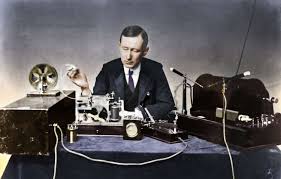
Marconi demonstrating apparatus he used in his first long-distance radio transmissions in the 1890s. The transmitter is at the right, the receiver with paper tape recorder at the left.
Feeling challenged by sceptics, Marconi prepared a better-organised and documented test. In February 1902, the SS Philadelphia sailed west from Great Britain with Marconi aboard, carefully recording signals sent daily from the Poldhu station. The test results produced coherer-tape reception up to 1,550 miles (2,490 km), and audio reception up to 2,100 miles (3,400 km). The maximum distances were achieved at night, and these tests were the first to show that radio signals for medium wave and longwave transmissions travel much farther at night than during the day. During the daytime, signals had been received up to only about 700 miles (1,100 km), less than half of the distance claimed earlier at Newfoundland, where the transmissions had also taken place during the day. Because of this, Marconi had not fully confirmed the Newfoundland claims, although he did prove that radio signals could be sent for hundreds of kilometres (miles), despite some scientists' belief that they were limited essentially to line-of-sight distances.
On 17 December 1902, a transmission from the Marconi station in Glace Bay, Nova Scotia, Canada, became the world's first radio message to cross the Atlantic from North America. In 1901, Marconi built a station near South Wellfleet, Massachusetts, that sent a message of greetings on 18 January 1903 from United States President Theodore Roosevelt to King Edward VII of the United Kingdom. However, consistent transatlantic signalling was difficult to establish.[53]
Marconi began to build high-powered stations on both sides of the Atlantic to communicate with ships at sea, in competition with other inventors. In 1904, he established a commercial service to transmit nightly news summaries to subscribing ships, which could incorporate them into their on-board newspapers. A regular transatlantic radio-telegraph service was finally begun on 17 October 1907[54][55] between Clifden, Ireland, and Glace Bay, but even after this the company struggled for many years to provide reliable communication to others.
The role played by Marconi Co. wireless in maritime rescues raised public awareness of the value of radio and brought fame to Marconi, particularly the sinking of RMS Titanic on 15 April 1912 and RMS Lusitania on 7 May 1915.[56]
RMS Titanic radio operators Jack Phillips and Harold Bride were not employed by the White Star Line but by the Marconi International Marine Communication Company. After the sinking of the ocean liner, survivors were rescued by the RMS Carpathia of the Cunard Line.[57]Carpathia took a total of 17 minutes to both receive and decode the SOS signal sent by Titanic. There was a distance of 58 miles between the two ships.[58] When Carpathia docked in New York, Marconi went aboard with a reporter from The New York Times to talk with Bride, the surviving operator.[57] After this incident, Marconi gained popularity and became more recognised for his contributions to the field of radio and wireless technology.[59]
On 18 June 1912, Marconi gave evidence to the Court of Inquiry into the loss of Titanic regarding the marine telegraphy's functions and the procedures for emergencies at sea.[60] Britain's Postmaster-General summed up, referring to the Titanic disaster: "Those who have been saved, have been saved through one man, Mr. Marconi ... and his marvellous invention."[61] Marconi was offered free passage on Titanic before she sank, but had taken Lusitania three days earlier. As his daughter Degna later explained, he had paperwork to do and preferred the public stenographer aboard that vessel.[62]
Share of the Marconi Wireless Telegraph Company of America, issued 20 August 1913
Over the years, the Marconi companies gained a reputation for being technically conservative, in particular by continuing to use inefficient spark-transmitter technology, which could be used only for radio-telegraph operations, long after it was apparent that the future of radio communication lay with continuous-wave transmissions which were more efficient and could be used for audio transmissions. Somewhat belatedly, the company did begin significant work with continuous-wave equipment beginning in 1915, after the introduction of the oscillating vacuum tube (valve). The New Street Works factory in Chelmsford was the location for the first entertainment radio broadcasts in the United Kingdom in 1920, employing a vacuum tube transmitter and featuring Dame Nellie Melba. In 1922, regular entertainment broadcasts commenced from the Marconi Research Centre at Great Baddow, forming the prelude to the BBC, and he spoke of the close association of aviation and wireless telephony in that same year at a private gathering with Florence Tyzack Parbury, and even spoke of interplanetary wireless communication. In 1924, the Marconi Company co-established the Unione Radiofonica Italiana (now RAI).[63]
Prince Axel was an active member of the Rotary Club of Bologna, Italy.
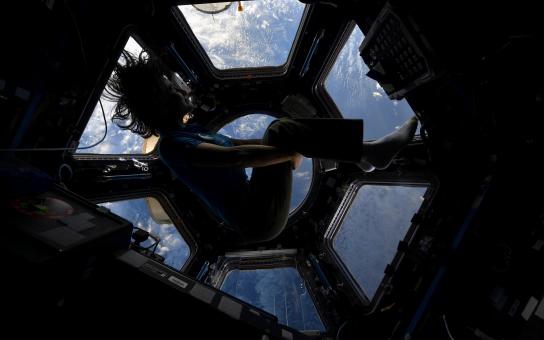
Rotary member and astronaut Samantha Cristoforetti dreamed of space travel since she was a kid. Now, she’s sharing the cosmic awe with her fellow earthlings
Throngs of tourists are overwhelming the world’s most popular destinations. Here’s how to rethink the way you travel — and an alternative bucket list to get you started.