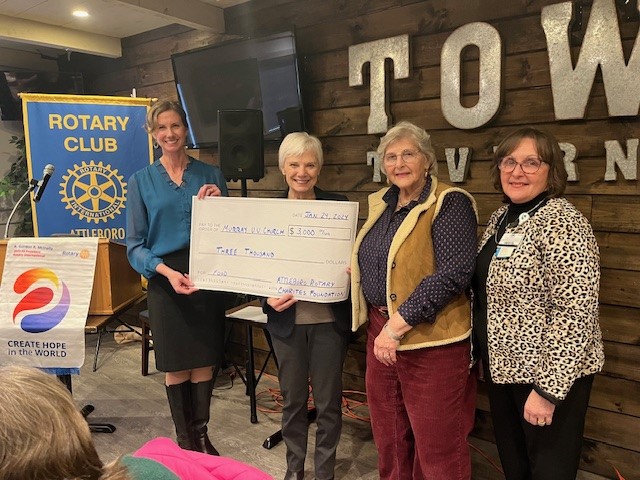
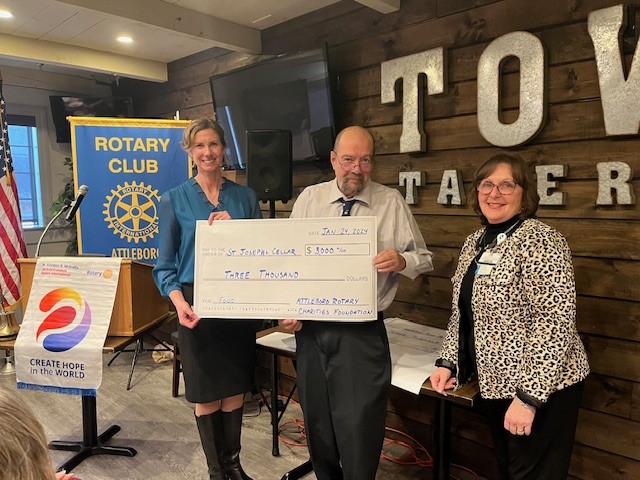
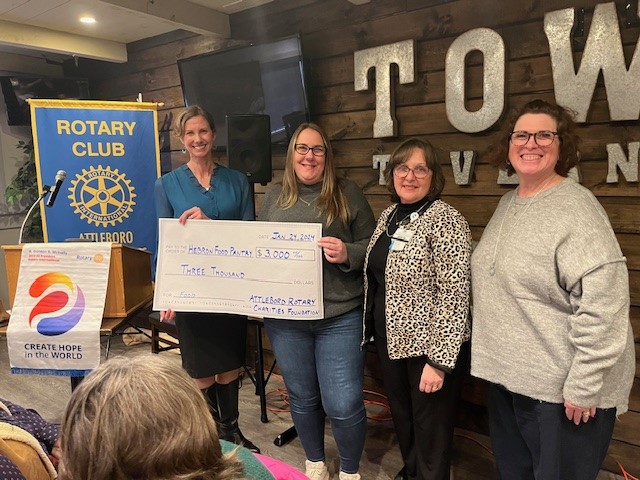
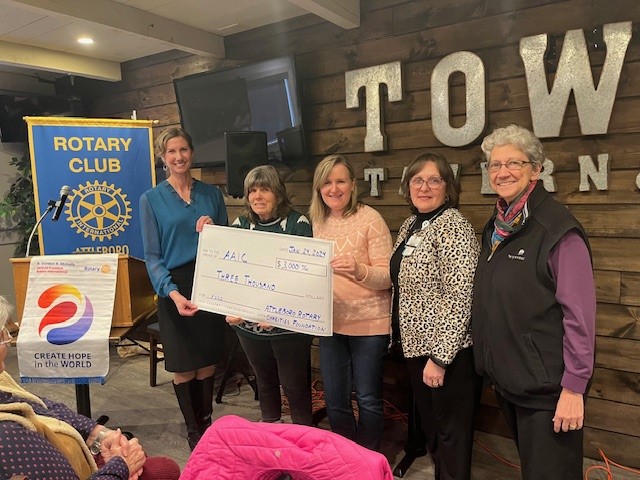
TODAY'S SPEAKER (1/24/2024): Today the Attleboro Rotary Club is hosting four local food pantries and presenting each with a $3,000.00 donation. In attendance will be the Hebron Food Pantry with Heather Porreca and Carissa Phillips; the Attleboro Area Interfaith Collaborative with Marcia Szymanski, Pam Tarallo, and Ellen Sullivan; St Joseph's Food Cellar with Jim Spratt; and the Murray Unitarian Universalist Church with Judy DePue and Russet Morrow.
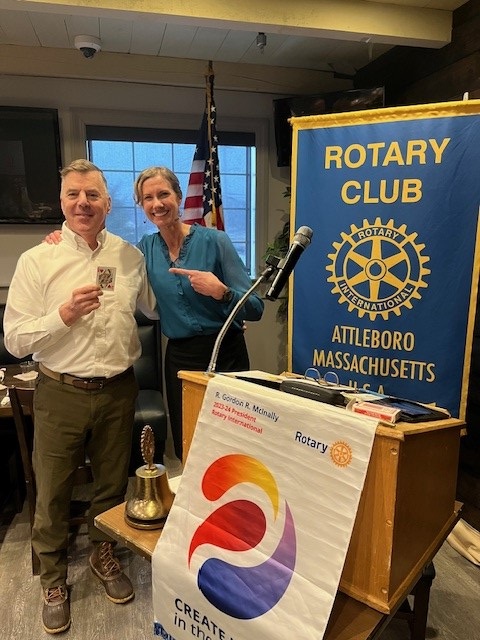
ROTO  : Ed Casey....and he won. Congratulations!!!
GUESTS: Victoria Antonucci, Executive Director of the Attleboro Area Industrial Museum, guest of Joan Pilkington-Smyth.
VISITING ROTARIANS: None
HAPPY BUCKS: Marcia Xzymanski - she's happy to be back and having lunch with the club again!
ANNOUNCEMENTS:
2/15/24 - The ARC of Bristol County will be having a plaque dedication at 9:00am. It will be at the Family support location at 140 Park Street, 3rd floor.
2/17/24 - Winter Festival from 4:30pm - 7:30pm; volunteers needed
4/1/24 - Annual Rotary Auction - Gerry and Jim will talk more about this at next weeks meeting.
**Todd is still working on a date for the soup kitchen, but we are probably looking at March.
Fun Fact: Food Pantries
The world's first food bank was
St. Mary's Food Bank in
Phoenix, Arizona, founded by
John van Hengel in 1967. According to sociology professor Janet Poppendieck, the hunger within the US was widely considered to be a solved problem until the mid-1960s. By the mid-sixties, several states had ended the free distribution of
federal food surpluses, instead providing an early form of food stamps which had the benefit of allowing recipients to choose food of their liking, rather than having to accept whatever happened to be in surplus at the time. However, there was a minimum charge and some people could not afford the stamps, leading to severe hunger.
One response from American society to the rediscovery of hunger was to step up the support provided by
soup kitchens and similar civil society food relief agencies – some of these dated back to the
Great Depression and earlier. In 1965, while volunteering for a community dining room, van Hengel learned that grocery stores often had to throw away food that had damaged packaging or was near expiration. He started collecting that food for the dining room but soon had too much for that one program. He thought of creating a central location from which any agency can receive donations. Described as a classic case of "if you build it they will come", the first food bank was created with the help of
St. Mary's Basilica, which became the namesake of the organization.
Food banks spread across the United States, and Canada. By 1976, van Hengel had established the organization known today as
Feeding America. As of the early 21st century, their network of over 200 food banks provides support for 90,000 projects. Other large networks exist such as
AmpleHarvest.org, created by
CNN Hero and World Food Prize nominee Gary Oppenheimer which lists nearly 9,000 food pantries (1 out of every 4 in America) across all 50 states that are eager to receive surplus locally grown garden produce from any of America's 62 million home or community gardeners.
In the 1980s, U.S. food banks began to grow rapidly. A second response to the "rediscovery" of hunger in the mid-sixties had been extensive lobbying of politicians to improve welfare. Until the 1980s, this approach had a greater impact. In the 1970s, U.S. Federal expenditure on hunger relief grew by about 500%, with food stamps distributed free of charge to those in greatest need. According to Poppendieck, welfare was widely considered preferable to grassroots efforts, as the latter could be unreliable and did not give recipients consumer-style choice in the same way as did food stamps. It also risked recipients feeling humiliated by having to turn to charity. In the early 1980s,
Ronald Reagan's administration scaled back welfare provision, leading to a rapid rise in activity from grassroots hunger relief agencies. According to a comprehensive government survey completed in 2002, over 90% of food banks were established in the US after 1981. Poppendieck says that for the first few years after the change, there was vigorous opposition from the left, who argued that state welfare was much more suitable for meeting recipients needs. But in the decades that followed, food banks have become an accepted part of America's response to hunger. Demand for the services of US food banks increased further in the late 1990s, after the "end of welfare as we know it" with
Bill Clinton's
Personal Responsibility and Work Opportunity Act.






.png)