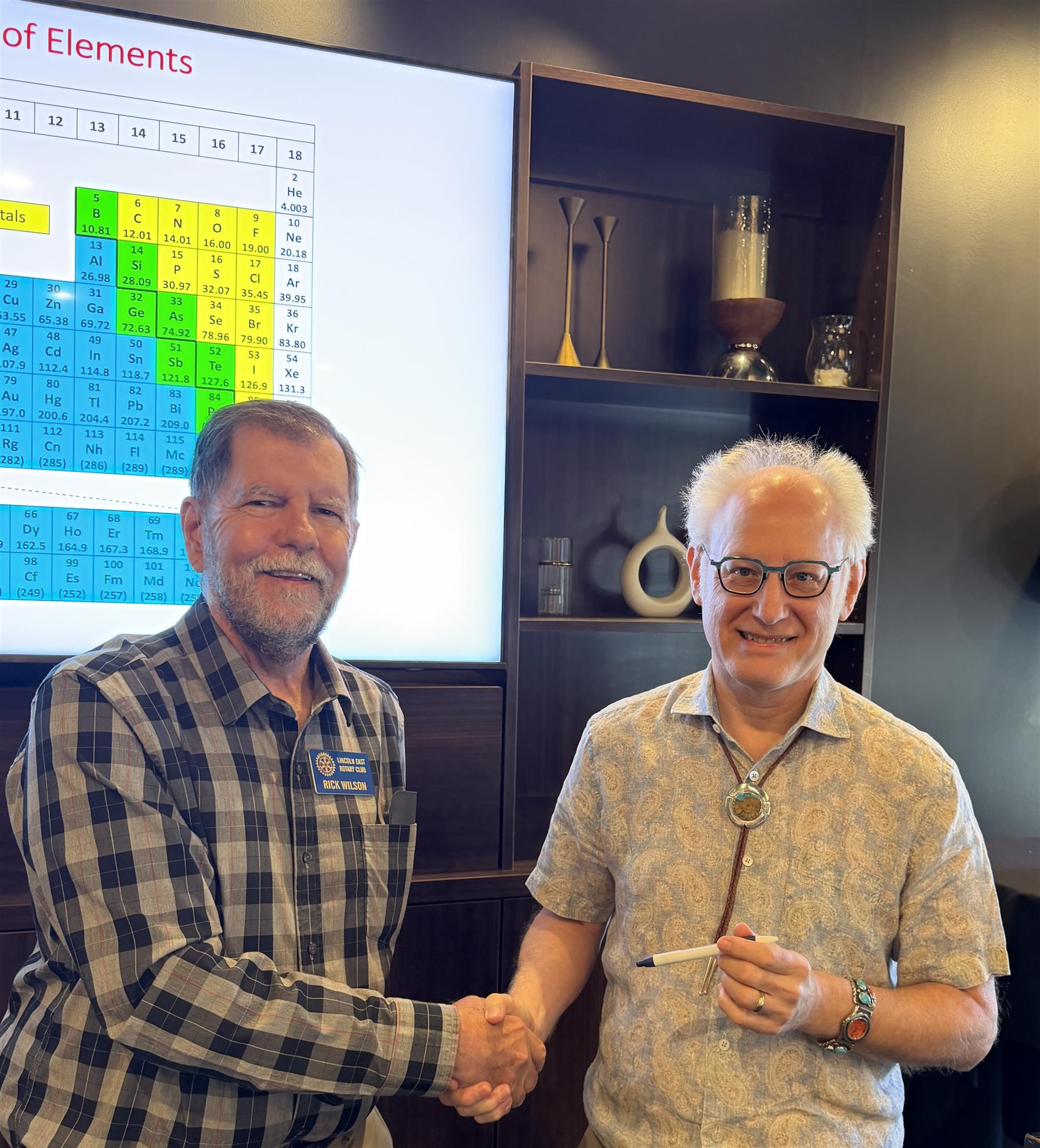
Thank you to UNL Emeritus Professor Mark Griep for the captivating chemistry lesson and overview of the Elk Creek Project southeast of Lincoln.
Mark shared about “Nebraska's Niobium Nirvana,” the Elk Creek Critical Minerals Project located in Johnson County, Nebraska. Led by NioCorp Development Ltd., the project is expected to produce niobium, scandium, titanium and several rare earth products. The materials have uses in the defense and aerospace sectors, steel infrastructure, medical uses, electric vehicles, wind turbines and more.
Niobium, Scandium and Titanium Dioxide:
In the early stages of Earth's formation, the shifting tectonic plates allowed for magma to flow near the surface and deposit niobium. Niobium is a hard, gray transition metal that can strengthen alloys at low temperatures. Jet engines and rockets use alloys with niobium. Fracking will be used for extraction by injecting soapy/salty water into the ground. The mineral rich soil then rises to the top and goes through a refinery process to purify the niobium. Waste-water from this process needs to be handled carefully to avoid any harm to the natural water sources or wildlife in the area.
Mark is an emeritus professor at the University of Nebraska-Lincoln, where he was a chemistry professor for 35 years. His bench research was focused on the function of the enzymes that duplicate DNA in bacteria.
In his teaching and outreach, he developed new ways to make chemistry more engaging, including a partnership with Nebraska’s tribal colleges to connect chemistry laboratory experiments to tribal history, language, and culture. He also co-wrote a book about chemistry in the movies with his wife Marjorie Mikasen, and he managed the chemistry department’s NSF-funded summer undergraduate research experience for 13 years.
Dr. Griep received many awards, including the Hazel R. McClymont Distinguished Teaching Fellow Award from the University of Nebraska-Lincoln College of Arts & Sciences, the Estée Lectureship in Chemical Education from the University of South Dakota Chemistry Department, the Champion of History Award from the Nebraska State Historical Society, and the Helen M. Free Award for Public Outreach from the American Chemical Society.