Disparities and Inequalities in Youth Sports
Steve Dosskey is a soccer coach and substitute teacher for Lincoln Public Schools, also a technologist at Don’t Panic Labs, a data research partner with the Community Health Endowment, and a volunteer with several youth development organizations in Lincoln. Steve spoke to us about the “Disparities and Inequalities in Youth Sports.”
Steve had added free time in his life when the Coronavirus pandemic first hit the United States in the spring of 2020. With the additional time he decided to finally dive into a project he had been thinking about for years. He looked to see if there was a correlation between the number of students on free and reduced lunch and the school’s success on the sports field.
What he found was there is a performance gap in high school sports and he has the data to backup his claim. Steve told us that to find the poverty rate for a school, you take the number of students on free and reduced lunch and divide it by the total student population of the school.
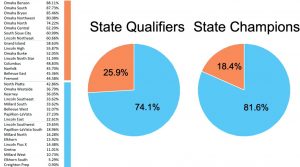
Schools in the bottom half of student poverty level account for 74.1% of state championship appearances and 81.6% of state championships over the last 20 years. When digging through data and trends, there always tends to be outliers. One of the outliers in this data set is Omaha South soccer. In the last 20 years, they’ve won four state championships, received one state runner-up and have 12 state tournament
Alongside the lack of develop, there is another factor that is a detriment to OPS schools: the cost of equipment. The average price of golf clubs is around $360 dollars, a price that many schools cannot afford to supply to every golfer. This often puts the cost of equipment on the student and their family.
There are several reasons why these disparities exist – Poverty effects the performance of any student, athletic or academic. Some students do not have access to the opportunity to participant in a sport. That opportunity might be competition level or the quality of the sport. Many students don’t take the full advantage of fully participate in a sport because they don’t have the means to do so.
Students who participate in public youth sports have to look at offerings of sports available, any organizations that might offer the kind of sport they want to participate in, the location, team formation, who is the coaches, the facilities, the equipment available for that kind of sport, and the financial cost. Usually, the public youth sports cost less. If it is a “Club” youth sports you need to look at the same things, but it might cost more.
There are barriers with youth sports and those include: financial costs, equipment needed, location and transportation, family commitments, work obligations, general fitness levels needed, injury prevention, etc. and academic eligibility (especially school sports).
Steve would like to look at other states around the Midwest and the rest of the country to see if the trends he found in Nebraska are repeated. He was able to present and talk about his research and findings at Ignite Lincoln earlier this year. Steve would like to add other type of events, such as school marching bands, and other activities to see if they show the same trends. Due to lack of resources, “not everyone has the opportunity to meet their full potential,” he says. Which is why he wants to bring more awareness to this topic.
“Sports are some of the most enriching and formative a young person can be involved with” he said. “Every kid deserves that opportunity the problem is they are not getting it and the data suggests poverty has something to do with it.” Kids should be in sports because it helps them mature, interact with other kids, and grow.