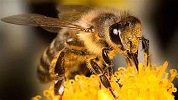
 Warren Nelson, owner of Valhalla Bee Farm, told us about bees. There is the Queen Bee, Workers and Drones. Did you know that bees are very important because they are the leading pollinators in the world. We humans depend on pollinators to help produce food crops. These pollinated crops contribute to one-third of the world’s food supply.
Warren has been in the beekeeping business for 30 years. He distributes his honey in several Nebraska towns, and quite a few stores here in Lincoln. Warren was a State Trooper for 21 years in Sidney, NE before moving to Lincoln in 1991. He thought about going into the beekeeping busy than, and went to a class that the University of Nebraska-Lincoln held on East Campus. His thought was this would be a great hobby when I retire, but it started to get out-of-hand before he retired, but it has been rewarding. He also distributes supplies to those already in the business and helps those who want to get started.
Queen Bee - A fully fertile female specialized for producing eggs. When a queen dies or is lost, workers select a few young worker larvae and feed them a special food called "royal jelly." These special larvae develop into queens. The only difference between workers and queens is the quality of the larval diet. There is usually only one queen per colony. The queen also affects the colony by producing chemicals called "pheromones" that regulate the behavior of other bees.
Workers - Reproductively underdeveloped females that do all the work of the colony. A colony may have 2,000 to 60,000 workers.
Drones - Male bees. A colony may have 0 to 500 drones during spring and summer. Drones fly from the hive and mate in the air with queens from other colonies.
The produce section at your favorite supermarket might end up being reduced by 50% and could pose a major threat to global agriculture if we didn’t have bees to pollinate some of our fruits, vegetables, etc. Some of those foods are apples, lemons, carrots, onions, broccoli, almonds, olives, strawberries and blueberries to name a few.
During certain months of the year, many beekeepers send their hives to California to help pollinate the fruits and vegetables out there. Some of the hives are sent to Maine to help pollinate the blueberries.
Since 2006, some beekeepers have seen about 30% of those colonies disappear. The reasons for the disappearance of the bees can be due to pesticides and insecticides, the spread of viruses and disease, habitat loss, poor nutrition, the varroa mite and stress factors.
The “workers” take care of the Queen and those newly emerged workers begin working almost immediately. As they age, workers do the following tasks, in this sequence: clean cells, circulate air with their wings, feed larvae, practice flying, receive pollen and nectar from foragers, guard hive entrance and forage.
The Queen will mate while flying in the air. The drones (males) mate with the Queen as she is in flight. She usually flies around for about two weeks and can mate with as many as 15-20 males. Once a drone mates, they will die. In September the Queen usually “kicks” out the drones and in the Spring new drones come into the colony. The queen lays all her eggs in hexagonal beeswax cells built by workers. Developing young honey bees (called “brood”) go through four stages: the egg, the larva (plural “larvae”), the inactive pupa (plural “pupae”) and the young adult.
During winter, bees cluster in a tight ball. In January, the queen starts laying eggs in the center of the nest. Because stored honey and pollen are used to feed these larvae, colony stores may fall dangerously low in late winter when brood production has started but plants are not yet producing nectar or pollen. When spring "nectar flows" begin, bee populations grow rapidly. By April and May, many colonies are crowded with bees, and these congested colonies may split and form new colonies by a process called "swarming." A crowded colony rears several daughter queens, then the original mother queen flies away from the colony, accompanied by up to 60 percent of the workers. These bees cluster on some object such as a tree branch while scout bees search for a more permanent nest site - usually a hollow tree or wall void. Within 24 hours the swarm relocates to the new nest. One of the daughter queens that was left behind inherits the original colony.
Beekeeping is not necessarily a profitable occupation, but a combination of things, it can become profitable. One thing you need to do is make sure your neighbors, friends, relatives, etc. understand why you are doing this before you decide to start a bee farm (especially in town). There are classes held at UNL-Lincoln East Campus for one day and there is a monthly class held for two hours at Southeast Community College.
Keep Calm and Buzz On!