When you were a kid, did you go roller skating either on the sidewalk or in a skating rink? Have ever seen a bear skate? Did you know there are different kinds of skating? Well, seven members of Lincoln East Rotary Club enjoyed learning more about the history of roller skating..jpg)
 The National Museum of Roller Skating was established in 1980, located here in Lincoln and is the only one in the world. The goal of the museum is to give all who come here a better understanding of the history of roller skating. With this goal in mind you need to keep in mind that part of the building houses USARS (United States America Roller Skating) which is the national governing body for roller skating. They deal with the business side of the sport.
When you first enter the Museum you find two girls ready to go skating done in bronze. As you enter the Museum you will find displays of the four different areas of competitive skating (speed, derby, artistic, and hockey). There are two display cases on the opposite side of the room that show the history of skating in Nebraska. One display shows the many different rinks located in cities across the state. Lincoln at one time had five, the last to go was located on North 48th Street.
Another display case shows the progression of the roller skate. The first skates had a wooden plate that you strapped your street shoe to, the wheels had no ball bearings so picking up a lot of speed was not possible, and there were no toe stops! With all of these obstacles to overcome skating was a very exclusive activity to engage in. As you walk down the “Hall of Honor” and into the Museum you will find awards along the walls for outstanding coaches, skaters, and individuals who have contributed so much to the sport of roller skating.

History
No one can say with certainly who wore the first pair of roller skates or when this happened. By the mid-1700s experimentation with variations of inline roller skates were common, a design which is a logical extension of the ice skating experience. The precedence of the inline skate to quads often surprises people who believe them to be a recent invention of the Rollerblade Company.
In 1819 M. Petitbled designed the first patented roller skate. The “Petitbled” from Paris, France featured three inline wheels, a wooden plate, and leather straps. The wheels were constructed from wood, metal, or ivory. This was the first mass produced roller skate and is on display at the Museum. Experimentation with inline skate concepts have continued to the present, and because of the recent introduction of the polyurethane wheels, today’s inline skates are restored to viability in competition with the quad skate.
Roller skating had never achieved widespread popularity until the Civil War years, when an American James L. Plimpton invented the first steerable roller skate. He produced this skate initially for his own personal health and recreation. He was the person who actually enabled the roller skates’ popularity, because unlike its predecessors, it was both steerable within the confines of restricted areas of mass participation (rinks), and Plimpton made his skates accessible to potential users throughout the world. He opened the first successful commercial roller skating rink and personally created and supervised roller skating classes to train beginners. In 1863 he had come up with nonsteerable roller skates to be used in “quad” roller skating. Speed skating begin in the late 1800s and early 1900s using quad skates which became quite popular.
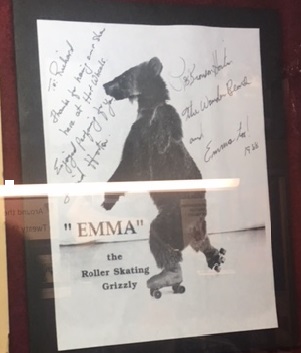
The Museum has exhibits of unusual skates, displays of skate and wheel evolution, vaudeville acts, touring tent rinks, skate box stickers, rink organs, hockey, roller derby, photos of skating animals (such as bears), clothing, different types of toe stops, and a display from Snyder Roller Skate.
Are you wanting to try roller skating? This was a very informative tour.

