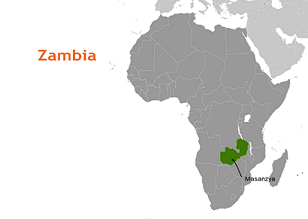
Dan Blankenau told us that the project he is working on is a collaboration between the SAM Project and Rotary International. This collaboration project is comprised of nutrition, agriculture, micro-enterprise and water.
There are 16.2 million people in Zambia and 71.3% employed by agriculture. There are 59% of people who live in the rural areas and 60.5% are below the national poverty line ($1.90/day US). The rural population has 77.9% who fall below the national poverty line. The statistics is much, much worse in southern, drier areas.
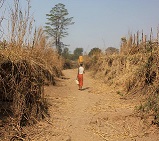
There as no drilling attempts until 2015. It is quite difficult to drill be most drilling attempts fail because there just isn’t much water to be found. They tried eight different attempts and only one successful well was able to be done. Women and children still have to walk less than 5k to access a borehole for water.
The problem is extreme water scarcity. Masansya is a very rural area and it is difficult to drill for a well, especially when you are trying to get water for 1500 people. In Masanzya, women and children walk less than 5km one way to dig for water beneath stream beds and in dangerous, unprotected wells. Some of the other problems are high rates of water-related disease, poor school attendance, especially girls, limited irrigation and food insecurity, limited time for income generating activities, mental/physical stress in collecting water, and gender inequality.
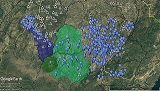
The balloons show where where there are Hand Pumps and the Triangles or Tents show where Earthen Dams are located.
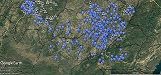
Dan said that their objectives are: SAM/Rotary project would like to increase access to basic water services in the community by 2023. Help establish independent, sustainable maintenance systems for each water source created. They would like increase access to basic sanitation facilities from 15% to 90% by 2023.
The approach that the SAM/Rotary group would follow the Rotary Water and Sanitation guidelines which Dan say was some of the best put together. They would test “new” water supply technologies applicable to difficult drilling environments to get water into new wells. They want to expand Zambia and Rotary Community Led Total Sanitation (CLTS) program into Masanzya.
This can be done through Rotary International’s Global Grants, using the Community Tools that Rotary provides to those doing Rotary projects. This sustainable project is a community involvement. One of the Global Grants has helped them do a hydrogeological assessment survey to help find groundwater.
Dan reported that they are trying to use a Hydrogeologic Assesment Borehole feasibility. Until 2019, all boreholes in the region were sited using a method called 1D resistivity. It is used to identify fractures the rock which could hold the water. Other methods such as 2D resistivity, EM, VLF, and Seismo-electric are more suitable to the regional geology but are difficult to find in Zambia. In 2019, we sourced EM/VLF/Seismo-electric technologies to see if they could improve drilling success.
Known Basalt Dike Detected

They tested these technologies over well understood areas. This gave hope that the technologies could identify structures and water, and they spent three days thoroughly siting in Masanzya and identified three promising sites.
They actually drilled three best sites 80m deep with no water! They came to the conclusions that boreholes are currently unfeasible for cost-effective water security with the current technologies/expertise. They need to diversify the means of finding and harvesting water.
Dan talked about Sand Dams and how they can help with obtaining water. The advantages of Sand Dams are: Sand dams perform best in areas where boreholes perform the worst (poorly-weathered bedrock aquifers); sand filters water while protecting it from evaporation; avoids surface water pooling and malaria; recharges surrounding aquifers; and is proven effective in similar environments (Kenya, Tanzania, Zimbabwe).
They are in the process of testing alternatives with a pilot protected well which will be perfect to install in traditional water points, it will increase amount of water by safely digging deeper, will make abstraction easier, cleaner, and safer. It will be paired with new shallow water pump = very cheap and easy to maintain and the total costs = $600, a tenth of the cost of a borehole and the community very enthusiastic about results.
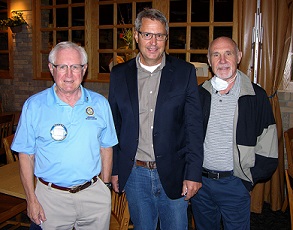
(left to right) Chuck Erickson, Dan Blankenau and Bob Simmering
Thanks Dan for updating of what is happen with the Zambia Project.