 Creating Everything from Nothing
The University of Nebraska, along with 19 other Universities received $11 million at the beginning and now they are sharing $51 million from the National Science Institute to do research on the Higgs Boson. You might ask – What is the Higgs Boson? Dan Claes explained to Lincoln East Rotary Club how the Department of Physics and Astronomy got involved. One thing we learned is that everything has mass.
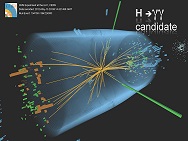
The Bible describes God as creating the cosmos—all matter, space, time, and energy—from nothing, a scenario (known as creation ex nihilo) supported by big bang cosmology. Exploring and understanding the Higgs boson could give us a glimpse into how God went about accomplishing this awesome work. (Hence one reason why some have nicknamed the Higgs “the God Particle.”)
Without the Higgs boson, the universe as we know it would not exist. Research indicates that in the beginning of the universe, all particles were massless, so everything travelled at the speed of light. Moreover, the universe was most likely completely empty since no energy existed to create any particles. However, through a process called the Higgs mechanism, enough energy was released to help power the big bang and create matter. At the same time, the Higgs mechanism gave some particles mass, allowing them to come to rest. Without mass, life could not exist.
In the Lincoln Journal Star in December 2021 an article appeared about the University of Nebraska-Lincoln was tapped to lead the research for atom-smashing research. It’s roughly 4,774 miles from the laboratories of the European Organization for Nuclear Research (CERN) near Geneva, Switzerland, to the University of Nebraska-Lincoln. But over the next five years, UNL will play a central role in the behind-the-scenes work being done at the Large Hadron Collider, the 16.6-mile-long tube where physicists smash atoms into one another at near the speed of light in order to study the aftermath. UNL was named the leader of the US Compact Muon Solenoid Operations Program in early December, putting it in charge of a $51 million grant — among the largest in school history — from the National Science Foundation to prepare the collider for another run later this decade. Taking over leadership from Princeton University, UNL is the steward for a project involving 1,200 physicists from 19 different institutions across the country, all working to unveil more of the universe’s secrets.
How the Higgs Boson Works
Most particles have a potential energy surface that looks like a bowl or valley with the lowest point at the origin, where the field of particles is zero (see figure 1). Another way of understanding this potential is to imagine standing at the bottom of an empty swimming pool. In order to get out of the pool you would need to expend energy to climb, no matter the direction. Likewise, energy is required to make a non-zero number of particles.