
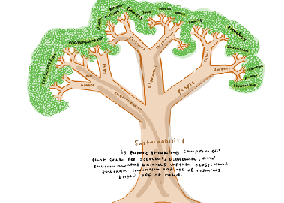
 Dave had students do some graphic work to show what they thought about Sustainability in 2018. In 2019 the students came up with this definition for "Sustainability" -- “the effective, efficient, economic, equitable, and environmentally/socially responsible use of resources to meet our needs that considers the long-term implications of our choices today on the future of Earth’s life support systems and the impact that this use has on all stakeholders involved.”
What does University Sustainability do/mean?
Promote the responsible stewardship of resources and provide leadership in sustainability practices among UNL and its stakeholders that results in the effective, efficient, economic, equitable, and environmentally/socially responsible use of resources in the short- and long-term. The University is like a "mini-city." It has buildings -- design, construction, envelope, maintenance; it has people -- eat, travel/commute, use and demand resources, waste. Therefore, they need to be environmental friendly. The four key ones is: Transportation, energy, solid waste and food.
There are ten themes that they are working to address within three tiers. They are:
Tier 1 - External and Internal Engagement: Administrative Structure
Tier 2 - Teaching, Research and Wellness: Research and innovation, health and wellness, health and wellness mindfulness
Tier 3 - Facilities and Operations: Water management, transportation, landscape and ecosystems, energy, and waste management
Implementation of Framework for UNL Environment, Sustainability and Resilience Commission --
1) Establish an infrastructure for external and internal audiences to access and support a culture of sustainability and resilience at UNL and in the community. 2) Establish a policy governance and administrative infrastructure that results in a highly-efficient campus with net-zero CO2 emissions and net zero energy readiness by 2050. 3) Catalyze a culture of health, wellness, and sustainability that employs affordable, practical, effective, acceptable, safe and equitable interventions to improve people's ability to live a life within the limitations of Earth's resource and environmental systems. 4) Establish the UNL Center for Mindfulness Education and Research (CMER). 5) Preserve and enhance the natural landscape of University owned ecosystems to improve the quality of life on campus. 6) Establish UNL as a leader in the creation of new knowledge and solving real world problems related to sustainability and resilient systems. 7) Establish UNL as a leader in innovative educational experiences that fosters and promotes a culture of sustainability and resilience within the UNL and broader community. 8) Develop an integrated transportation system with City of Lincoln that promotes multi-modal and sustainable transportation consistent with public health requirement. 9) Create a culture that strives for zero-waste and materials management through a circular economy. 10) Develop the most efficient and effective system for the use and reuse of water through water resource conservation and education.
Grand Challenges that Face the CESRC -- Anti-racism and racial equity, climate resilience, early childhood education and development, health equity, quantum science and engineering, science and technology literacy for society, and sustainable food and water security.
What the UNL CESRC has already done -- Facilities and Operations
1) > $1 million: Recycling Renovation
Plan to standardize bins, signage and provide coherence
2) Integrated pest control management policy, construction and demolition policy
3) Student and divest NU campaign.
4) ASUN passed resolution to make UNL plastic free, offset travel related carbon.
5) BIG TEN: Greening athletics, SDG's in curriculum.
For further information the CESRC go to: https://sustainability.unl.edu/