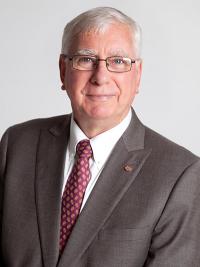
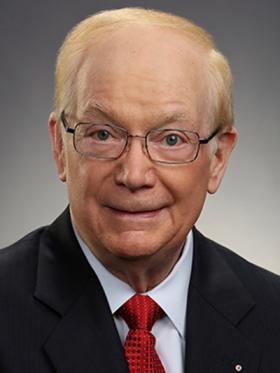
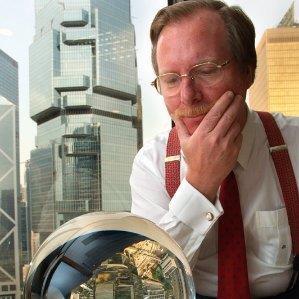
David O’Rear is the Chief Economist at the London General Chamber of Commerce. At the Chamber, Mr. O’Rear manages overall economic policy with an emphasis on taxation, laws, regulations and major industrial sectors. He is responsible for drafting many of the Chamber’s submissions to government on policy issues, including the budget and policy address. He is a regular commentator on current events in print and electronic media. After earning bachelors and masters degrees from the University of California, Berkeley, David moved from his native California to Asia in 1980, first to Taiwan for language study and later to Hong Kong where he has lived and worked since 1984 in the areas of economic, political and business conditions analysis.
Julie Waters, Executive Director of Save Our Students (SOS), with help from staff and students, provided an overview of the services provided by SOS and its history, accomplishments and goals for the future. Rescue, Rebuild, Stabilize and Strengthen are the four pillars that drive SOS trainings, counseling and justice representation outreach.
Some of the statistics that support the comprehensive services SOS delivers to our community are: counseling and education for 155 parents, 165 teachers and 350 college students. SOS also responded to police calls to assess mental health on scene. An estimated 1,820 assessments were provided last year.
Victims of the recent fires who found refuge in shelters throughout the county also were provided with special mental health services for five to six weeks. Needs for this type of counseling are expected to increase over the next year.
SOS services are extended by associates and trainees working on their masters degrees, under the direction of three clinical supervisors. Services that would cost an average of $250 per session are provided on a sliding scale according to ability to pay. Support from Rotary Clubs help to make this possible.
Peer leadership groups created by high school students working with two to three middle and elementary schools, this year, also bring awareness of LGBTQ issues to younger students in small groups that are non-threatening.
Flash Welch, manager of counseling at Rohnert Park/Cotati High School, advised that students showing up for classes are dealing with so many life issues that they are unable to do their school work. Counseling services focus on awareness of stress, including anxiety and depression, and how to overcome these challenges, as well as education on mental illness. He also seeks to provide a protective space for youth who are struggling with gender identity as well as information to help destigmatize mental illness.
Truly a GREAT organization providing badly needed services to those in need!
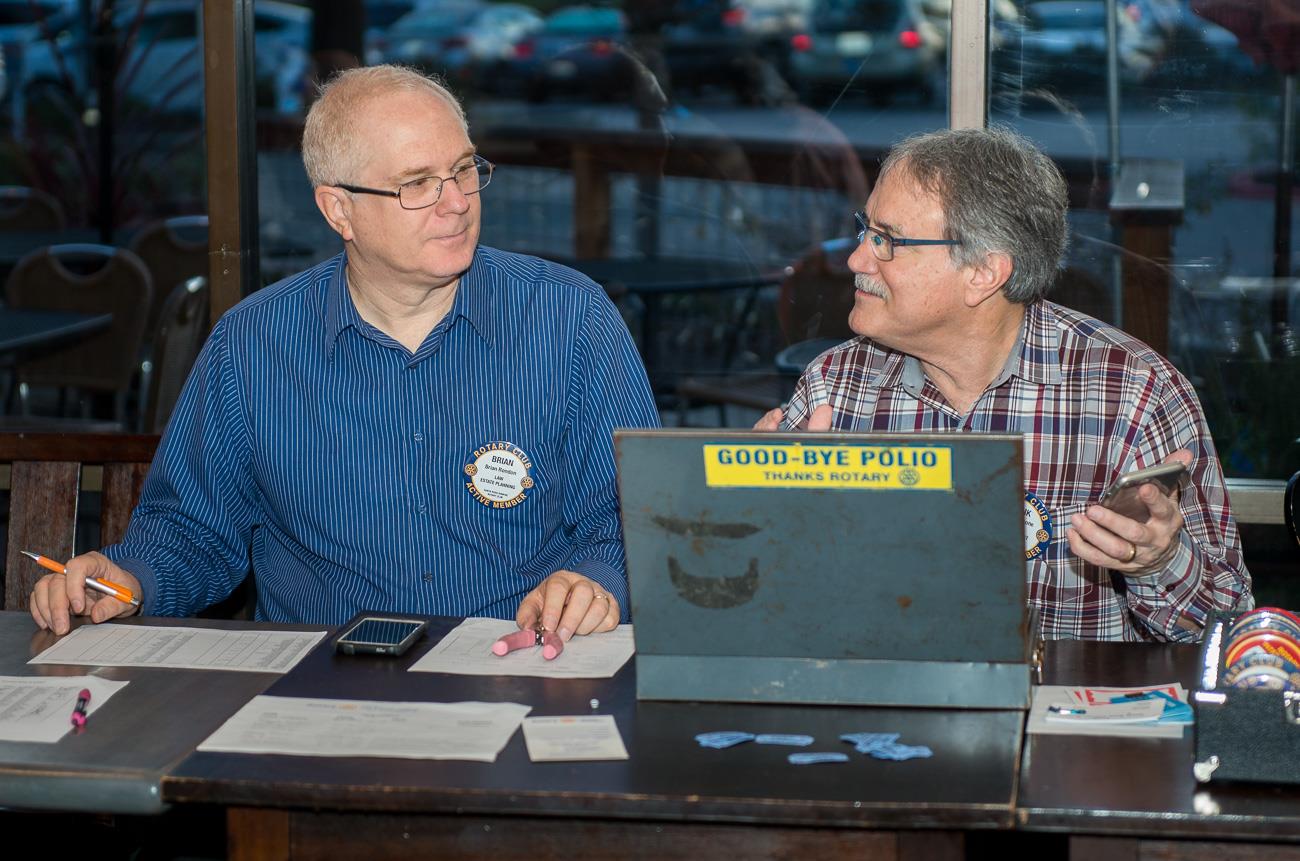
On a regular basis, our resident photo pros Warren Smith and Jack Strange submit pictures of what is going on at the weekly meetings. You can always find the most recent pictures at the websites photo journal called "Meeting Sighting" Please note that all the meeting photos for the entire Rotary year are at this location with the most recent on the last page.
Thanks for all the great pictures Warren and Ross! Link to Meeting Sightings. The most recent are on the last page!
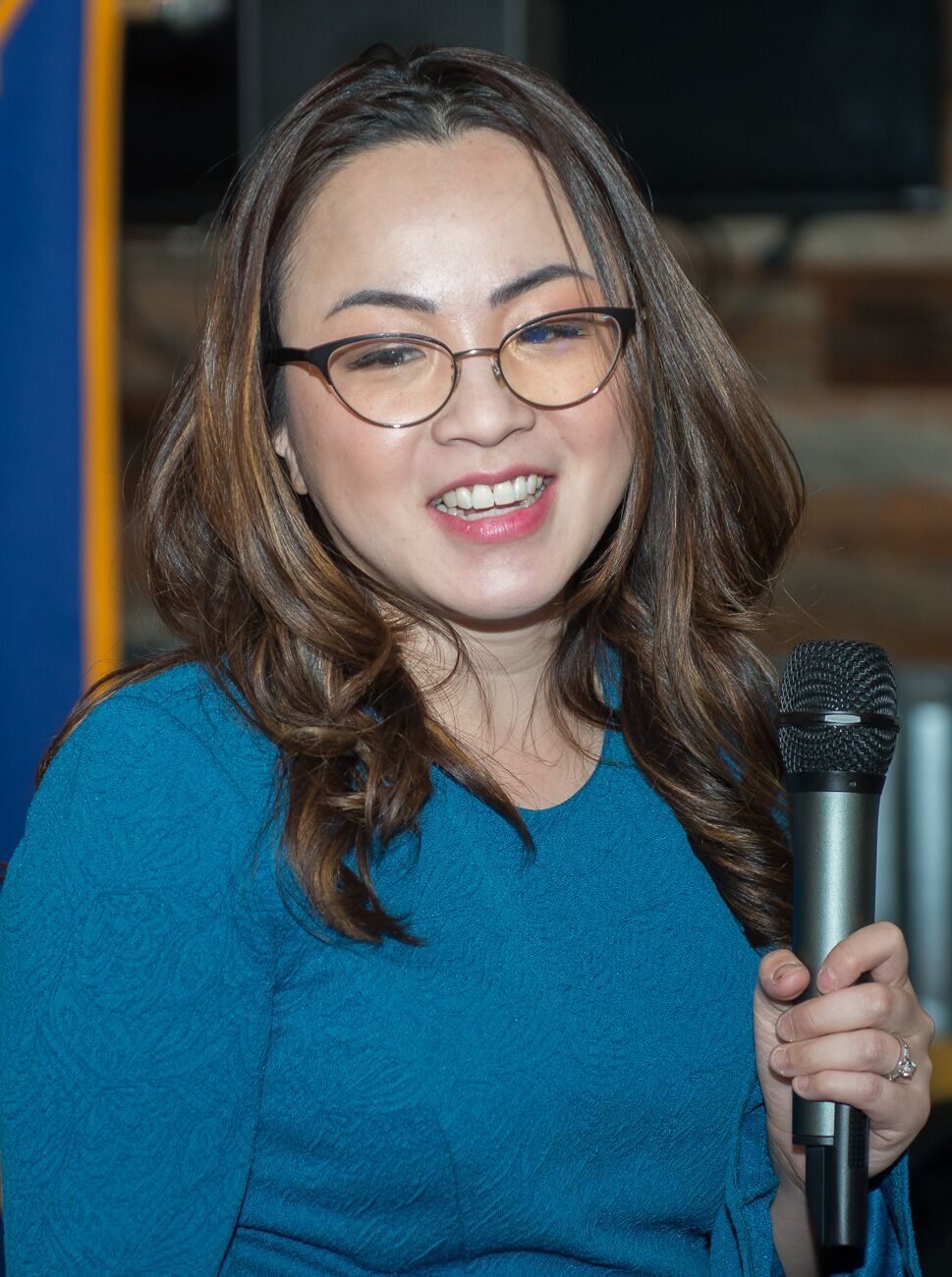
Sunriser Rebecca Poon returned from a family trip visiting both Thailand and Singapore. In addition to tales of a family honeymoon, Tiger Beer and Elephant Pants she also brought back gifts for the pres.
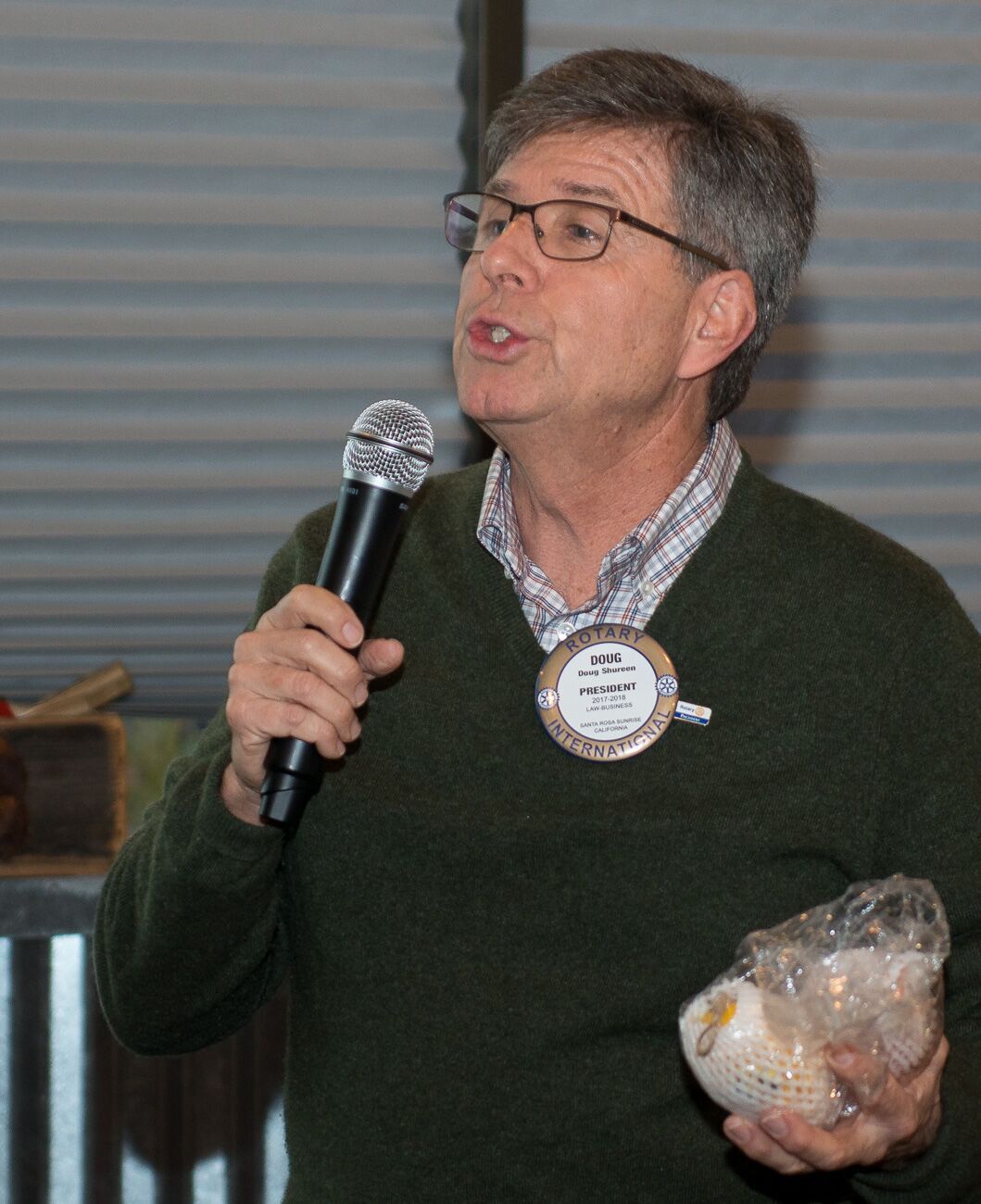
President Doug Shureen was intrigued to learn that Rebecca had brought him back some Elephant Pants. However, she was quick to tell him that the bundle he was clutching was....soap.
$25,000 gift is largest single contribution toward Sonoma County fire relief
President Doug Shureen announced that an anonymous donor has given $25,000 to Rotary for Sonoma County fire relief projects which are being identified and coordinated by members of the club.
Sabalos is a remote area. Dangers abound and accidents can happen -- like Harry Coffey sitting on Steve Herron's glasses. Not to worry. Rotary expeditions carry resources for vision as well as dental needs. And are equipped to meet the needs of one of our own.
Club match adds jewels to Sunriser Paul Harris pins
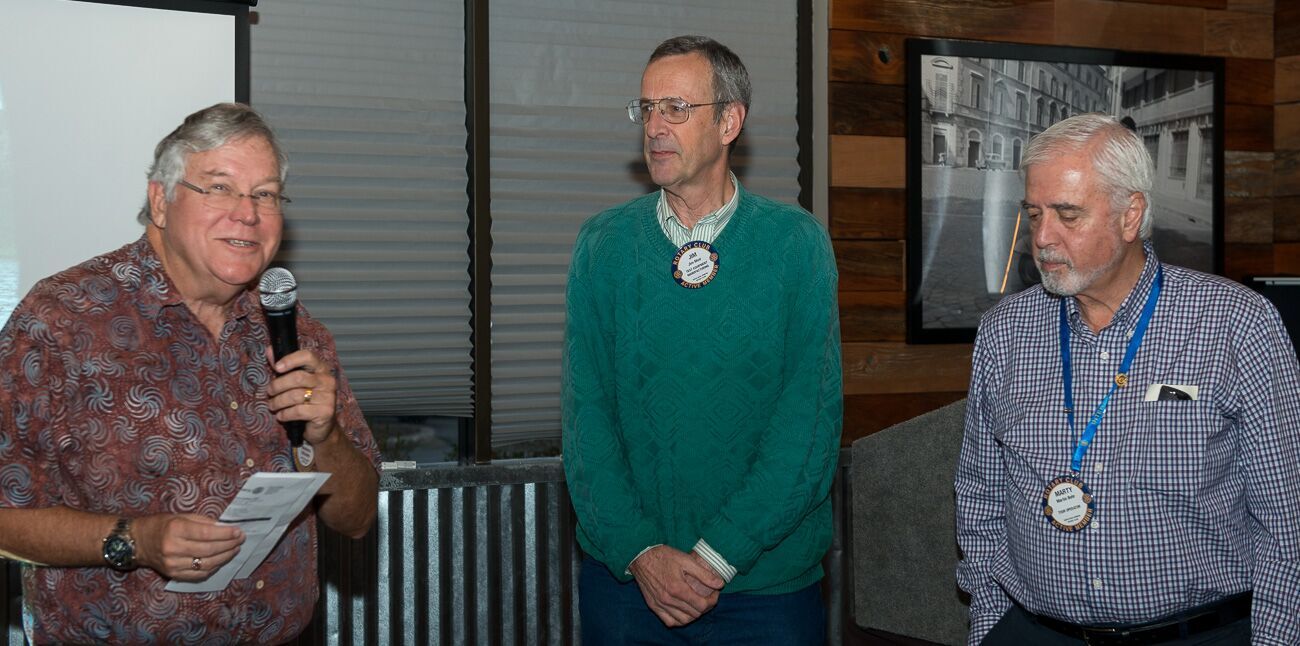
Sunrise Rotary Foundation Chair Randy Seelye acknowledges special gifts, over the past two months, that included gift-matching benefits. Seelye presented jeweled Paul Harris pins to Jim Moir and Marty Behr, who have each contributed a total of $4,000 to the Foundation making them "Paul Harris+3" donors. Photographer Warren Smith (who took this photo) achieves a special "Paul Harris+5" distinction, giving a total of $6,000. Others, not pictured, who also gave above and beyond their initial $1,000 Paul Harris contribution during this period, are Steve Worthen, Steve Herron and Eloise Tweeten.
One hundred thirteen years ago this month, the four members of Rotary's first club held their first meeting. Although no minutes were kept, it's unlikely anyone talked about service; the club did not begin focusing on the needs of the community for another few years.
The meeting was held not in a hotel or a restaurant, but in a member's office; there were, so far as we know, no agendas or announcements, no committee reports, speakers, or nametags. The meeting would have failed today's usual standards for a productive Rotary meeting most resoundingly. It was, of course, the most productive Rotary meeting ever held.
Today, as in 1905, many of us come to Rotary seeking what Paul Harris sought: friendship, connections, a place to feel at home. But today, Rotary gives us so much more than it could ever have given its earliest members in those earliest days. The Rotary of today, more than 1.2 million members strong, lets us feel at home not only in a small group of our peers, but also in our diverse clubs, across our communities, and indeed throughout the world. Today, Rotary connects us all in a way that Paul Harris could never have dreamed on that February evening so long ago. Not only can we go anywhere in the world there is a Rotary club and feel at home, but we can reach out to anywhere in the world there is a Rotary club and make a difference.
In the 113 years since that first meeting, Rotary has become far larger, and more diverse, than those founding members could have conceived. We have gone from an organization that was all white and all male to one that welcomes women and men of every possible background. We have become an organization whose stated purpose is service, reflected in our motto, Service Above Self. And we have become not only an organization that is capable of changing the world, but one that has already done so, through our work to eradicate polio.
None of us can know what lies ahead for Rotary. It remains for all of us to continue to build on the solid foundations that were laid for us by Paul Harris and his friends: to forge and strengthen the bonds of service and friendship through Rotary: Making a Difference.
On 23 February, Rotarians will celebrate World Peace and Understanding Day – the 113th anniversary of Rotary's founding.
Peace has been at the core of our organization from its earliest days. We established the Fourth Object of Rotary in Edinburgh, Scotland, in 1921. We were in London when the seeds were sown for what became UNESCO after World War II. In Havana in 1940, we adopted a resolution calling for "freedom, justice, truth, sanctity of the pledged word, and respect for human rights," which became the framework for the United Nations' Universal Declaration of Human Rights in 1948.
We were active in the formation of the United Nations. In 1945, almost 50 Rotarians served as delegates, consultants, and advisers at the San Francisco Conference when the UN charter was written. Today, almost 73 years later, Rotary maintains the highest consultative status with the United Nations of any nongovernmental organization. A number of our Rotary Peace Fellows work in UN agencies. Rotary's representatives to the UN also host a Rotary Day every November to celebrate our partnership for peace.
Today we also have a new partnership with the Institute for Economics and Peace, which was founded in Australia by tech entrepreneur Steve Killelea. The institute emphasizes what is called Positive Peace, based on eight "pillars": a well-functioning government, a sound business environment, equitable distribution of resources, acceptance of the rights of others, good relations with neighbors, free flow of information, high levels of human capital, and low levels of corruption.
Between now and June, we have the opportunity to participate in Rotary President Ian H.S. Riseley's Presidential Peacebuilding Conferences in six cities across the world. Take a look online at rotary.org/presidential-conferences. We will continue to explore how the eight Pillars of Peace align with our areas of focus.
We also are joining with the University of Chicago to host Pathways to Peace, a series of talks featuring leading scholars, practitioners, Rotary Peace Fellows, and thinkers in the field of peace and conflict prevention and resolution. Watch the first one, which was held in September, at bit.ly/2j9cSUh.
Together with our partners, we will work to establish ourselves as global thinkers and leaders to advance understanding, goodwill, and international peace.
Let us work together on this journey.
Rotary Club of Santa Rosa Sunrise - Founded June 30, 1986


.png)
.jpg)
.jpg)

.jpg)
.jpg)



.jpg)
.jpg)
.jpg)
.jpg)
.png)