banner
Bulletin Editor
Max Bridges
CONTRIBUTORS

Dave Lorenzen - Website

Rich Randolph - Program Summaries

Dicksie Tamanaha - Sunrise Stuff

Sponsors
Interested in being a sponsor?
Download the website sponsorship guide
Meeting Responsibilities
Presiding At Meeting
Shureen, Doug
 
Secret Greeter
Randolph, Rich
 
Greeter
Bridges, Max
 
Thought of the Day
Stark, Jon
 
Pledge Leader
Jen, Ezbon
 
Sunshine Committee
Randolph, Rich
 
Web Site Editor
Lorenzen, Dave
 
Bulletin Editor
Bridges, Max
 
Bulletin Notes First
Randolph, Rich
 
Bulletin Notes Second
Tamanaha, Dicksie
 
Photographer
Smith, Warren
 
Speakers
Aug 31, 2017
Whats new with Habitat for Humanity
View entire list
Upcoming Events
Social with DG Bob
St. Rose Church Business Center
Sep 11, 2017
5:30 PM – 9:00 PM
 
Sep Board Meeting
Interiors Inc.
Sep 13, 2017
5:30 PM – 7:30 PM
 
District Governor Visit
Fountaingrove Inn Conference Center
Sep 14, 2017
7:15 AM – 8:30 AM
 
Living Room Center Social
Living Room
Sep 29, 2017
5:00 PM – 8:00 PM
 
October Board Meeting
Interiors Inc.
Oct 10, 2017
5:30 PM – 7:30 PM
 
Fall Fundraiser
Saturday Afternoon Club
Oct 21, 2017
4:00 PM – 7:00 PM
 
17th. Annual Tribute to our Veterans Day Lunch
Nov 09, 2017
11:30 AM – 1:30 PM
 
November Board Meeting
Interiors Inc.
Nov 14, 2017
5:30 PM – 7:30 PM
 
Guest Day at regular breakfast meeting
Fountaingrove Inn Conference Center
Nov 16, 2017
7:15 AM – 8:30 AM
 
December Board Meeting
Interiors Inc.
Dec 12, 2017
5:30 PM – 7:30 PM
 
Birthdays & Anniversaries
Member Birthdays
Shauna Lorenzen
August 5
 
Nancy Aita
August 8
 
Jim Kirkbride
August 12
 
Ezbon Jen
August 28
 
Spouse Birthdays
Ardys Jones
August 3
 
Shauna Lorenzen
August 5
 
Bob Aita
August 10
 
Ginny Behr
August 13
 
Anniversaries
Steve Amend
Kathleen Amend
August 4
 
Steve Worthen
Georgia Worthen
August 9
 
Max Bridges
Dee Dee Bridges
August 15
 
Ross Andress
Stacy Drucker-Andress
August 19
 
Stacy Drucker-Andress
Ross Andress
August 19
 
John Jones
Ardys Jones
August 21
 
Paul O'Rear
Penny Millar
August 21
 
Penny Millar
Paul O'Rear
August 21
 
Steve Olsen
Lynn Olsen
August 25
 
Flo Floriani
Wendy Floriani
August 28
 
Join Date
Ezbon Jen
August 13, 1998
19 years
 
Links
Links
Partners of Santa Rosa Sunrise Rotary
What Are My Make Up Options?
How to Contact the Sunshine Committee
Rotary Showcase - SRSR Dental Clinic
SR Sunrise Facebook Page
Youth Exchange - District 5130
SCARC Meeting Schedule
Rotary International Business Portal
Latest "Rotarian Magazine"
Executives & Directors
President
 
President Elect
 
President Nominee
 
Secretary
 
Treasurer
 
Past President
 
Rotary Foundation
 
Membership
 
Service Projects
 
Club Administration
 
Public Relations
 
Stories
The Program for August 24th.

Chris Coulombe

Regulation and Laws on Cannabis Distribution in California


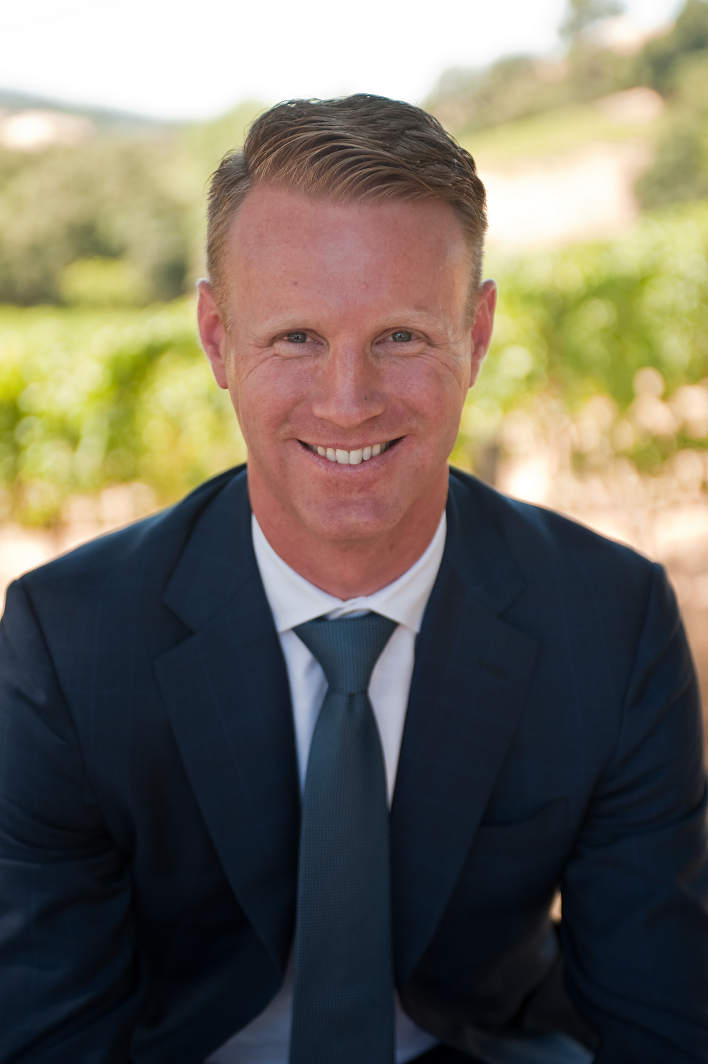
Chris Coulombe is the CEO of Pacific Expeditors, a state-wide medical cannabis distribution company that specializes in logistics and fulfillment operations as well as government relations and business consulting. He has over 16 years of operational planning experience and is responsible for developing and leading one of the largest cannabis distribution operations in the state of California.

Chris works closely with regulators and lawmakers on cannabis distribution in California. He has met with several California legislators, the Governor's office, and the CHP leadership in an effort to improve and better understand the regulatory environment for cannabis distributors.

He is also a founding member of the Cannabis Distribution Association, an industry trade group of over 30 distribution companies in the US dedicated to providing education and a voice to decision makers on behalf of distributors nationally.

Before entering cannabis space, Chris served in the military for 16 years and has led teams of four to organizations over two hundred. He has been hand-picked to lead specialized teams and institutional development schools. As well, he has planned for and facilitated the support of operations for organizations of over 1,100 members.

Chris holds a B.A. in Politics from the University of San Francisco and a M.A. in Corporate Diplomacy from the oldest military university in the US, Norwich University.

He also serves in his former Boy Scout Council as the Council President of 1,000 Scouting youth and 2,000 adult volunteers: if Chris has a cause it is building the future through our decisions and actions and preparing our youth to be ready to make their future better than we could for them.

Learn everything about the new law as it effects us and our community.


Program Summary

Dr. Cyriaque Beurtheret

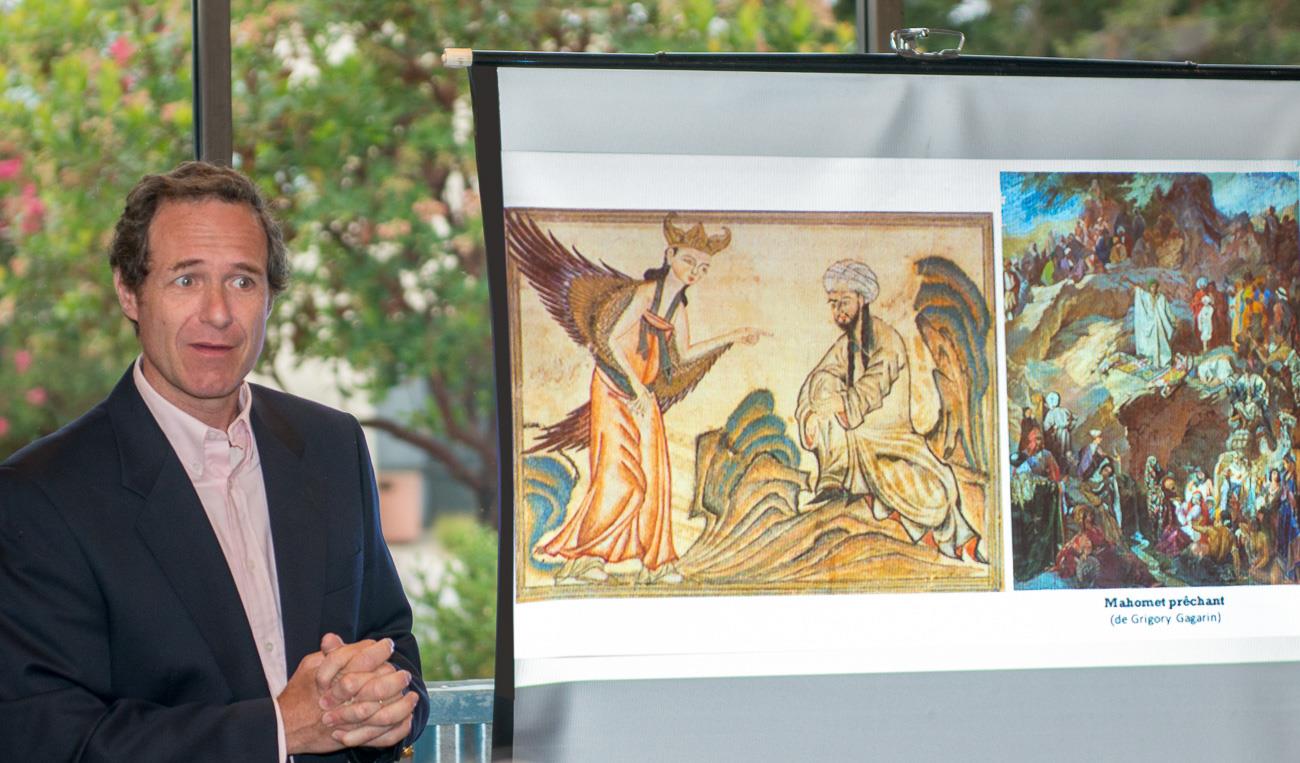
The Origins of Islam


Dr. Beurtheret provided a very detailed and informative look into the origins of Islam from the "Western" perspective. He also provided a look into the history of the Quran and the life of Muhammad. There is no historic mention of Muhammad until 40+ years after his death!

He described the development of Islam from Mecca, Saudi Arabia, India and China.


Photo of the Week

Photo of the Week 


On a regular basis, our resident photo pros Warren Smith and Jack Strange submit pictures of what is going on at the weekly meetings. You can always find the most recent pictures at the websites photo journal called "Meeting Sighting" Please note that all the meeting photos for the entire Rotary year are at this location with the most recent on the last page.

Thanks for all the great pictures Warren and Ross! Link to Meeting Sightings. The most recent are on the last page!

Additional photos may be found on the SR Sunrise Facebook Page.


Pedal for Polio

District Pedals for Polio Eradication


Dear Sunrise Rotary
 
Fellow Sunrise Rotarian Peter Hoberg successfully completed the 350 mile Pedaling 4 Polio bike ride Saturday along with a cycling team from our Rotary District that started in Crescent City and ended in Petaluma.
 
The team will have raised significantly more than $50,000 to support Rotary's efforts to eradicate polio. 
 
Thank you all for pledge support of Peter on the ride. Your donation to the Rotary Foundation will count toward a Paul Harris Fellow award.
 
Please make out your check to "The Rotary Foundation" and put "PolioPlus" in the memo field.   Checks will be collected at the Sgt.-At-Arms check-in table and I will send them to RI.
 
BUT WAIT,  there's more........
 

Hi, I’m Bob Rogers, and I have the honor and privilege of serving as your District Governor for this next Rotary year. 

As you may all know, The Gates Foundation, for the last 4 years, has offered us a 2:1 match for PolioPlus funds, up to $35 million per year.  At the Rotary International Convention in Atlanta last month Bill Gates Jr. announced they will continue the 2:1 match, and have INCREASED the match to $50 million (from $35 million) and extended it for 3 years.

To that end, District 5130 will strive to do it’s part to help raise that $50 million, by staging a 6 day bicycle ride, from one end of our district to the other called Pedal 4 Polio. A dedicated cadre of Rotarian bike riders will ride from Crescent City to Petaluma and solicit pledges for their rides, at the very minimum, of 10 cents per mile (Remember the March of Dimes?).  10 cents times 350 miles equals $35.  If each and every one of us in this district donated $35 towards a rider, that would amount to $84,000 (And after the Gates match, $252,000)…That’s “Making a Difference”  Please consider supporting your favorite rider.  Right now the list of riders are, in no particular order:

 
Again, thank you for your support!
 
Randy Seelye                                                     
Club Rotary Foundation Chair                              
 
Peter Hoberg
Sunrise Rotary Secretary & P4P Team


Rotary Day at the Laguna


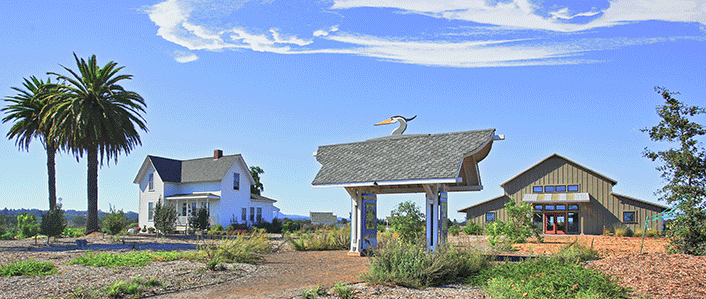
Rotary Day at the Laguna Environmental Center
30 Volunteers Needed for Facility Repairs & Gardening!
All ages and abilities welcome. Tools and training provided.


Date: Saturday, September 9, 2017 9am-3pm (lunch provided)
Location: 900 Sanford Rd (corner of Occidental Rd), Santa Rosa

Projects include: installing a “Stump Jump” in the Children’s Playscape, touch-up sanding/painting, tool repair, weeding and mulching, etc.

No experience needed. Wear clothes that can get dirty.


Please RSVP to Ellen Harrington, The Rotary Club of Sebastopol
classical_home@msn.com
 

Mission: The Laguna de Santa Rosa Foundation works to restore and conserve the Laguna de Santa Rosa, and to inspire public appreciation for this Sonoma County Wetland of International Importance.


Fisherman Confesses

Scales Come Off Misconception

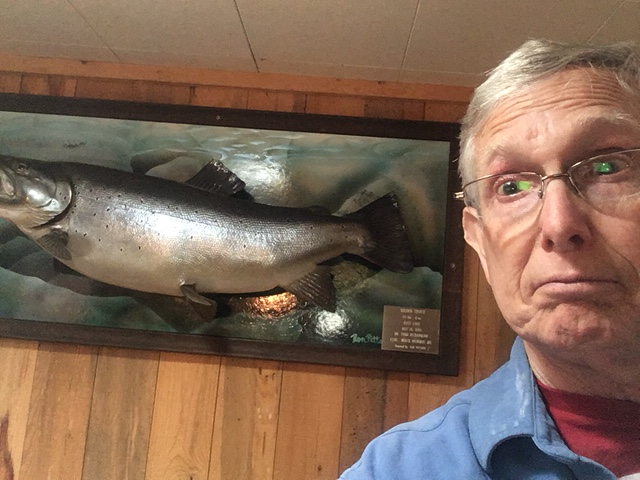
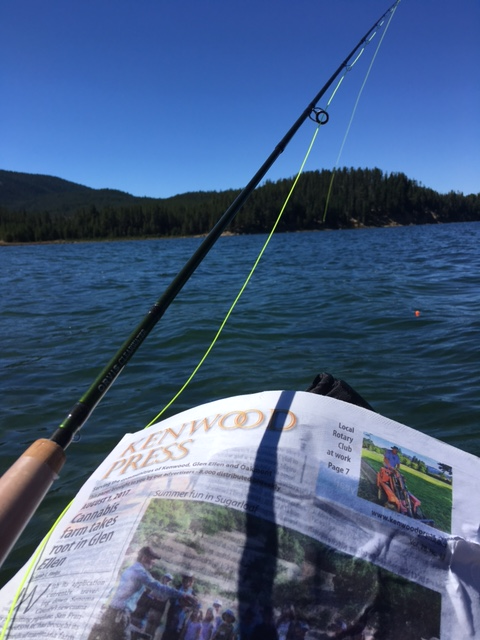
Two terms are often loosely used in angling:  Pole and rod, essential pieces of equipment.  Holding every pole or rod is someone who thinks of themselves as a fisherman, while they actually are a sportsman.  This writer recently discovered his true identity while angling for trout on an Oregon volcanic lake.

Briefly to clarify, a pole is a stick of varying length to which a line is attached, commonly with on a reel.  A rod is also a stick of varying length, with a line attached, but always via a reel.  Fish may, and are caught of both.  Cost, quality, countries of origin vary, as does the skill required to coordinate stick, line, reel and the essential "tackle", aka fish's foe, the lures, bait holders, flies, weights, jigs etc to name a few.  So much for the gear.  Here is this anglers confession.

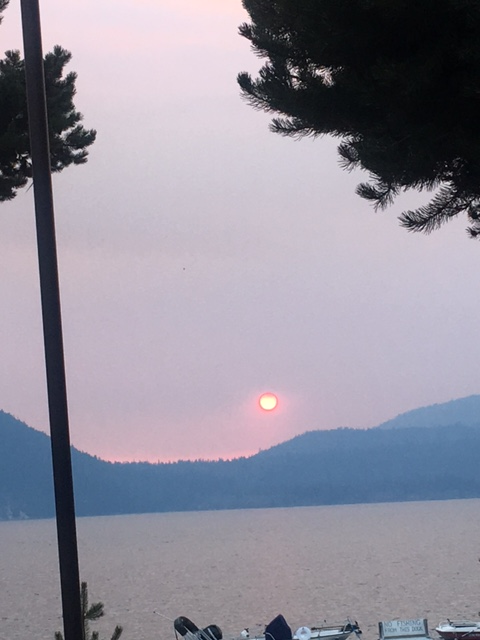
(This is not the eclipse, but smoke from nearby forest fires, about 150 miles from Madras OR, eclipse prime view city. Eyes burned and the sky did darken)

I thought I was going fishing.  Many trips before, spanning half a century my tackle box rattled along, anticipating a day on the lake, or stream-side, even ocean-bound.  Were I to be asked what I was doing, my obvious answer would have been "going fishing".  I know now my words would have been wrong. In reality I was an active sportsman.  Any fish caught would be secondary to the pursuit.  Consumption has long become anathema to most sportsman.  Catch and release is the sporting norm.  In my locale, naturally occurring mercury rendered the catch and release even more appealing.

So what distinguishes a fisherman from a sportsman?   For me and my two compadres it was partly pride.  We could accept our  400 mile+ trek and low catches (I got one, the other guys 6-9 depending on technical definitions of catching) as gaining experience as sportsmen, rather than admitting defeat (failure) as hunter/fishermen.  What is more, angling for trout alone is a cerebral game:  Are they feeding on egg layers, emergers, wooly buggers, shady ladies or not at all?  Sure, worms and salmon eggs can catch fish in some waters (not Oregon), but the sport of matching wits with a particular fish in a particular water body can transport an active imagination into realms ordinarily occupied by species with gills and scales.  

Whether you use a pole or rod, fish or sport, keep on casting and take a kid along.  You just may find another under your own hat!


News From RI

Rotary Community Corps lets local volunteers tap into our organization’s network


Mobilizing more than 200,000 volunteers across 92 countries, the Rotary Community Corps expands Rotary’s reach by bringing the knowledge and talents of local people to projects in their communities. 

Sponsored by a local club, corps members are not Rotarians but can tap into the Rotary network. 

Conceived as the Rotary Village Corps during the term of RI President M.A.T. Caparas in the late 1980s, the Rotary Community Corps (RCC) was initially viewed as a program for the developing world. 

Even today, most of the 9,400 RCCs are concentrated in India, followed by the Philippines and Africa. About 60 are sponsored by clubs in the United States; Canada hosts four. Every community corps differs in size and scope. Meet four of them.

Leticia, Colombia

In 2010, rains thrashed Colombia, flooding nearly 4,000 square miles of farmland and coastal villages – including Leticia, an impoverished community reliant on the shrimp harvest. 
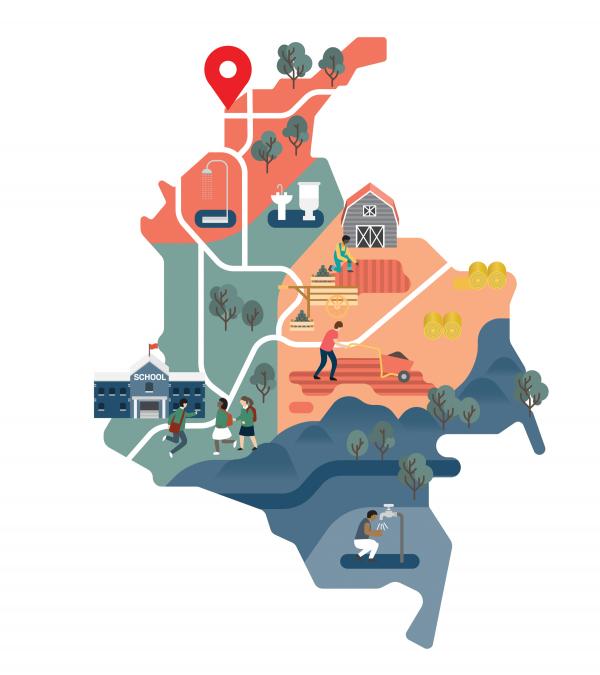
“It was completely flooded. You had to go house to house in boats,” says Carolina Barrios, a member of the Rotary Club of Cartagena de Indias, which delivered essentials to the community of about 400 people in the immediate aftermath of the storm. “But when the floods passed,” Barrios says, “we could not just leave this community by itself.”

The Cartagena Rotarians wanted to help revitalize Leticia. But the journey there was difficult – a 45-minute drive from Cartagena, followed by another 45 minutes aboard a motorboat. 

“This community doesn’t receive a lot of assistance because it’s so far away,” says Barrios. 

To bolster the relationship, the Rotarians recruited residents for a Rotary Community Corps.

“We got a leader from each block,” Barrios says. “All the elected leaders in Leticia are women. At the time, our club was also all women. It was easy for us to relate to them.”

Initially, Barrios says, the members of the RCC of Leticia were not always on the same page. “But they have developed the ability to solve problems in an amicable way, because they know they are important to the community.”

One thing the village struggles with is adequate sanitation. “We asked them for their solutions,” says Barrios. Asking people from the community to do their own assessment and come forward with solutions to problems is a core principle of RCCs. 

After putting together a needs assessment, the Leticia RCC members worked with districts 4271 (Colombia) and 5280 (California) and the Rotary clubs of Los Angeles and Woodland Hills, Calif., on a $38,000 global grant to install a basic sanitation system that included 25 septic tanks and 25 bathrooms, each including a toilet, shower, and sink. 

Members of the RCC monitor the system to ensure that it is working properly. 

Using other funding, the corps also beautified a church that serves as a community hub, equipping a small room with computers, improving a playground, and planting trees. 

New friendships have developed. We have music, we have dances, we eat together. The RCC members consider us part of the family. It’s also been important for our growth as a club.


Rotary Club of Cartagena de Indias

In 2015, the high school that serves Leticia and the nearby village of El Recreo faced closure. 

Members of the Rotary club encouraged the women in the RCC to go to the municipal offices and advocate for their rights. The appeal spared the school and brought a new Rotarian into the Cartagena de Indias club – the local secretary of education, Clara Inés Sagre Hernández – and resulted in a new RCC in El Recreo. 

“New friendships have developed,” Barrios says. “We have music, we have dances, we eat together. The RCC members consider us part of the family. It’s also been important for our growth as a club.” 

Panay, Philippines

In 2011, when Jerry Olson was president of the Rotary Club of Metro Roxas, Philippines, some members suggested investigating how the club could bring clean water to Ameligan, a remote ward, or barangay, on the island of Panay. 

Olson, now chair of the District 3850 (Philippines) Rotary Community Corps Committee, says the club applied for a Rotary Foundation grant, enlisting the Rotary Club of Pomona, Calif., and District 5300 (California) as international partners.

**“We did our homework on how to make the project sustainable,” Olson says – one that would be managed by local people in a new RCC and would provide potable water, helping prevent waterborne diseases and allowing hundreds of children to spend time in school instead of fetching water by ferry from across the river. 

Anchored to withstand the tidal currents of the Panay River, a 5-kilometer line now conveys fresh water to 60 households in the barangay. The line was laid by hand by RCC members and a dozen Rotarians. 

“As a club, we went to Ameligan with professional trainers to teach the residents how to manage their RCC and the water project,” Olson says. “By March 2012, we had laid the piping and built five water stations.” A sixth has since been added.

About 10 members of RCC Genesis Ameligan maintain and administer the water system, collecting payments from the owners of homes linked to the line, as well as from individuals who buy water by the can. 

“The RCC pays the water bill, and the profits are kept in a bank account for maintenance and upkeep,” Olson says. “After super Typhoon Yolanda hit in 2013, the system had many breaks due to trees uprooting, but there was more than enough in the account to repair the damage.”

For Rotary clubs thinking of starting an RCC, Olson says it’s important for the prospective members to take ownership and to understand that their RCC is for them.

“The first step is for club members to go to the area and explain the benefits of having an RCC and see if people really want to form one,” he says. “Then take this information back to the Rotary club and see if the members are willing to put in the time to make the RCC a vibrant one.”

Training corps members, particularly when complex projects such as water systems are involved, is key, says Olson, who adds that continuing oversight by the Rotary club helps ensure sustainability.

“Also, you will need to visit with RCC members four times a year,” he says. “An RCC can also work with their sponsor Rotary club to apply for a global grant if they have a need in a certain area.”

In Ameligan, Olson notes, “The RCC improved the water system by expanding it to more areas on the island that before had never had a clean source of water.” RCC members also plan to use a surplus of $1,200 toward improvements.

Parker, Colorado

Once they leave the public education system, people with developmental disabilities in the United States often lose their social support system and opportunities for friendship and personal development, says Kam Breitenbach, a member of the Rotary Club of Parker, Colo.

**“When they turn 21, the school district is done,” says Breitenbach, a longtime Special Olympics basketball coach who was a special education assistant while her children were growing up. “There’s no place for them to learn or do any leadership activities.” So in 2010, she asked her club’s board of directors to consider starting an RCC for adults with developmental disabilities.

“They said, ‘We’ll try it for six months, and then we’ll review it,’” Breitenbach says. Seven years later, the Parker Rotary Community Corps is still going strong. More than 50 members with varying ability levels participate in service projects and hold meetings patterned after Rotary club meetings. 

“We never had that review,” she notes.

The Parker RCC’s projects range from putting on homecoming dances and proms to stuffing backpacks for needy schoolchildren and filling grocery bags for a local food pantry. In December, the corps members were busy organizing a holiday breakfast at a local senior center and putting the finishing touches on 100 fleece blankets intended for facilities including a local hospital. 

Expecting success from people with special needs yields dividends in self-confidence, notes Breitenbach. 

“When we first started we had a member, Doug, say he would not run for office in the RCC because he didn’t want to be put on the spot,” she says. The RCC had a ShelterBox display at a community event called the Parker Days Festival, and Breitenbach urged people to ask the corps members about the exhibit. “Doug said that changed his life, because he found he could talk to people and they would listen.” He has been the RCC’s sergeant-at-arms for four years.

Enterprising, enthusiastic, and entrepreneurial, the Parker RCC once raised $1,000 in four hours with a car wash. In 2016, the group made a $3,500 donation to End Polio Now. “Everybody knows them all over town,” Breitenbach says. “The members have all kinds of opportunities they would not have without Rotary.”

Swindon, England

In the United Kingdom, induction (or hearing) loops help broadcast sounds for people with hearing loss by generating a magnetic field that is picked up by hearing aids and cochlear implants to lessen background noise and bring conversation to the forefront. 

Under the Equality Act 2010, such loops should be installed in most public buildings, including libraries and council offices. But without anyone trained to activate them, many of the audio-frequency systems (which are based on World War II technology developed by the Royal Navy to detect enemy submarines) remain idle.  

Heeding the call of member Dave King, who worked with a nonprofit focused on hearing loss, the E-Club of West of England started a Rotary Community Corps in the town of Swindon to address the problem.

Tim Mason of the Rotary Club of Cosham, who had started Britain’s first RCC in nearby Malmesbury, formed a steering committee that included the borough councilor and officials from a local hospital and an international insurance company. They recruited 15 people, including two Rotarians. By December 2016, two-person teams from the Let’s Hear in Swindon RCC had checked more than 500 loops around the town. 

“With Let’s Hear, there was a groundswell of people who wanted to improve the situation” for the hearing impaired, and community groups across the country have begun to replicate the project, says Anthony Horn, past governor of District 1100 and a member of the Rotary Club of Swindon Phoenix. 

While England is a latecomer to adopting the RCC model, Horn and Mason see promise for hands-on, technical projects. Members of the RCC in Malmesbury focus on flood control, monitoring the water level of the Avon River, and checking that sluice gates remain free of debris. 

“There was a need for a service group that could help the town,” says Mason. “Rotary Community Corps is a good way for us to recruit volunteers and get them interested in Rotary. It’s an ideal platform for people to start learning what Rotary is all about.”


Rotary Club of Santa Rosa Sunrise - Founded June 30, 1986