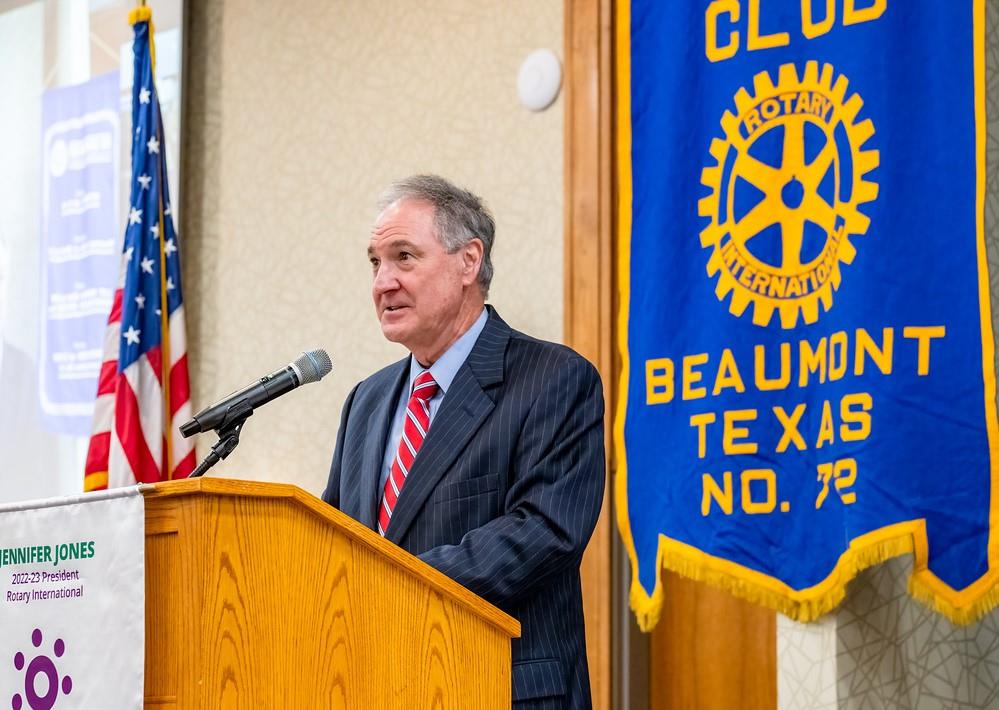
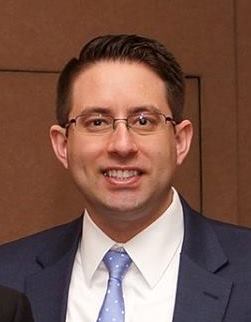
Judge John Stevens
Jefferson County Criminal District Court
by Chuck Heare
Our program on Wednesday came from the Honorable John Stevens of the Jefferson County Criminal District Court where he is entering his fifth four-year term as judge. Judge Stevens started his talk with COVID saying “Who would have ever thought that someone wearing a mask could enter a bank and demand money, and they would be happy to see you?” It has been an amazing time in our country the last couple of years.
He then discussed how the law began in our country with the Declaration of Independence, eighty percent of which was a list of grievances about how the colonists didn’t like the way the British were treating us. The Declaration talks about how all men are created equal and that they are endowed by their creator with certain inalienable rights of life, liberty and the pursuit of happiness or ownership of property.
We then won our independence and found it necessary to adopt a constitution binding us together in a union for our protection and forming a government with three separate branches. The preamble of the constitution he said, sums up the purpose of this union. “We the people of the United States, in Order to form a more perfect Union, establish justice, ensure domestic Tranquility, provide for the common defense, promote the general Welfare and secure the Blessings of Liberty to ourselves and our Posterity, do ordain and establish the Constitution for the United States of America.” Each branch has its own responsibilities and limits – the legislative branch makes laws, the executive branch enforces the laws, and the judicial branch resolves differences in the administration of the laws.
Jefferson County, according to Judge Stevens, is the 22nd largest county in Texas by population. We have in Jefferson County two felony criminal courts. Judge Stevens presides over one and Judge West presides over the other. We also have two courts that handle misdemeanors, four courts that handle civil disputes and two courts that are family courts.
In 2007, the two felony courts were receiving about 3500 new cases per year. The four civil courts received between 15,000 – 20,000 per year. Most were asbestos cases which were transferred to Harris County in 2009. After that the number of civil cases dropped to about 2500 per year.
When COVID hit, the courts were shut down, but the criminals were still active. He said the unfortunate thing about the people who come into his court is that most are uneducated, and they generally don’t have a job. Two thirds of the cases are drug related or are crimes committed because of drugs. Most of them are products of poor parenting.
Judge Stevens went on to say that we have an excellent probation office in Jefferson County. The national average for probation success is 70% and our probation office’s rate stands at 85%. Those in probation get education and help finding jobs. But 15% fail and the penalties for failing probation are extremely harsh.
Judge Stevens has presided over 504 criminal trials since taking office. He said each one is different, and you learn something or see something different in every one of them.
Then Judge Stevens asked the question – All persons charged with crimes are presumed innocent … and he asked us to finish the sentence. Most said “until” proven guilty, but the correct answer is “unless proven guilty.”
He also discussed the phrase dealing with the burden of proof – beyond a reasonable doubt. In Texas, we did not have a definition, then we did, then we reversed ourselves twenty years ago and decided that people can determine what it means.
Judge Stevens then stated that as of March 31, 2022, the felony criminal court had 3000 cases pending and had 3528 cases presented last year. Those on probation are regularly tested for drug use, and if they test positive, probation is revoked. Before COVID, the rate of revocation was about 1 in 8. Now it is 4 out of 5. Drug use is a very serious problem in our county.
Finally, he encouraged all to serve on a jury if called. It is an extremely important part of our legal system in the United States.

.png)


.png)










.jpg)