McDonald said the topic of “personal bandwidth” has been highly requested because of the strange times we’re in due to the global pandemic, which has caused a lot of change and stress, while also preventing stress relief.
She said many people she talks to are experiencing anxiety, irritability, forgetfulness and exhaustion. New terms have been coined to describe these feelings as related to the pandemic: Zoom-haustion and blursday, i.e. every day is a blursday. There is a general feeling of overwhelm and difficulty focusing which has led to the concept of a personal bandwidth.
PERSONAL BANDWIDTH
According to McDonald some people have large personal bandwidths and can manage career, marriage, parenting, exercise, volunteerism and a host of other activities with ease. However, others have small personal bandwidths and are content going to work and spending time with family and maybe exercising daily. Individuals with large and those with small bandwidths can be very successful people. McDonald said problems arise when we compare ourselves to others who have larger bandwidths than we do and when we push ourselves beyond our personal bandwidths.
According to McDonald, when we are in a low state of arousal, we have that fatigue, sleepiness feeling; we’re not operating on all cylinders. We tend to perform at a lower level in a lower arousal state. Our performance improves when we reach optimal arousal. But when we get highly stressed or overwhelmed, our performance decreases. This is related to the concept of bandwidth. When we are pushing ourselves beyond our own personal bandwidth, we decrease our ability to perform no matter what the task is in our life.
SCARCITY
Economists define scarcity as the fundamental problem of having seemingly unlimited human wants in a world of limited resources. McDonald said emerging research shows that we as humans, even if we’re not experiencing poverty-level scarcity, have the same effects on our functioning as those who are.
“When we are pushing ourselves beyond our bandwidth and doing more than we are cognitively, physically, emotionally, psychologically wired to do, we are pushing ourselves into a scarcity mindset.”
McDonald provided some examples. “Scarce energy” is the toll of continual self-sacrifice. McDonald used the image of “The Giving Tree,” where the tree represents the parent who loves the boy so much and gives him everything he needs, shade, branches for climbing and apples he can eat and sell. Eventually, the boy cuts the tree down to build a house. At the end of the book, the tree is a stump having given away everything to the boy. The book reminds us, according to McDonald, that we have to be careful how much energy we give to others and to things that are important to us, to our family, our children, to community effort, to our jobs, “because when we give away too much, it creates an internal experience of scarcity.” The scarcity McDonald reports seeing a lot of is “scarce time.” Time gets filled up quickly, and so we experience time as a scarce resource. “We live in a culture of busyness, where in some realms the busier you are, the higher status is perceived.”
However, we’re learning there are consequences of being overtaxed.
McDonald said we can also create an internal feeling of scarcity by the way we talk to ourselves, saying things like, “I’m not good enough, successful enough, not smart enough.” She says, this internal dialogue can create the same feeling of scarcity, even if we have everything we need to be able to function in our lives.
Being aware of scarcity is important because researchers have discovered that being in a state of scarcity can tax your mind enough to cause a 13-point drop in I.Q. McDonald said indicators of such scarcity is rushing around and making silly errors, like looking for your glasses when they are on your face, locking yourself out of the house, etc. “Scarcity can tax our mind so that it doesn’t work the way it’s supposed to. Fortunately, I.Q. points don’t go away and can come back when you’re not in state of scarcity.”
EXECUTIVE FUNCTIONING
Executive functioning is this suite of self-management tools that our brain has that allows us to move to particular goals and that we rely on to get through the day. They are:
1. Intelligence
2. Decision making: being able to decide what to do next; prioritizing
3. Impulse control: being able to reign in our first emotion or instinct; making good choices
4. Task initiation: being able to get started on something we don’t really want to do; switching between tasks
5. Metacognition: ability to step back from ourselves and see ourselves from an objective place
6. Working memory: being able to take information and use it for something else; post-it notes in the brain
7. Sustained attention: being able to focus on a task until you can complete it
8. Time management: being able to accurately access the passage of time and manage it
9. Emotional regulation: being able to express emotion appropriately for the situation
“I say all of this to make you aware, but to also normalize what some of you may be experiencing these past 9 to 10 months that things have been so crazy and upside down. It’s important to kind of know what’s going on and to be able to figure out what I need to do to get myself out of that state of scarcity.”
McDonald said that one of the things that happens when we’ve taxed ourselves and are in a state of scarcity is that we become disconnected. We don’t want to be around people. We disconnect and this is not good because, she says, an important part of who we are as human beings is connection with others and social isolation is a precursor and predictor of depression.
Another effect of scarcity – cellular deterioration - happens at a lower level of awareness, according to McDonald. The chronic effects of stress are detailed in a book, called, “The Telomere Effect: A Revolutionary Approach to Living Younger, Healthier, Longer.” Scarcity is a form of stress. When we are chronically stressed or in a state of scarcity over time, cell division stops and exacerbates medical conditions.
McDonald provided a “Scarcity Matrix,” (per email via Jacque) for Rotarians to simply assess any scarcity in their lives. McDonald used sleep scarcity as an example and recommended a book, “Why We Sleep: Unlocking the Power of Sleep and Dreams.” She also listed her own scarcities including time alone, intellectual stimulation, free time. She suggested identifying scarcities, addressing them and then making note if irritability, fatigue, emotional regulation, etc. improves once the scarcities are addressed.
RECOMMENDATIONS
From studies, McDonald said we know how to buffer ourselves from scarcity by having a healthy lifestyle - getting enough sleep, 7-9 hours; exercise; eating well; human connection; setting boundaries and asking for what we need.
To set boundaries, McDonald suggested the following script:
I need to X in order to X and the benefit to you is X. Can we work together to make this happen?
Work example: I need to keep our team calls between 8 a.m. and 2p.m. to be fully present with you all and have some uninterrupted time in the afternoon to get strategic work done. Can we work together to make this happen?
Home example: I need to have 20 minutes to myself right after I get done with work in order to be ready to be a good spouse/parent/human and have the opportunity to transition from work to home. Can we work together to make this happen?
Home example: I need to be in bed by 9:30 p.m. in order not to be cranky and cross with you and have the energy to do the things I need to get done during the day. Can we work together to make this happen?
“It really comes down to identifying what you need, asking for what you need and making sure the other person understands that they are probably going to benefit from you not being in a state of scarcity.”
Q&A
Q: How do you choose the best “yes”?
A: It starts with doing an internal assessment of how much time, energy and bandwidth you have already given the things you’ve already committed to, and I think it’s important to figure out what are those things I say ‘yes’ to that are important but deplete us and what are those things we say ‘yes’ to that energize us. For some people volunteer work is really energizing, meaningful and gives them a sense of doing important work in the world. For others, they know it’s important, but it’s very depleting. Give yourself permission to do an assessment first.
Q: How do you deal with the “covid-y blues,” and not keeping yourself too busy?
A: Nobody has blueprint for how to do this (pandemic/covid), but I think I would say the same thing. Assess what really gives you energy, what really is meaningful and what you might be filling up your time with that is preventing you from really getting what you need.
Q: Expand on your previous comments about setting boundaries with family.
A: Yeah, so I will say, ‘I don’t have the bandwidth for that right now; I want to talk about this but can we put this off so I can be fully present in this conversation with you.’ Or If I don’t have the cognitive bandwidth in the moment, I might say, I need to lay down for five minutes and clear my head,’ and I’m a nicer person and more present.
Q: How can we help people who are alone, isolated?
A: Being alone is hard- send cards and letters, Zoom, Facetime, send pictures, email. McDonald also suggested having a good gratitude practice through the pandemic and listing things we took for granted like going to dinner with friends, get-togethers and connection with others. McDonald invited everyone to subscribe to her newsletter by texting “HUMAN” to 33777.
* * * * * * *




.png)
















 While we are practicing social distancing, this is the
 .jpg)











.jpg)
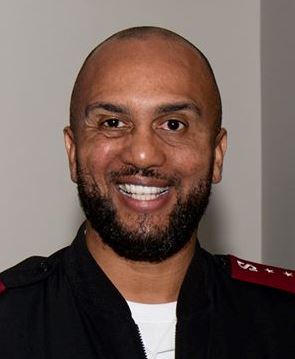


.jpg) We wish Rotarian John Lee a speedy recovery from a head injury he received on Saturday. He was victim of a freak accident when a drill dropped on his head! He was knocked unconscious and it took 15 staples to close the wound.
We wish Rotarian John Lee a speedy recovery from a head injury he received on Saturday. He was victim of a freak accident when a drill dropped on his head! He was knocked unconscious and it took 15 staples to close the wound.