We often talk about the importance of our Rotary pin during our meetings, as it proudly represents our commitment to service, support, and our role as ambassadors of Rotary International. But have you ever considered the benefits of wearing it every day, not just on meeting days?
First, wearing our Rotary pin is a powerful way to let everyone know that you are a Rotarian. It serves as a visible symbol of our dedication to making a positive impact in our local communities and around the world. By proudly displaying our pins, we not only invite others to ask, "What does your pin mean?" but also spark conversations about our mission and the incredible work we do as Rotarians.
These conversations are essential opportunities for us to share the importance of Rotary's values and projects. By engaging with others in dialogue about our pins, we can create awareness and encourage involvement in our endeavors. Each time someone asks about our pins, we have the chance to inspire them to become part of our Rotary family and participate in our life-changing initiatives.
Also, wearing our pins daily serves as a personal reminder of our commitment to being servant leaders. It symbolizes our dedication to good will, friendship, and ethical conduct in all aspects of our lives. As we go about our daily routines, glancing at our pins can reinforce the values we, as Rotarians, hold dear.
In East Texas, our Rotary clubs have made a significant impact, bringing positive change to our communities. But to further amplify our efforts and expand our reach, we need to attract more like-minded individuals. We must actively seek out those who share our passion for service and invite them to join our ranks.
By wearing our Rotary pins every day, we showcase our pride in being part of this incredible organization. We send a strong message: we are devoted to making a difference and are actively seeking others who are willing to join us.
Let us continue to proudly wear our Rotary pins, fostering conversations, inspiring others, and reminding ourselves of our duty as servant leaders. Together, let's attract and ask more like-minded individuals to join us on this journey of service in East Texas.
I personally challenge you to wear your pin, on all the days that end in ‘Y.’
Yours in Rotary,
Tiffany Damskov
District 5830 Public Image Chair
ROTARY HISTORY
How Rotary’s emblem evolved
The Rotary wheel, unchanged since 1924, was redesigned many times in the early years of the organization.
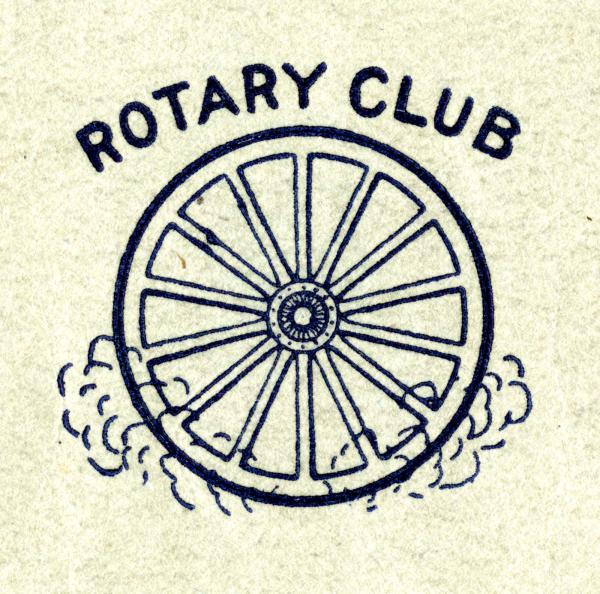
A Rotary Club of Chicago emblem that featured a wagon wheel influenced early logos of other clubs and Rotary International.
Rotary Club of Chicago emblem, circa 1906.
Early club emblem
In 1905, Montague M. Bear, an engraver and member of the Rotary Club of Chicago, sketched a wagon wheel with 13 spokes as a club emblem. When fellow club members began to complain that the design was static and lifeless, Bear added flourishes that made the wheel appear to ride on a bed of clouds. Unfortunately, some members felt the clouds looked like dust, defying the laws of physics by being kicked up on both sides of the wheel. Bear responded by superimposing a banner with the words “Rotary Club” over the clouds.
Early association emblem
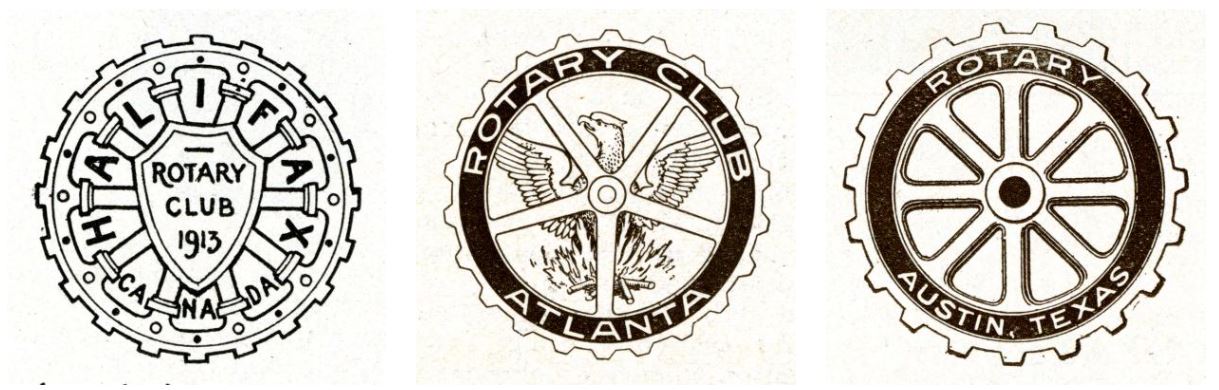
In 1911, Secretary Chesley R. Perry recommended that “action be taken by the National Association to establish the wheel as the basic part of the emblem of every Rotary club.” Clubs were invited to submit designs to an emblem committee before the 1912 convention in Duluth, Minnesota, USA.
The Duluth convention provided some definition. “The emblem consists of the basic principle of a wheel with gears cut on the outer edge. ... The spokes are to be so designed as to indicate strength; the object of the gears, or cogs, being two-fold: First to relieve the plainness of the design, and Second, to symbolize power.”
The word “Rotary” appeared at the top and “International Association” at the bottom. (Rotary became an international organization in 1912.) Clubs were encouraged to use a similar design, placing the name of their city at the bottom instead of “International Association.” The number of spokes and cogs was unspecified. As a result, many variations on the emblem were in use by 1918.
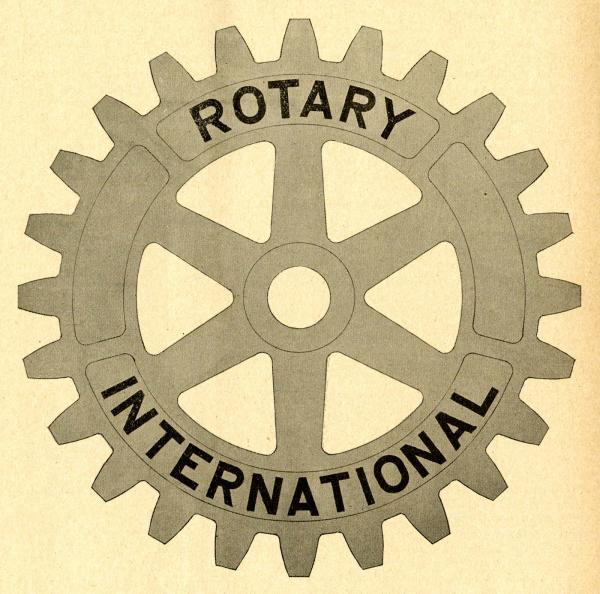
Oscar Bjorge’s design for the Rotary emblem, as published in the January 1920 issue of The Rotarian.
A standard emblem
To address the growing number of emblems, the Board appointed Charles Mackintosh, of the Rotary Club of Chicago, Illinois, USA, and Oscar Bjorge, of the Rotary Club of Duluth, Minnesota, USA, to the committee charged with standardizing the Rotary emblem.
Bjorge drafted an emblem with six spokes and 24 cogs, giving it a sturdy appearance. In this design, the number of teeth and spokes was intended to reflect a real, working gearwheel. The number of spokes and cogs did not reflect any specific aspect of Rotary’s history or its programs, and this is still true today.
In November 1919, the Board adopted Bjorge’s design and a detailed description, and the 1921 convention formally approved them. For many years, descriptions of the emblem simply referred to an article called “Redesigning the Rotary Wheel” in the January 1920 issue of The Rotarian, which announced the Board’s decision.
By 1924, Bjorge’s design had been modified to include a keyway. This addition has been attributed to Will R. Forker, of the Rotary Club of Los Angeles, California, USA. He was reported to have said Bjorge’s design made no provision for the transfer of power to or from a shaft, rendering the wheel idle. Forker perceived Rotary as a “living force,” and inserting a keyway into the hub made the new wheel a “real worker.”
In January 1924, the Board formally approved the emblem that was then in use. Not all written descriptions were updated immediately, however. To clear up any confusion caused by the various decisions about the emblem between 1912 and 1929, a standard description of the existing design, with a keyway, was approved by the 1929 convention.
A mark of excellence
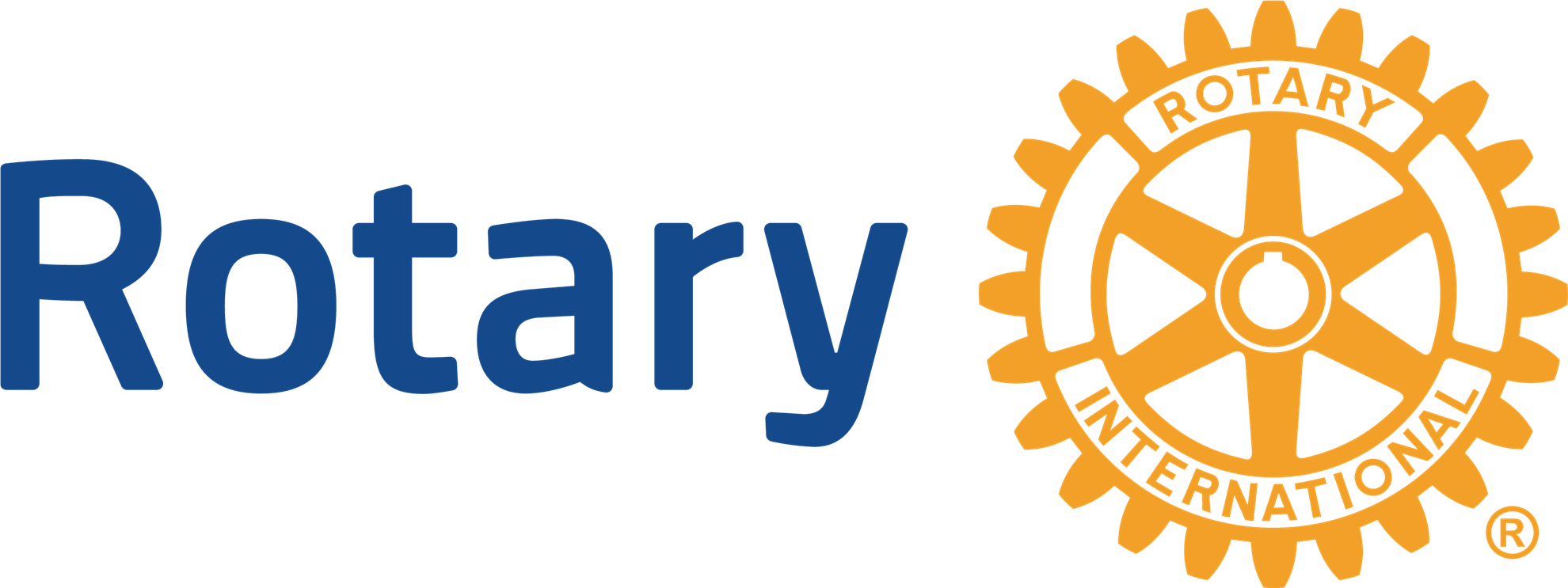
The Rotary emblem today.
For many years, the wheel stood alone as our logo. Although the words “Rotary International” are embedded in the wheel, they’re hard to read from a distance. So in 2013, Rotary expanded the official logo to include the word “Rotary” next to the wheel.
The Rotary wheel remains our mark of excellence. In addition to being part of the official logo, it may be enlarged for greater impact and used separately but near the logo.

.png)