Vocational Service is one of our Five Avenues of Service (not to be confused with either the Four-Way Test or the Six Areas of Focus… or the partridge in a pear tree). The fact that each Rotarian is given a classification means that we each join Rotary as a representative of our profession or business and therefore need to represent that vocation within our club. We serve others by using our unique skills and business experience in a variety of ways:
We can use our skills directly to address community needs. That’s exactly what Greg Moore does through the dental project, Rotary Making a Difference. It’s also what Kris Medina did in October by shepherding Rotarians through a Habitat for Humanity build. When we participate in the high school’s mock trial tournament, we need both community judges with no legal training and also lawyer judges, which is how Marcus Houston, or Jack Donley, or I (among other Rotarian attorneys) can directly use our vocations.
We can empower others through training and skill development. This is exactly what the Pathways program from the North Club speaks to. In Pathways, Rotarians and educators collaborate to provide mentoring, internships, apprenticeships, and job shadowing to qualified high school students with a strong interest in non-college type careers. The Pikes Peak Business and Education Alliance (ppbea.org) has a similar mission and similarly provides Rotarians with an opportunity to use their business skills to empower others.
We can connect our professional networks with our Rotary Club activities. For example, our club will be offering leadership development opportunities through Toastmasters this year. Samantha Chapman will be giving us more information in the near future about a joint social and service project involving Rotarians and the Rising Professionals. Our President Elect, Rodney Gullatte, routinely introduces his professional network to Rotary and vice versa both through invitations to club meetings and professional events and by cross-posting on FaceBook.
We can join a Rotary Fellowship related to our vocation. I would love to see at least five of us join a Rotary Fellowship this year, to the end that when we connect through Fellowships, we better exemplify the theme of “Rotary Connects the World.” You can find a list of Rotary Fellowships here: https://www.rotary.org/en/our-programs/more-fellowships
If Rotary Fellowships focus on connecting us through our own shared interests, Rotary Action Groups connect us through our mutual passions for service. Do you want to use your vocation to prevent domestic violence? Combat malaria? Promote literacy or microfinance? You can join like-minded and action-orientated Rotarians here: https://my.rotary.org/en/take-action/empower-leaders/join-rotarian-action-group
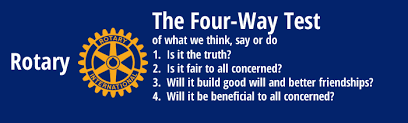
All Rotarians can inspire other to act with integrity by living Rotary’s Four-Way Test and the guiding principles in our professional lives.
Finally, DO SOMETHING. Take some concrete action today that you can point to and say, “Here is how I used my vocation to serve others.” For example, I signed up my business for the PPBEA and signed myself up for a Rotary Action Group while composing this column. When we represent our vocation within the club and exemplify our Rotary ideals in our workplaces, we put into concrete action “the recognition of the worthiness of all useful occupations” and the “fair treatment of employers, employees, associates, competitors, and the public.”
Dr. Douglas Jackson serves as the President/CEO of Project C.U.R.E. Project C.U.R.E. is the largest provider of donated medical supplies and equipment to developing countries around the world. Since 1987, Project C.U.R.E. has delivered equipment and supplies to hospitals and clinics in over 135 countries. Project C.U.R.E. is consistently recognized with the highest rankings from Guidestar and Charity Navigator, and was named by Forbes as one of the top 20 charities in America.
More than 25,000 people volunteer with Project C.U.R.E. every year, making the organization one of the most efficient and effective grass-roots organizations in the country. In addition to delivering approximately five semi-truck sized containers of medical relief each week, teams of medical professionals travel abroad to provide hundreds of hours of hands-on medical care and training through the C.U.R.E. Clinics program.
Doug Jack graduated magna cum laude from Northwest Nazarene University, receiving a Bachelor of Arts degree in business administration. He earned a JD at the University of Colorado in Boulder, receiving the American Jewish Prudence Award for Excellence in the study of law.
He later returned to CU and was awarded a Ph.D. in business administration with an emphasis in finance offering dissertation on leveraged buyouts and secondary public offerings. In addition to his work at Project C.U.R.E., Dr. Jackson has taught at the university level in the disciplines of finance, investments, leadership development, legal, and international issues. Dr. Jackson is a Rotary International Paul Harris Fellow and was the president of the Denver Rotary Club Number 31. He serves on the board of directors for InterAction, rural Denver, and Nanda Center for International & Comparative Law at the University of Denver, and Rueckert-Hartman College for Health Professionals at Regis University. Dr. Jackson received the Lifetime Achievement Award in healthcare from the American Red Cross, the 5280 magazine Philanthropist of the Year Award, and accepted the CoBiz Best Places to Work and Colorado’s Ethics and Business Award on behalf of the team at Project C.U.R.E.
Please consider bringing a guest to our meeting on January 17, 2020. We will have an informative presentation about our Rotary Club, a brief update of what's happened in the 2019-2020 Rotary year so far, some upcoming service opportunities, and a fantastic speaker with a really compelling story. It should be quite the barn burner.
Join the Colorado Springs Rotary Club in a non-perishable food drive for One Nation Walking Together and the Pine Ridge Indian Reservation. Your donations will also support Rotarian, Cass Daley's daughter, Emerald, in achieving her Girl Scout Gold Award for her ongoing project.
Emerald will be present at each Friday meeting in January (10th, 17th, 24th and 31st) to collect any non-perishable food donations like:
She will also be collecting Hygiene products as it has recently come to light that most teenage girls on the Reservation do not attend school one week a month due to the lack of money to purchase personal hygiene products. Often times these teenagers are faced with dropping out because they are so behind.
Emerald has walked to 2,400 houses door-to-door passing out flyers and requesting donations and it would be amazing if the Rotary Club can assist Emerald in achieving her goal.
Last year Rotary raised over 800 lbs. of food in two weeks. Let's see if we can surpass that in the month of January and support One Nation Walking Together and the Pine Ridge Indian Reservation.
Charlie Brown is looking for Rotarians who can sit and listen (no law-related experience needed but Rotarians with speeding tickets accepted) to sign-up to judge our local high schools' mock trial tournament on February 7 (afternoon), February 8 (morning or afternoon) and February 11 (evening). Our high schoolers have put a lot of time and thought into their presentations. All they ask of us is that we listen and give positive feedback and constructive criticism. This is a one-time three-hour service opportunity.
From the earliest days of the organization, Rotarians were concerned with promoting high ethical standards in their professional lives. One of the world's most widely printed and quoted statements of business ethics is The 4-Way Test, which was created in 1932 by Rotarian Herbert J. Taylor (who later served as RI president) when he was asked to take charge of a company that was facing bankruptcy.
This 24-word code of ethics for employees to follow in their business and professional lives became the guide for sales, production, advertising, and all relations with dealers and customers, and the survival of the company is credited to this simple philosophy. Adopted by Rotary in 1943, The 4-Way Test has been translated into more than a hundred languages and published in thousands of ways.